

US Border Logistics Briefing - November 22, 2026
Prepared 6:00 AM PST
Cross-border operations begin the day with an unusual information gap on wait times: CBP/CBSA feeds show no active crossing-delay data in the last two hours, so there is no lane-level congestion picture to anchor current dispatch decisions. That absence matters operationally as much as a delay reading would, because it leaves weather, airport disruptions, and any local field conditions as the only live signals in the packet. The freshest border pull is 12 minutes old, so the data itself is recent, but the traffic layer is effectively blank.
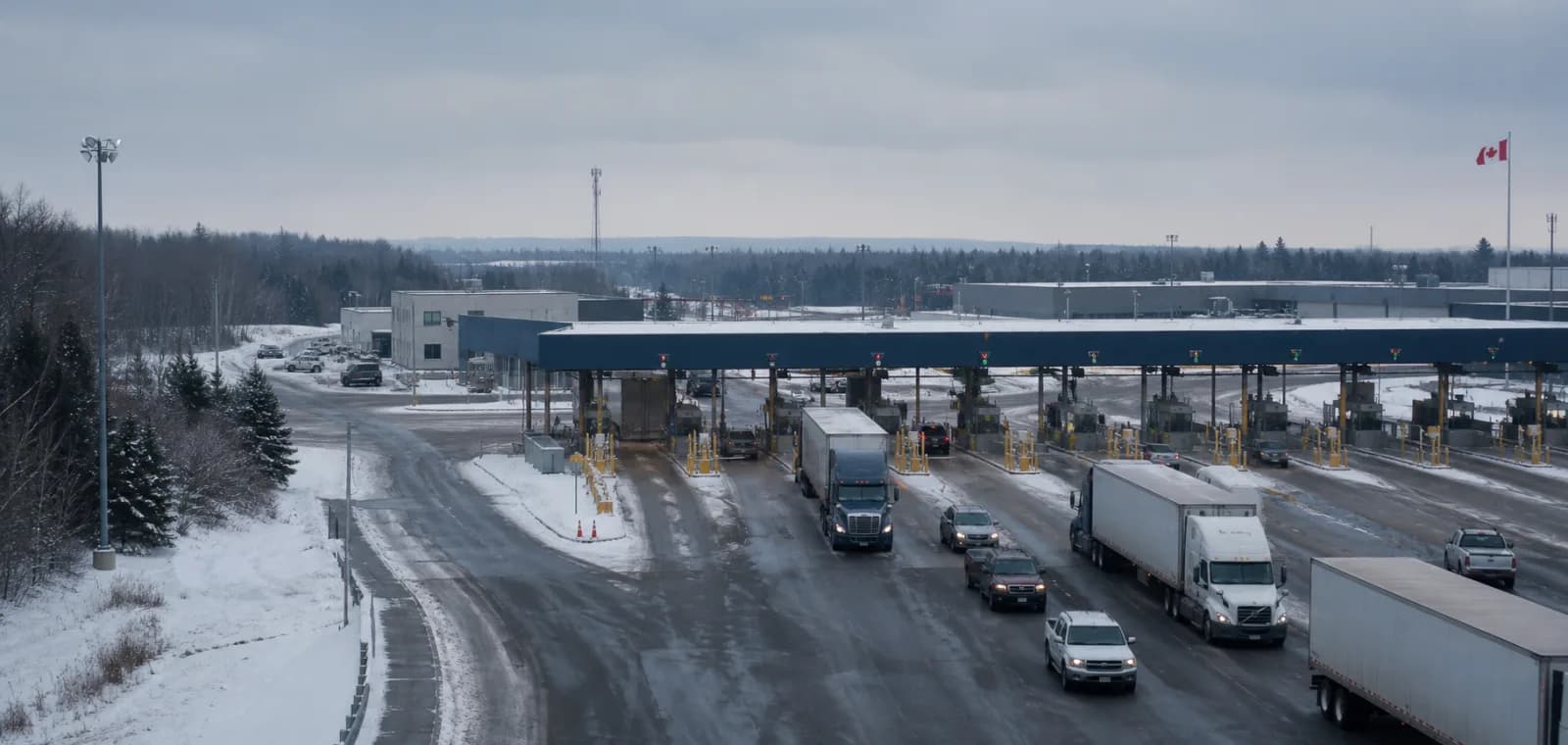
The most material operational pressure today is weather-driven rather than queue-driven. Freeze warnings cover the El Paso/Santa Teresa area and Tucson through the morning, while freezing temperatures are explicitly reported at Grand Forks, North Portal, and Sweetgrass. That combination suggests elevated risk of cold-weather impacts at northern and southwestern crossings even though no current wait-time values are posted. On the West Coast, a coastal flood watch is active for San Diego, and a separate airport closure note at SAN reinforces that the region is not operating in a routine posture. The upshot for logistics teams is that the day’s watch points are corridor-specific: northern portal approaches, the El Paso–Santa Teresa/Tucson regions, and the San Diego area each carry different weather-related operating constraints, but no feed-backed evidence of live border delay has been posted.
Trade-policy coverage remains active in the background, but the packet is explicit that these items are raw-current policy-document context only and should not be treated as normalized policy facts or legal advice. Most of the listed items are dated November 23, 2026 and therefore function as near-term notice context rather than current operational evidence. Even so, the mix is worth noting: CBP has an extension of import restrictions for archaeological and ethnological material of Egypt, while a separate CBP rule extends similar restrictions for Greece. The International Trade Commission also shows multiple notices involving transformers, magnesia carbon bricks from China and Mexico, plastic balloons from China, and a complaint on athletic footwear. Commerce and the trade agencies additionally have NAFTA/USMCA panel-review notices and a preliminary result for certain cold-rolled steel flat products from Korea. These documents are relevant to trade-risk monitoring, but the packet’s own caveats require them to be treated as planning and policy context, not as evidence of current crossing friction.
Crossing Delays and Lane-Level Coverage
No active wait time data were available in the last two hours, and that is the only current crossing-status signal supplied. Because there are no posted lane-level figures, there is no basis in this feed to identify which ports, lane types, or directions are under pressure. For operators, that means the briefing cannot distinguish a passenger-versus-commercial pattern or single-facility concentration from the border data itself. Any routing decision today has to rely on weather, local field knowledge, and carrier updates rather than on posted border wait minutes.
The absence of wait data also limits what can be said about corridor health. In a normal morning briefing, lane-specific figures would help separate a localized issue from a broader system problem. Here, that distinction cannot be made. The only defensible conclusion is that the wait-time layer is silent, not that crossings are unconstrained.
Significant 24-Hour Changes
There are no active wait-time comparisons to report because the feed provides no current delay values. The significant change over the past day is therefore not a measured improvement or deterioration in border queues, but the arrival of weather alerts and a fresh airport closure advisory in the absence of traffic data. Cause for the missing wait-time layer is not identified in current feeds.
The weather side of the story is more explicit. Freeze warnings are active for El Paso/Santa Teresa and Tucson, flood warnings remain in effect in the Phoenix area, and a coastal flood watch now covers San Diego. The northern tier also shows freezing conditions at Grand Forks, North Portal, and Sweetgrass, indicating that cold-weather exposure is not limited to one region. While these alerts do not themselves quantify crossing delay, they are the most actionable 24-hour change in the packet.
Trade-Policy Documents and Explicit Caveats
The trade-policy section is dense but must be handled with its own claim discipline. The packet labels the entries as raw-current policy-document context only and warns not to treat them as normalized policy sources or legal advice. Several items are future-dated to November 23, 2026, which reinforces that they are notice context rather than live operational evidence.
Among the substantive entries, CBP has a rule extending import restrictions on archaeological and ethnological material of Egypt, and a separate CBP rule extends restrictions on corresponding material from Greece. The International Trade Commission has a notice on transformers and components thereof terminating an investigation following settlement, a scheduling notice for expedited five-year reviews of magnesia carbon bricks from China and Mexico, a notice of receipt of a complaint on certain athletic footwear, and an institution notice for antidumping and countervailing duty investigations on plastic balloons from China. The International Trade Administration also lists a NAFTA Article 1904 binational panel review completion notice and two USMCA Article 10.12 panel-review notices tied to softwood lumber products from Canada, alongside Commerce’s preliminary cold-rolled steel results for Korea. Operationally, these items matter for compliance teams and import programs, but the packet gives no evidence that they are affecting today’s border throughput.
Aviation and Airport Conditions
Aviation is not broadly disrupted in the data, but San Diego International Airport has a specific closure notice: “AP CLSD TO NON SKED TRANSIENT GA ACFT EXC PPR,” effective through the date range in the advisory. That means non-scheduled transient general aviation aircraft are restricted unless prior permission is obtained. The notice is airport-specific and does not by itself speak to airline passenger operations or cargo handling, but it is a clear constraint for any aviation-dependent logistics plan that uses SAN as a staging or recovery point.
Given the concurrent coastal flood watch for San Diego, the airport notice should be read as part of a broader regional caution set rather than as an isolated administrative item. The packet does not provide delays, diversions, or runway-impact details, so no broader airport disruption claim is supportable here.
Weather Alerts and Notable Crossing Conditions
The weather picture is the strongest live operational signal in the packet. A Severe Freeze Warning issued November 21 at 5:59 PM MST remains in effect for El Paso Tx/Santa Teresa NM until November 22 at 9:00 AM MST, and a separate Severe Freeze Warning from November 21 at 1:12 PM MST covers Tucson AZ until 8:00 AM MST today. Flood warnings issued November 20 remain active in Phoenix through November 24 at 11:00 AM MST and November 27 at 3:15 PM MST, respectively. In addition, a Moderate Coastal Flood Watch was issued November 22 at 5:24 AM PST for San Diego CA through November 26 at 1:00 PM PST.
The notable temperature readings align with those alerts. Grand Forks is freezing at -0.6°C, North Portal is at -4.8°C, and Sweetgrass is the coldest listed point at -15.7°C. For border operations, that profile suggests particular attention to northern crossing surfaces, equipment reliability, and any cold-chain handling near those corridors, but the packet does not provide direct evidence of resulting delays or closures. Because no live wait-time data are present, the weather readings should be treated as a risk flag rather than as proof of active congestion.
Community Intelligence
No community intelligence items were supplied in the packet. There is therefore no retired or raw diagnostic context to carry forward on this briefing.
Macro and Economic Indicators
The macro layer is mixed and, in several cases, not especially fresh. The latest balance-of-payments goods and services trade figure, BOPGSTB, is -57,347.00 as of 2026-02-01, which remains an older datapoint in this packet and should be treated accordingly. Energy prices are more recent: Brent crude is 92.94 and WTI is 89.53, both as of 2026-11-17. Fuel and currency indicators are also supportive of a cost-conscious logistics read, with USD/CAD at 1.4256, USD/MXN at 18.5690, and the trade-weighted dollar at 122.65, each as of 2026-11-13.
Diesel and gasoline references are high enough to matter for over-the-road costs. US diesel retail is 5.94 as of 2026-11-16, while the gasoline series in the packet shows 5.55, 5.97, and 6.95 across the listed observations, also as of 2026-11-16. Industrial price inputs are older but still directionally relevant: IR is 153.80, PCU484121484121 is 230.99, PCUOMFGOMFG is 286.97, and PPIACO is 293.92, all as of 2026-10-01. TOTALSA is 16.00 on the same date. These figures do not point to a border-specific disruption, but they do frame a generally expensive operating environment for freight, warehousing, and cross-border transport.
Outlook and Operational Watch List
The immediate outlook is weather-led, not queue-led. With no current wait-time data available, the most defensible expectation is that today’s operational variability will come from temperature, flood, and coastal conditions rather than from a documented surge in border lines. The lack of wait data is itself a monitoring problem, because it prevents a precise assessment of whether the weather alerts are translating into border friction.
What to watch next:
- Any reappearance of CBP/CBSA wait-time readings, especially for El Paso/Santa Teresa, Tucson, North Portal, Sweetgrass, and San Diego-adjacent routes.
- Weather evolution around the freeze-warning expiration windows this morning and the longer flood-watch periods in Phoenix and San Diego.
- Whether SAN’s transient-GA closure advisory expands or remains limited to the stated non-scheduled category.
- Any newly posted policy-document items that are current, claim-bearing, and relevant to freight compliance, especially those touching North American trade programs.