

US Border Logistics Briefing - November 10, 2026
Prepared 6:00 AM PST
Border conditions this morning are being shaped less by lane congestion than by the absence of live wait data and the persistence of weather-related operational friction along selected corridors. The latest CBP/CBSA border pull is very fresh at 13:55:47Z, but the feed shows no active wait-time data in the last two hours, so there is no current lane-level delay signal to anchor a congestion assessment. For planners, that means dispatch decisions should be made with caution: the monitoring window is open, but the feed is not currently producing measurable border queue evidence.
The strongest immediate operating story is weather. There are two severe Flood Warnings in the Austin/San Antonio area, both issued this morning and carrying into overnight hours on November 11, and those alerts matter for surface connectivity and local access even though the report does not specify impacted crossings. In the Pacific Northwest, a Wind Advisory is in effect for Seattle through tomorrow evening, while San Diego is under Beach Hazards Statements through tonight. Those coastal advisories are not border-crossing alerts in themselves, but they can influence airport and regional transportation conditions. Separately, several northern observations are below freezing, which is a notable operational backdrop for the high-latitude ports listed in the feed.
Airport conditions are also relevant this morning because San Diego International has an FAA closure notice for non-scheduled transient general aviation aircraft, with exceptions available by prior permission only. That is a narrow restriction rather than a full airport shutdown, but it is still operationally meaningful for time-sensitive aviation movements tied to regional logistics support, business aviation, or irregular freight lift. The notice is dated to remain in effect through the stated period in the FAA message. Because the feed contains no other airport delay items, SAN is the only aviation constraint that currently stands out.
Trade-policy activity is active and broad, but it should be treated as raw current policy-document context rather than as normalized legal or customs advice. The day’s notices include multiple Commerce preliminary determinations involving polytetramethylene ether glycol (PTMEG) from Vietnam, Taiwan, and China, plus preliminary determinations on tin mill products from Taiwan and Türkiye. Commerce also initiated a country-wide circumvention inquiry on certain magnesia carbon bricks from China, and the International Trade Commission posted determinations on prestressed concrete steel wire strand from China as well as a complaint involving certain electronic control units and products containing the same. In addition, USTR issued a notice modifying Section 301 action covering China’s targeting of the maritime, logistics, and shipbuilding sectors for dominance, and another notice extending product exclusions related to China’s technology-transfer, intellectual-property, and innovation actions. The operational significance is not a direct lane impact in today’s feed, but rather a reminder that trade compliance and tariff exposure remain active across multiple industrial categories relevant to logistics and warehousing. No claim in the feed ties these notices to immediate border delay.
Crossing-level delay data are notably sparse. There are no active wait times reported in the last two hours, and there are no lane-by-lane figures to compare against yesterday or against typical baselines. That absence itself matters: it means the report cannot identify which crossing, lane type, or direction is under pressure, and it also prevents a reliable 24-hour comparison for the border network. In practical terms, operators should treat any dispatch plan that depends on precise queue timing as higher risk than usual today because the live feed is not furnishing current delay evidence. If a corridor is sensitive to queue volatility, the lack of data should be treated as a monitoring gap, not as proof of smooth flow.
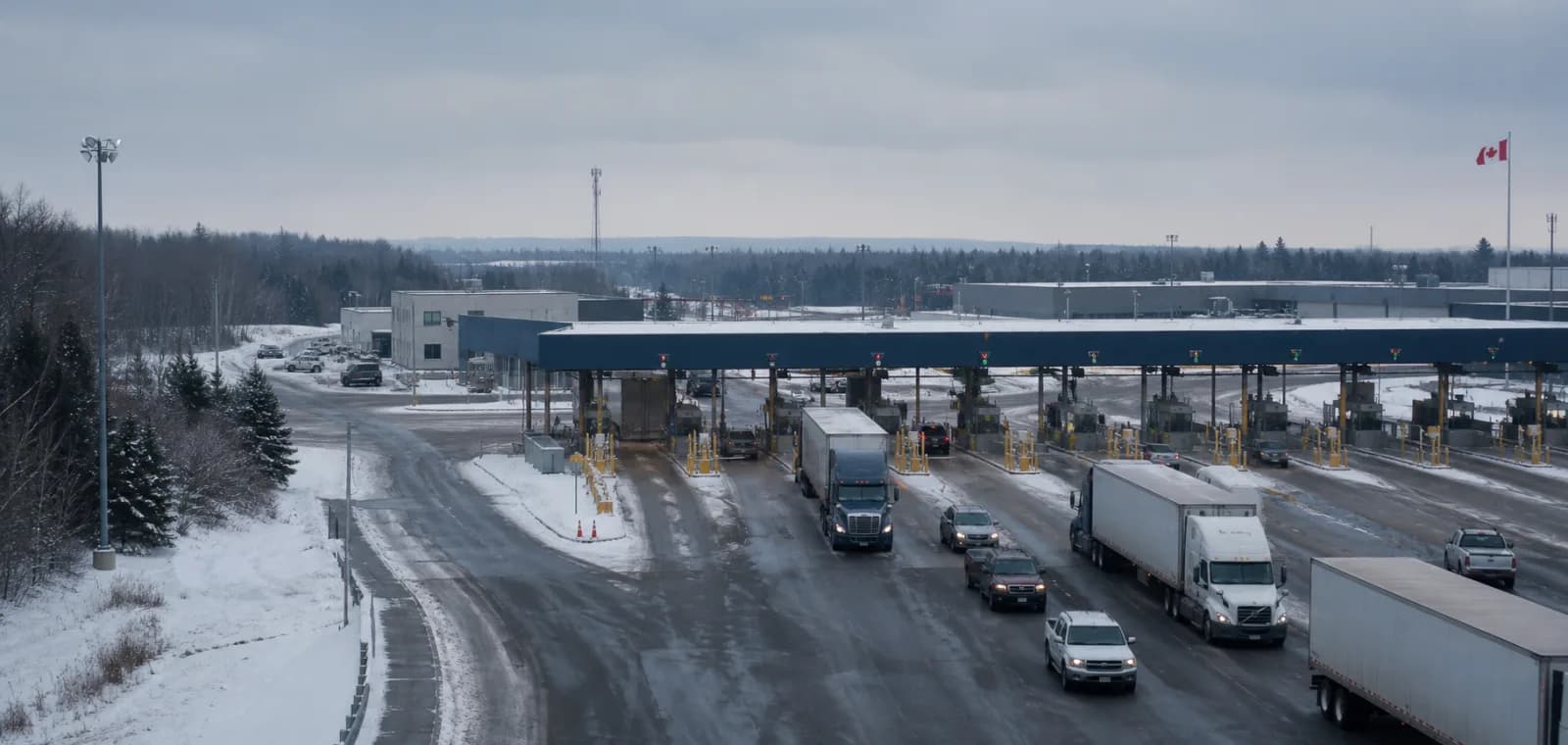
The weather and temperature data point to a separate, northern corridor concern. Freezing observations were recorded at GFK at -0.6°C, International Falls at -0.4°C, North Portal at -2.8°C, and Pembina at -0.7°C. Those values indicate below-freezing conditions at or near several northern points of interest, which can matter for pavement condition, equipment handling, and general road operations even though the feed does not identify any corresponding incident or delay. Because no active wait times are available, the data do not support a claim that these temperatures are currently slowing border processing. They do, however, justify increased attention to road surface and cold-weather equipment readiness if loads are moving through these areas.
The macro backdrop remains mixed and operationally relevant. The latest Brent crude price is 107.03, with WTI at 99.64, both as of November 3. Fuel cost pressure is also visible in diesel measures: US Diesel Retail is 6.29 as of November 2, with GASDESGCW at 5.91, GASDESMWW at 6.40, and GASDESWCW at 7.27 on the same date. For cross-border trucking, those price levels continue to support elevated transport cost sensitivity, especially on longer-haul moves and fuel-intensive lane structures. Currency conditions also matter: USD/CAD stands at 1.4106 and USD/MXN at 18.6226, both as of November 6, while the Trade Weighted Dollar is 121.88 on the same date. Those exchange rates affect landed-cost calculations and can shift exporter/importer behavior even when there is no immediate queue pressure at the border.
Other macro indicators provide a slower-moving but still important context. The BOPGSTB value is -57347.00 as of February 1, while industrial price measures including PCU484121484121 at 219.38, PCUOMFGOMFG at 287.13, and PPIACO at 295.71 are all dated September 1. TOTALSA is 16.00 as of October 1. These observations are not border-specific and do not imply a direct operational effect by themselves, but they reinforce that the broader freight environment remains shaped by cost, pricing, and demand conditions that may affect shipment timing and margin management. Because the observations are dated and the feed does not provide a change narrative, they should be treated as contextual indicators rather than as new market shocks.
The most grounded outlook for today is one of selective operational caution rather than generalized border congestion. The current feed shows no live wait-time evidence, so there is no basis to declare widespread crossing stress. However, the combination of severe Texas flood warnings, below-freezing northern temperatures, and the SAN aviation restriction means the logistics picture is not frictionless. The main question for the rest of the day is whether weather-adjacent operational effects begin to show up in the border feed later, particularly in southern Texas and the northern cold-weather crossings. Until then, the safest interpretation is that the system is watchful but not yet showing measurable border delay pressure.
Operational watch list:
- Monitor the Austin/San Antonio flood-warning area for any downstream road access issues that could affect regional movement.
- Recheck northern crossings tied to freezing temperatures for surface or equipment complications if new data appear.
- Watch SAN for any broader aviation knock-on effects beyond the transient GA closure notice.
- Track whether the next border pull restores lane-level wait times; without them, congestion assessment remains incomplete.
- Keep an eye on trade-policy developments in PTMEG, tin mill products, magnesia carbon bricks, and Section 301 maritime/logistics actions for any compliance or routing implications.