

US Border Logistics Briefing - November 5, 2026
Prepared 6:00 AM PST
# Morning Briefing — US Border Crossings and Supply Chain Conditions
Thursday, November 5, 2026
Border pull freshness: 4 minutes old
Operationally, today’s border picture is defined more by what is *not* present than by what is: CBP/CBSA shows no active wait time data in the last 2 hours, so there is no current crossing-delay signal to anchor a lane-by-lane congestion assessment. That absence matters because it leaves operators with a thinner real-time picture than usual and shifts attention toward weather, airport restrictions, and trade-policy notices that may affect planning more than immediate border throughput.
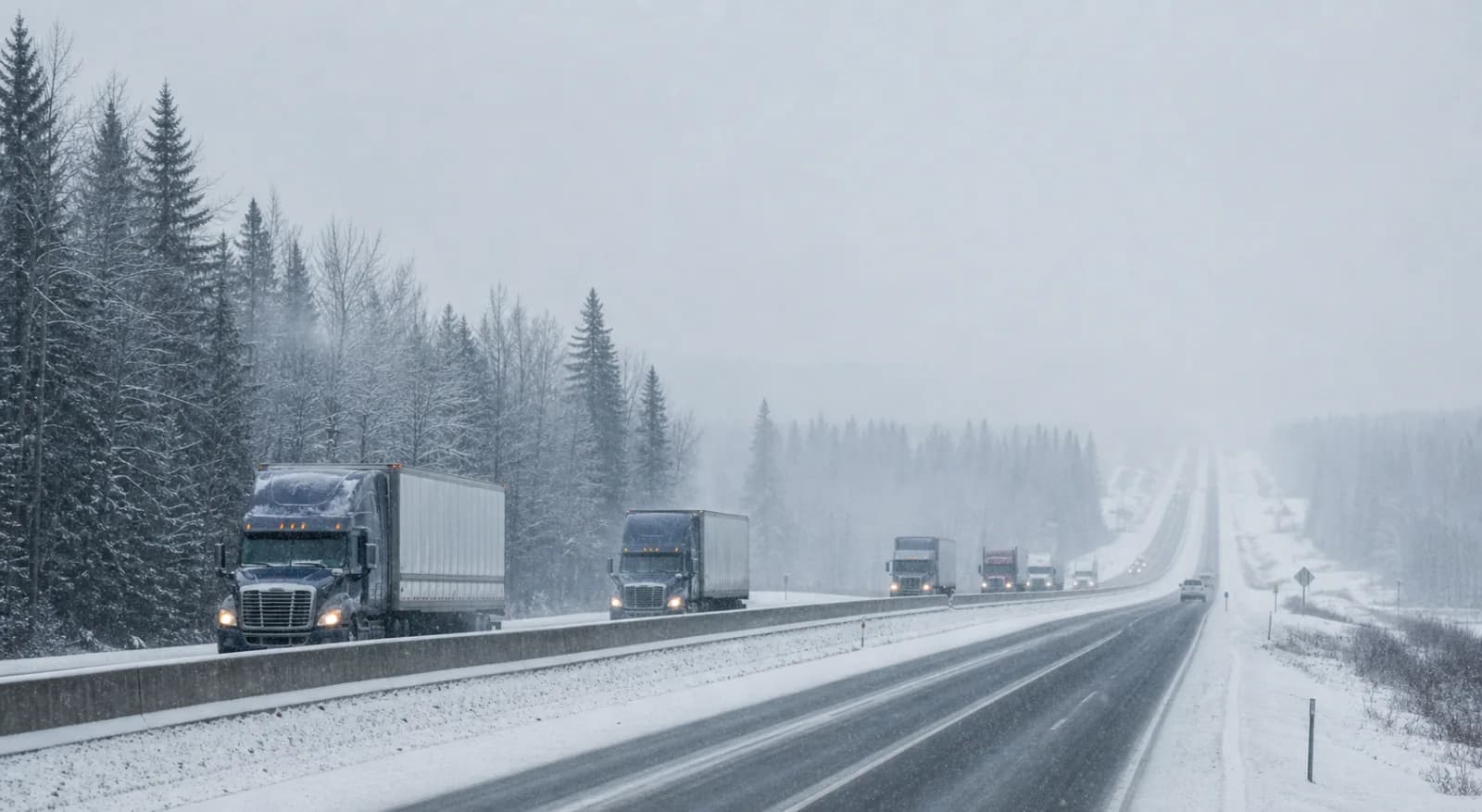
The weather layer is the clearest active risk set in the feed. A High Wind Watch is in effect for the Great Falls, Montana area through November 7 at 9:00 AM MST, while Dense Fog Advisory coverage in Bismarck, North Dakota runs until 10:00 AM CST today. On the Pacific side, Seattle, Washington has two overlapping Wind Advisories extending into November 6 at 4:00 PM PST. The only notable crossing-condition observation in the feed is north_portal at -0.2°C, which is a freezing reading and may matter for local operating conditions, but the feed does not provide any associated delay or causality.
Air cargo and passenger logistics are also not fully neutral. The FAA entry shows SAN (San Diego Intl) is under a closure to non-scheduled transient general aviation aircraft except PPR under notice `!SAN 10/004`, with the restriction effective 2610011633-2701010800. That is a specific operational constraint for transient GA activity, but the feed does not indicate broader commercial airline disruption. For border and surface freight planners, the practical implication is narrower: air-side flexibility at SAN is constrained for certain GA movements, while the border feed itself does not currently show active lane delays.
Trade-policy activity is heavy today, but the feed carries an explicit caveat that these are raw-current policy-document context only and should not be treated as normalized policy facts or legal advice. The notices are nonetheless useful for tracking where administrative pressure is accumulating. Today’s set includes multiple Commerce and ITC actions touching metals, wood products, and chemical inputs: Choline Salts from China with postponement of the preliminary determination in an LTFV investigation; an ITC expedited five-year review on seamless refined copper pipe and tube from Vietnam; preliminary results for common alloy aluminum sheet from China; final AD results for circular welded non-alloy steel pipe from Korea; rescission of a CVD administrative review for wood mouldings and millwork products from China; final CVD results for cut-to-length carbon-quality steel plate from Korea; initiation of a new round of AD/CVD administrative reviews; final AD results for oil country tubular goods from Mexico; ITC scheduling of expedited five-year reviews for metal lockers from China; and ITC determinations involving crystalline silicon photovoltaic cells from India, Indonesia, and Laos. Operationally, these are not current border-flow readings, but they do signal ongoing policy and duty-review activity across industrial supply chains that can matter to import calendars and landed-cost assumptions.
Macroeconomic context remains important because it frames margin pressure even when crossings are calm. The latest Brent crude is 107.03 and WTI is 99.64, both as of 2026-11-03, leaving energy costs elevated relative to many transport budgets. Currency conditions are also notable: the USD/CAD rate is 1.3957, the USD/MXN rate is 18.7942, and the trade-weighted dollar is 121.67, all as of 2026-10-30. Diesel remains expensive across the tracked series, with US Diesel Retail at 6.29 and regional gauges of GASDESGCW 5.91, GASDESMWW 6.40, and GASDESWCW 7.27, all dated 2026-11-02. Those levels matter for cross-border trucking economics even when border queues are not visible, because they directly affect linehaul cost and routing decisions.
Other indicators in the latest economic set are older but still relevant as background. BOPGSTB is -57347.00 as of 2026-02-01. Industrial price and output series are dated 2026-09-01: IR 152.20, PCU484121484121 219.38, PCUOMFGOMFG 287.13, PPIACO 295.71, and TOTALSA 16.38. These are not border readings, but they reinforce a broader cost environment that is still elevated in manufacturing and transport-related categories. The date stamps matter: these are not fresh daily signals, so they should be used as context rather than as a trigger for immediate operational action.
Crossing Delays and Lane-Level Conditions
There are no active wait time data in the last 2 hours, so there are no current lane-level delay figures to report from the CBP/CBSA feed. Because of that, there is no basis in today’s dataset to rank crossings by delay, lane type, or direction. The operational takeaway is a visibility gap rather than a congestion alert: dispatch teams should avoid assuming smooth flow, but the feed does not support any current claim of border delay at specific ports.
Significant 24-Hour Changes
The clearest 24-hour change is in the weather posture, not in crossing times. The border feed provides a new High Wind Watch for Great Falls and a fresh Dense Fog Advisory for Bismarck, while Seattle has two wind advisories posted this morning. The feed also records the freezing observation at north_portal (-0.2°C). In practical terms, the change set suggests a larger weather footprint today than a pure border-delay picture, with the greatest near-term operational relevance likely concentrated where local visibility or wind could affect travel timing.
Trade-Policy Documents and Claim Caveats
Today’s trade-policy notices should be treated as procedural / diagnostic context only, not as a current enforcement story. The feed explicitly warns against using them as normalized policy facts. Still, the number and spread of notices are notable for shippers with exposure to China, Vietnam, Korea, Mexico, India, Indonesia, and Laos. The documents span antidumping and countervailing duty reviews, postponements, rescissions, final results, and expedited reviews. For logistics teams, the main relevance is documentation vigilance and landed-cost monitoring rather than immediate border delay.
Aviation and Airport Conditions
The only airport condition supplied is the SAN closure restriction for non-scheduled transient GA aircraft except PPR. No broader airport delay network is included in the data, so the report cannot extend that restriction to commercial passenger or freight operations. The safe operational interpretation is limited: transient GA flexibility at San Diego is constrained, and operators using SAN should verify permissions before movement.
Weather Alerts and Notable Crossing Conditions
The active alert map is concentrated in three areas:
- Great Falls, MT: High Wind Watch through Nov. 7, 9:00 AM MST.
- Bismarck, ND: Dense Fog Advisory until Nov. 5, 10:00 AM CST.
- Seattle, WA: Two Wind Advisories, both extending to Nov. 6, 4:00 PM PST.
The only notable crossing-condition reading provided is north_portal at -0.2°C, indicating freezing conditions. No wait-time linkage, crossing classification, or operational impact statement is included in the feed, so that observation should be carried as a local weather diagnostic only.
Community Intelligence
No community-intelligence items were supplied in this dataset. There is therefore no live or retrospective crowd-sourced crossing evidence to incorporate.
Outlook and Operational Watch List
The near-term outlook is stable on the border-delay side but less stable on the weather side. With no active wait-time data available, the most defensible monitoring posture is to watch for weather-driven disruptions and any reappearance of lane data in the next pull.
- Monitor Great Falls, Bismarck, and Seattle weather zones for any escalation or extension.
- Recheck the next border pull for new wait-time entries, especially if the weather footprint widens.
- Validate SAN plans in advance if transient GA movement is part of the itinerary.
- Treat today’s trade notices as policy-document background only; do not read them as current border disruption evidence.
- Watch diesel, FX, and crude trends for cost pressure on cross-border trucking and import scheduling.