

US Border Logistics Briefing - November 4, 2026
Prepared 6:00 AM PST
Border-facing conditions this morning are defined less by queue pressure than by a data gap: the latest CBP/CBSA pull is fresh, but it reports no active wait time data in the last two hours. That means there is no current lane-level congestion signal to quantify from the border feeds themselves, so operations should treat today’s crossing picture as effectively unscored rather than clear. In practice, the absence of reported waits reduces visibility rather than confirming smooth flow, and dispatch teams should keep a close eye on any corridor where weather or airport disruptions could reroute freight demand into ground networks.
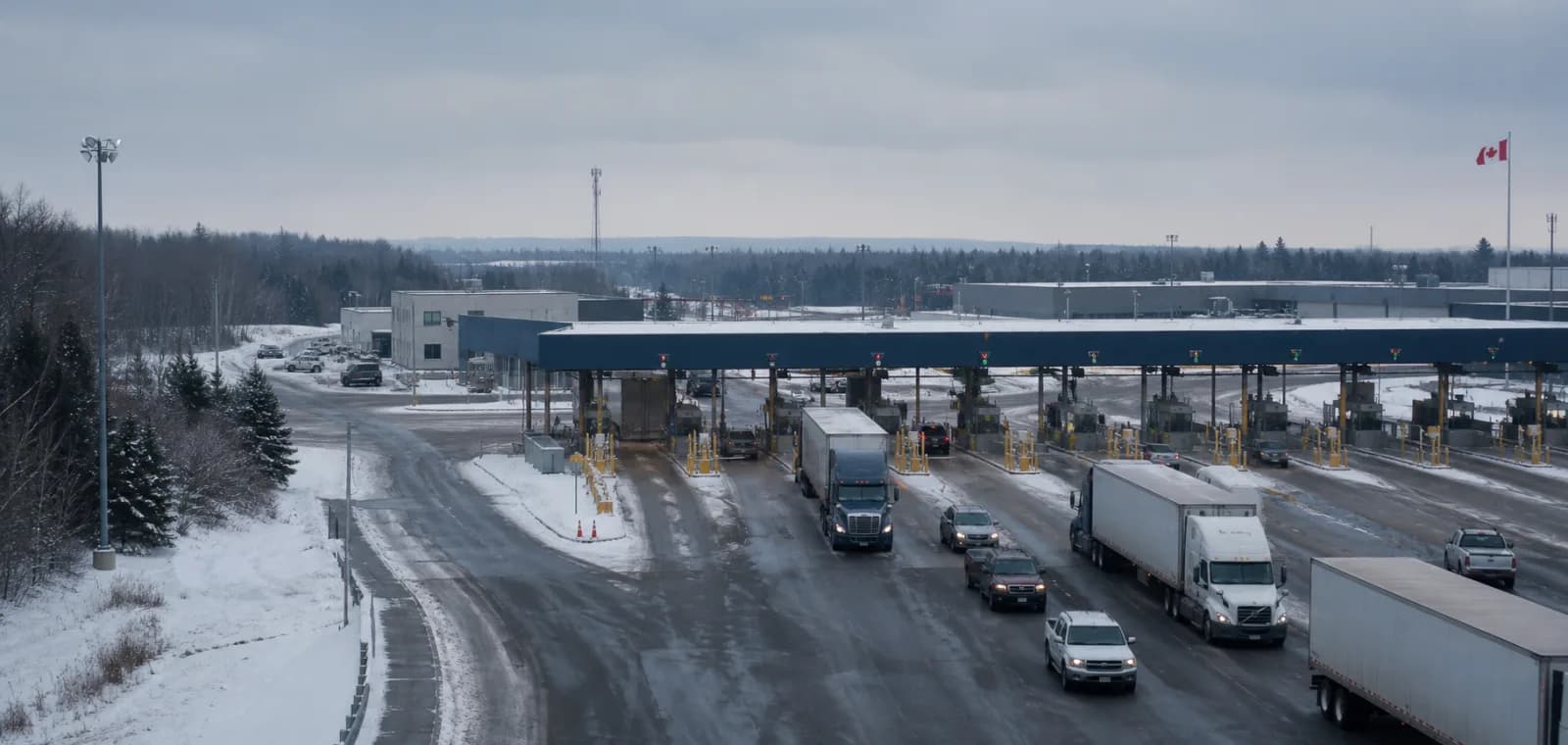
The most tangible operating friction in the current feed is weather-related, not port-of-entry related. A Severe Flood Warning is in effect for the Tucson, Arizona area from 5:09 AM MST until 2:45 PM MST, which places a time-bound risk window over southern Arizona movements through much of the business day. At the same time, the temperature readings at North Portal and Sweetgrass are below freezing, at -1.5°C and -3.2°C respectively. Those readings matter operationally because they flag cold-condition exposure at northern crossings even in the absence of explicit delay reports; however, no current wait times are being reported, so any impact must be treated as plausible exposure rather than confirmed congestion. Cause and effect are not identified in current feeds.
Aviation adds a separate constraint on regional logistics, though the scope is narrow. San Diego International (SAN) is closed to non-scheduled transient general aviation aircraft except by prior permission request, per the FAA notice. This is not a passenger airline disruption in the data provided, but it does narrow the airport’s flexibility for ad hoc GA movements and any freight-adjacent aviation activity that depends on transient access. For teams that use San Diego as a release valve or contingency node, the practical implication is reduced optionality for unscheduled operations until the closure window is lifted or permissions are secured.
Crossing Delays and Lane-Level Figures
No active wait time data has been reported in the last two hours, so there are no current lane-by-lane figures to cite for U.S. border crossings. That absence applies across the current border feed as provided, and it is the key operational finding of the morning. Without live lane metrics, neither the magnitude nor the distribution of delays can be assessed from the present dataset.
The lack of current wait-time observations does not mean border conditions are frictionless; it means the report cannot confirm or reject localized delay pockets. For planners, this is a monitoring problem more than a congestion problem. If freight is scheduled to move through the northern or southern frontier today, the prudent assumption is that timing risk is unresolved until fresh lane data appears.
Significant 24-Hour Changes
Because the current feed contains no active wait-time values, there are no quantified 24-hour border changes to report for crossing delays. The notable day-over-day movement instead appears in the weather and aviation layers: a severe flood warning was issued early this morning in Tucson, and SAN’s closure notice is active in the FAA feed. Those are the day’s most relevant changes because they can influence routing decisions even when the border itself is not showing measurable queues.
The temperature readings at North Portal and Sweetgrass also stand out as current environmental changes worth watching, but the feed does not provide prior readings for comparison. As a result, they are best interpreted as present-state conditions rather than a trend line.
Trade-Policy Documents and Explicit Claim Caveats
The trade-policy feed is populated with a dense slate of Commerce notices dated November 4, 2026, but these rows are explicitly raw-current policy-document context only and must not be treated as normalized policy facts or legal advice. The notices are relevant for shipment planning because they signal active administrative action across multiple product categories, but the data supplied here is limited to document titles and short summaries.
Among the items published today are final sunset review results for magnesia carbon bricks from Mexico and China, utility scale wind towers from India, Malaysia, and Spain, metal lockers and parts thereof from China, and floor-standing metal-top ironing tables and parts from China. There are also preliminary or preliminary-and-postponed determinations involving certain oil country tubular goods from the United Arab Emirates and from Taiwan, certain steel nails from China, and light-walled rectangular pipe and tube from China. CBP also announced a test of the Client Representative Technical Assistance Portal (CRTAP), described as a new case management system. The operational value of these notices is that they mark ongoing trade-remedy activity and a live systems test, both of which may matter to import compliance workflows, but the supplied data does not include implementation details, effective dates beyond the publication dates, or shipment-specific applicability. Any legal interpretation would exceed the evidence provided here.
Aviation and Airport Conditions
The only airport condition in the current feed is the SAN closure notice. The airport is closed to non-scheduled transient GA aircraft except with prior permission request via the listed phone number. The closure text in the feed indicates a restriction window rather than a general airport shutdown, so the impact is limited to that category of aircraft and operations. For logistics users, the key point is that ad hoc aerial flexibility is constrained at SAN, which may matter for time-sensitive movements, crew positioning, or contingency planning in the San Diego area.
No other airport delay, ground stop, or broader aviation disruption is present in the supplied data.
Weather Alerts and Notable Crossing Conditions
The weather picture is the most operationally relevant current risk. The Severe Flood Warning in the Tucson area runs until 2:45 PM MST, which means the alert is active through much of the workday. The feed does not specify affected ports of entry, road segments, or border-crossing subareas, so no direct linkage can be drawn beyond geographic proximity. Still, this is the one item in the data that could plausibly affect southbound or northbound trucking schedules in Arizona today.
The freezing readings at North Portal and Sweetgrass are also notable for crossing operations. At -1.5°C and -3.2°C, respectively, they suggest cold-weather handling conditions at those locations. The feed does not report associated delays, closures, or mechanical impacts, so this should be treated as a condition to monitor rather than a confirmed operational problem.
Community Intelligence Context
No community-intelligence rows were supplied in the current feed. There is therefore no retired, raw diagnostic, or anecdotal context to incorporate. In the absence of such inputs, there is no additional non-current field reporting to weigh against the official feeds.
Macro and Economic Indicators
The latest macro and market indicators reinforce a cost-sensitive operating environment, but several are dated well before today and should be read as the most recent available observations rather than same-day market prints. The trade-weighted dollar stands at 121.67 as of 2026-10-30, with USD/CAD at 1.3957 and USD/MXN at 18.7942 on the same date. Those currency levels remain relevant for North American cross-border pricing and landed-cost calculations, especially where the border itself is not providing a delay signal.
Energy prices remain elevated in the most recent oil prints. Brent crude is 123.10 and WTI is 103.37, both as of 2026-10-27. Diesel remains expensive as of 2026-11-02, with US Diesel Retail at 6.29 and the regional diesel series at 5.91, 6.40, and 7.27 on the same date. These figures matter directly for over-the-road freight budgets and may shape carrier acceptance or surcharge discussions. The broader inflation and industrial input indicators are also dated to 2026-09-01: the IR series is 152.20, PCU484121484121 is 219.38, PCUOMFGOMFG is 287.13, PPIACO is 295.71, and TOTALSA is 16.38. One balance-of-payments figure is also available, BOPGSTB at -57347.00 as of 2026-02-01. None of these data points imply a border event on their own, but together they describe a high-cost backdrop for transport and manufacturing logistics.
Outlook and Operational Watch List
With no active wait-time data in the last two hours, the border picture is currently under-observed rather than clearly congested. The most immediate operational risks come from the Tucson flood warning, the sub-freezing conditions at North Portal and Sweetgrass, and the SAN restriction on transient GA activity. The trade-policy pipeline is active, but the notices supplied today are policy-document context only and do not, by themselves, establish immediate lane or shipment disruption.
Watch list for the remainder of the day:
- Monitor any refreshed CBP/CBSA wait-time pulls for the southern Arizona corridor and northern crossings.
- Track the Tucson flood warning through its 2:45 PM MST expiration for any knock-on highway or port access effects.
- Keep North Portal and Sweetgrass on cold-weather alert status, even without current wait-time reporting.
- Confirm SAN’s closure status before any unscheduled GA movement.
- Treat today’s Commerce notices as compliance-monitoring items, not current border-delay evidence.