

US Border Logistics Briefing - November 2, 2026
Prepared 6:00 AM PST
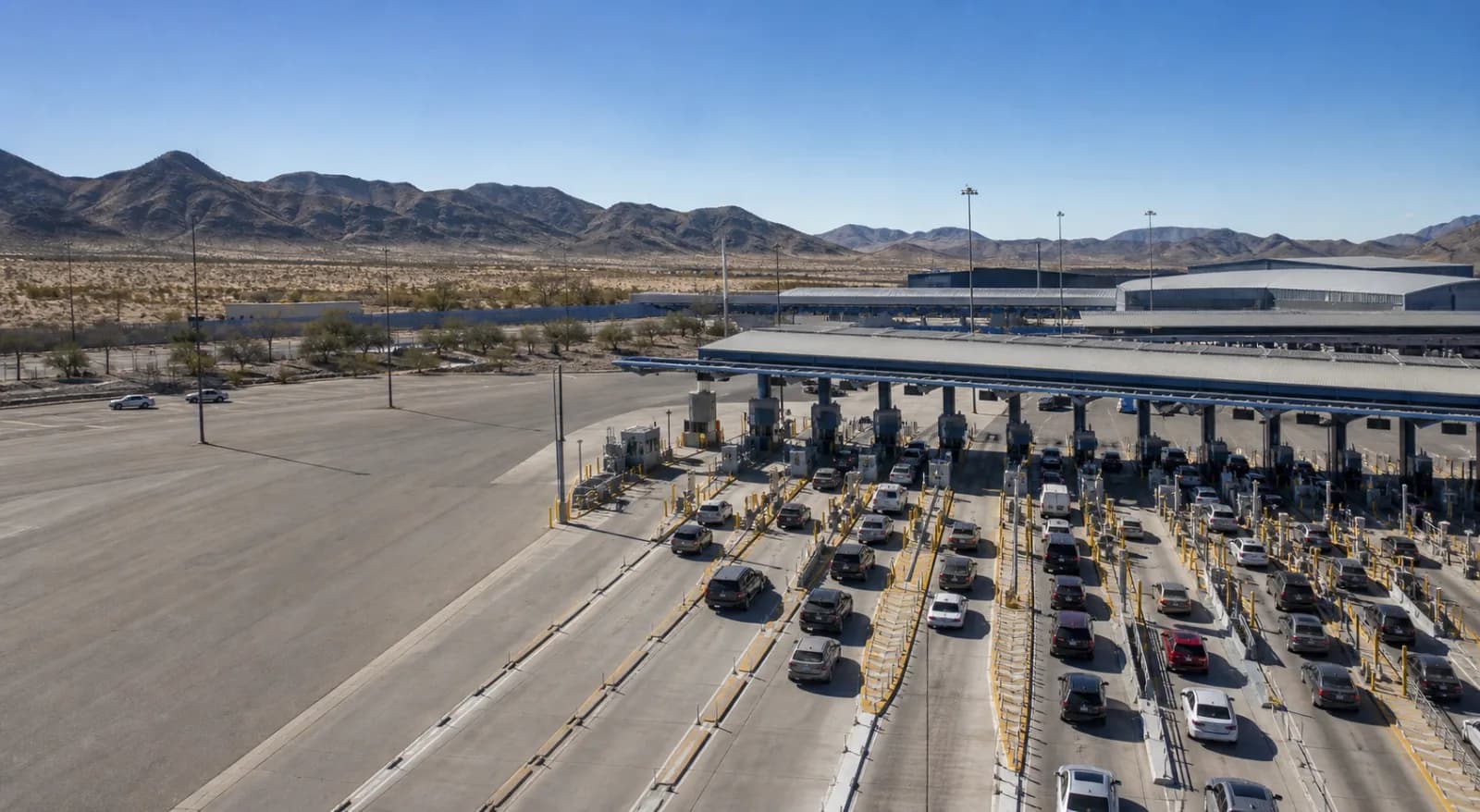
Border-crossing conditions are unusually quiet in the current feed: there are no active wait-time readings in the last two hours, so there is no lane-level congestion signal to anchor a live crossing assessment. That absence matters operationally because it leaves dispatchers relying more heavily on adjacent indicators—weather, airport flow, and policy activity—rather than on a measurable border delay pattern. The data today therefore points less to a specific chokepoint and more to a monitoring posture: verify route conditions before committing freight to corridors exposed to weather or airport network spillover.
The most immediate pressure signal is weather, not customs throughput. A severe Flood Warning is active for the Tucson, Arizona area from 3:05 a.m. MST on November 2 until 3:00 a.m. MST on November 3, and a Beach Hazards Statement is in effect for the San Diego, California area from 2:43 a.m. PST until 6:00 p.m. PST on November 2. Those alerts do not specify border impacts by themselves, but they do raise the likelihood of localized operational friction near affected corridors, especially where road access, staging, or last-mile movement depends on exposed surface conditions. In the same vein, freezing temperatures were observed at BLI (-1.7°C) and Sweetgrass (-0.3°C), which indicates subfreezing conditions at those locations at the time of observation and should be treated as a route condition to check before loading and departure decisions.
Aviation is also showing a measurable constraint. SAN, San Diego International, is reporting a ground delay with an average 29-minute delay attributed to airport volume. The feed does not identify the cause beyond that airport-volume designation, so it should be treated as a traffic-management condition rather than as evidence of a deeper disruption. For logistics planners, the practical implication is a modest but real timing risk for air cargo, belly capacity, and onward truck transfers tied to the San Diego metro area. With a Beach Hazards Statement active in the same region, the operational picture is one of broader coastal-weather sensitivity rather than isolated airport turbulence.
Crossing delays and lane-level figures
There are no active wait-time data points in the last two hours, and that is the key border-specific fact for today. Because no current lane readings are present, there are no lane-level figures to compare, no posted crossing queues to trend, and no basis in the live feed to call out a specific port of entry as slowed. That means the normal operational focus shifts from lane selection to route resilience and verification discipline. If shipments are headed toward the Arizona or California border approaches, the weather alerts become the most actionable live variable in the absence of crossing-delay telemetry.
Significant 24-hour changes
The most notable day-over-day change visible in the feed is not a congestion swing but a shift in what is observable. The border wait-time layer is effectively blank in the current window, while weather alerts are active and the airport delay layer is live. In practical terms, the operating environment has moved from a potential crossing-delay question to a more distributed risk picture across surface weather and air network timing. No cause is identified in current feeds for the lack of wait-time data, and no interpretation should be made beyond the fact that current border queue visibility is unavailable.
Trade-policy documents and claim caveats
The trade-policy docket is active, but it is presented here as raw current policy-document context only and should not be treated as normalized policy fact or legal advice. Several notices were published today, November 2, 2026, including International Trade Commission action on certain Wi‑Fi routers, Wi‑Fi devices, mesh Wi‑Fi network devices, and components; chassis and subassemblies from China; shopping carts and parts thereof from China; polyester textured yarn from Indonesia, Malaysia, Thailand, and Vietnam; potassium permanganate from China; certain mobile access equipment and subassemblies from China; and a DRAM-related matter where the Commission determined not to review an ID and terminated the investigation as to all respondents. The Commerce side also posted preliminary results for large power transformers from the Republic of Korea and an amended preliminary determination involving truck bed covers from China.
The most operationally relevant of today’s notices is the Commerce action on corrosion-resistant steel products from Mexico, which references a court decision not in harmony with the final determination and an amended final determination and antidumping duty order in part. The notice is explicit that it follows a CIT judgment from October 19, 2026, but the feed does not provide a full effect analysis, so any supply chain implication should remain limited to awareness that a material trade action changed status today. Because these are policy-document entries rather than adjudicated current compliance outcomes in this feed, they should be monitored as developments, not interpreted as final operational instructions.
Aviation and airport conditions
SAN’s 29-minute average ground delay is the only airport delay reported. The feed attributes it to airport volume, and no other airport disruptions are listed. In logistics terms, this is a moderate delay that can affect tight turns, cargo tender windows, and same-day ground connections in the San Diego corridor. There is no evidence in the feed of a wider regional airport system issue, but the overlap with active coastal weather advisories argues for checking the timing of any air-to-ground transfer chain that depends on San Diego arrivals.
Weather alerts and notable crossing conditions
Weather is the strongest live situational factor in today’s dataset. The Tucson-area Flood Warning is severe and extends through early tomorrow morning, while the San Diego-area Beach Hazards Statement remains in effect through 6:00 p.m. PST today. The feed also shows freezing temperatures at BLI and Sweetgrass, which may matter for surface handling and vehicle preparation even without an active alert flag. These observations do not prove border disruption on their own, but they do identify corridors where operational margin may be thinner than usual.
Community intelligence and diagnostic context
No community intelligence is supplied in a form that supports live claim-bearing use today. There are no raw anecdotal reports, retired diagnostics, or community-sourced status notes in the packet that change the operational picture, so nothing additional can be elevated from that channel. The report therefore relies only on current weather, airport, policy-document, and macro feeds.
Macro and economic indicators
The macro data is materially stale in several series, so it should be used as background rather than a current-market read. The latest balance on goods and services trade, BOPGSTB, is -57,347.00 as of 2026-02-01. Energy prices remain elevated in the latest readings available: Brent crude is 123.10 and WTI is 103.37, both as of 2026-10-27. Fuel and currency inputs are also dated but useful as context: USD/CAD is 1.3993, USD/MXN is 18.6638, and the trade-weighted dollar is 121.32, all as of 2026-10-23. Diesel benchmarks are high in the latest observations: GASDESGCW 5.95, GASDESMWW 6.48, US Diesel Retail 6.35, and GASDESWCW 7.33, all as of 2026-10-26.
Industrial-price and demand indicators are also older. IR is 152.20, PCU484121484121 is 219.38, PCUOMFGOMFG is 287.13, and PPIACO is 295.71, all as of 2026-09-01. TOTALSA is 16.38, also as of 2026-09-01. These values provide a macro backdrop, but because their observation dates are weeks to months old, they should not be treated as a current market pulse. The main operational takeaway is simply that the cost environment remains elevated relative to a low-friction baseline, while current-day routing decisions should lean more heavily on fresh weather and airport conditions than on stale macro prints.
Outlook and watch list
The near-term outlook is mixed but manageable: no live border queue data is visible, yet weather and airport conditions may still create localized delays in exposed corridors. The most important watch items for the next operational cycle are the Tucson flood zone, the San Diego coastal weather window, and SAN’s ground-delay status. Also monitor whether the current absence of wait-time data resolves into fresh crossing readings later in the day, since that will determine whether there is any lane-specific congestion to manage.
- Verify any shipments moving through Tucson-adjacent routes against the Flood Warning window.
- Recheck San Diego-area airport schedules and ground-transfer timing before committing time-sensitive cargo.
- Watch for refreshed border wait-time readings; current lane visibility is absent.
- Keep an eye on the trade-docket notices for Mexico- and China-linked product categories, especially steel and transport-equipment items, for any downstream compliance follow-up.