

US Border Logistics Briefing - October 27, 2026
Prepared 6:00 AM PDT
Border conditions are comparatively quiet in the latest CBP/CBSA pull, with no active wait-time data reported in the last two hours and no lane-level delay figures available for this cycle. That absence matters operationally: there is no fresh evidence in today’s feed of congestion at any individual crossing, but it also means dispatchers should not read “no data” as “no delay” where local conditions may still be changing faster than the reporting window. The freshest border pull is only four minutes old, so the feed itself is current even though the live wait-time layer is empty.
The more immediate operational pressure today comes from weather and a small number of non-border disruptions that can influence routing and schedule reliability rather than port processing directly. The strongest active alerts are coastal flood warnings in Southern California and flood warnings in West Texas, while below-freezing temperatures are registered across several northern crossings. Those conditions do not by themselves prove a crossing slowdown, but they do raise the chance of localized access issues, pavement concerns, and route-selection friction on approaches and feeder roads. For cross-border operators, the practical watch point is whether weather becomes the dominant constraint on specific corridors even in the absence of published wait queues.
Aviation adds one material constraint to the broader logistics picture: San Diego International is under a closure notice for non-scheduled transient general aviation aircraft, except by prior permission. That is not a commercial freight airport closure, but it is still relevant for time-sensitive movements, charter repositioning, and contingency planning around the San Diego area. With the border feed otherwise quiet, the airport notice stands out as the clearest discrete service restriction in today’s data.
Trade-policy activity remains active and wide-ranging, but the documents in today’s packet are policy notices and proceeding updates, not current border enforcement evidence. They should be treated as contextual, claim-caveated material only. Still, the pipeline is busy enough to matter for compliance teams and importers watching duty exposure, recordkeeping, and future sourcing decisions.
Border flow and delay picture
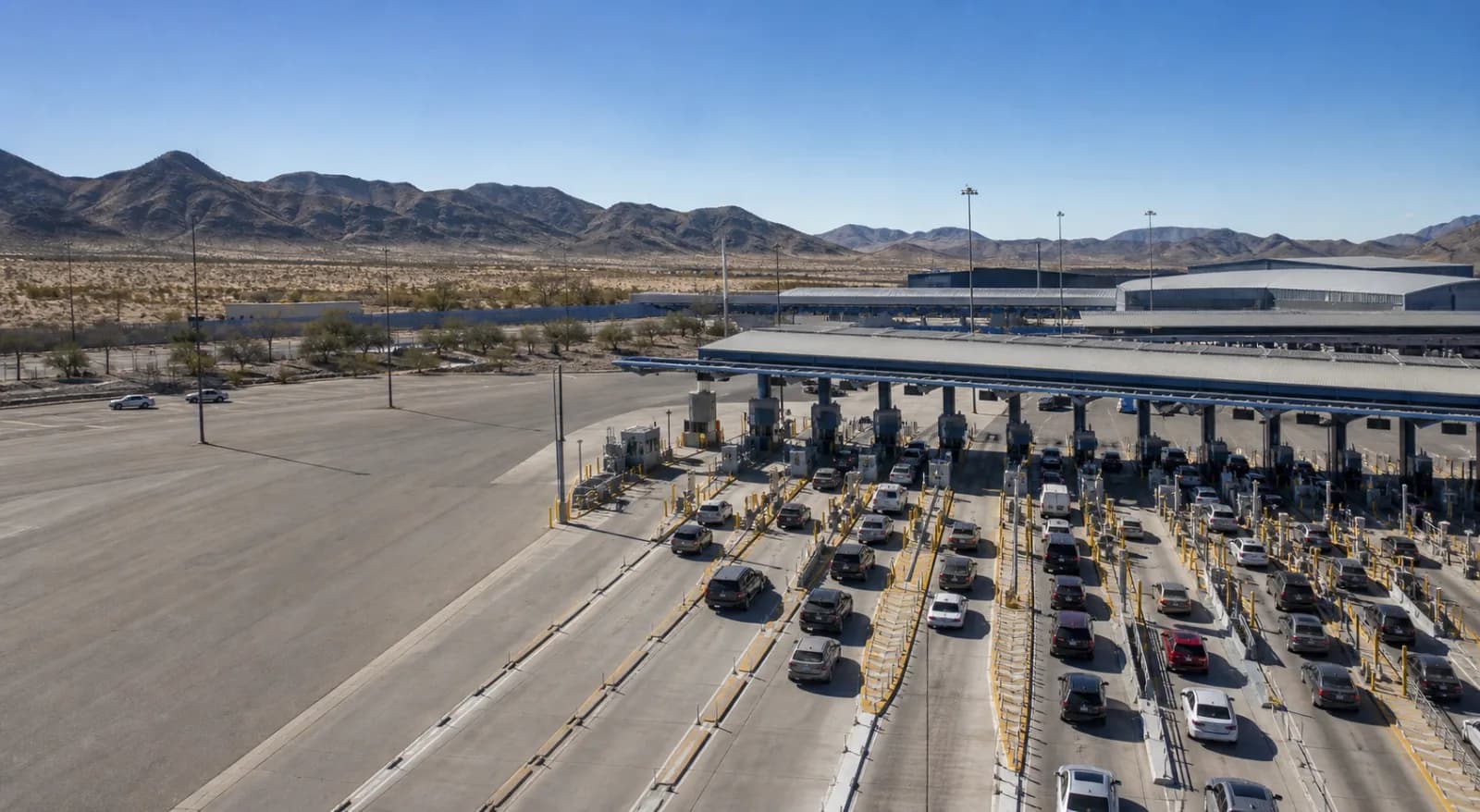
The latest live border layer shows no active wait-time data in the last two hours, so there are no current lane-delay figures to report for any port. That means today’s operational picture is defined more by what is not present than by measured queue times. In practical terms, brokers and carriers should treat this as a data gap rather than a clean bill of health. Where there is no lane reporting, local conditions can still change without a corresponding headline wait number.
Because there are no posted delays, there are also no lane-specific distinctions to compare today across passenger, commercial, FAST, or SENTRI-style channels. For planners, the important takeaway is that the feed does not currently surface a bottleneck strong enough to generate published wait times. If crossings begin reporting again later in the day, lane-level differences will matter immediately for dispatch timing, especially on high-volume northbound and southbound corridors.
Significant 24-hour changes
The most important 24-hour change is not a wait-time swing but the emergence and continuation of weather risk. Severe coastal flood warnings were issued for the San Diego area on October 27 at 2:02 AM PDT and earlier on October 26 at 9:52 PM PDT, both running until October 29 at 1:00 PM PDT. In Texas, flood warnings were issued for the Midland/Odessa region on October 26 at 9:31 PM CDT and again at 9:20 PM CDT, with one ending October 27 at 3:00 PM CDT and the other at 5:00 PM CDT. These are not border-queue measurements, but they are the most consequential day-over-day operational changes in the packet because they can affect access roads, staging patterns, and weather-sensitive movement planning.
Weather alerts and notable crossing conditions
The active weather alerts are concentrated in two regions. Southern California has severe coastal flood warnings extending through October 29, with the San Diego warning explicitly issued by NWS San Diego CA. West Texas has severe flood warnings from NWS Midland/Odessa TX that remain in effect through the afternoon of October 27. Neither alert names a specific port of entry, but both are relevant to logistics corridors near the border and to urban delivery networks feeding those markets.
The crossing-condition layer also shows subfreezing temperatures at multiple northern ports. Reported readings include Alexandria Bay at -1.3°C, Champlain at -0.5°C, Derby Line at -0.5°C, Hemmingford at -0.3°C, Highgate Springs at -0.1°C, Jackman at -0.6°C, Lacolle Route 221 at -0.6°C, Lacolle Route 223 at -0.4°C, Madawaska at -0.8°C, Massena at -1.7°C, North Portal at -0.1°C, Norton at -2.2°C, Ogdensburg at -0.8°C, and Pembina at -0.8°C. These readings are not accompanied by delay reports, but freezing temperatures are operationally relevant because they can affect vehicle handling, yard conditions, and the reliability of short-haul movements around the port footprint. The lowest reading in the set is Norton at -2.2°C, with Massena next at -1.7°C. In this packet, no cause is identified for any resulting operational effect.
Aviation and airport conditions
San Diego International is the only airport-specific restriction reported today. The FAA notice states that the airport is closed to non-scheduled transient general aviation aircraft except with prior permission, with contact information included in the notice. The restriction is identified in the NOTAM-style text as effective from October 1, 2026 through January 1, 2027. For logistics operators, the direct implication is limited to affected GA activity rather than commercial cargo schedules, but it still matters for charter flexibility, executive repositioning, and irregular operations planning around Southern California.
Trade-policy documents and explicit caveats
Today’s trade-policy feed is active, but the material is clearly caveated as raw-current policy-document context only and not normalized policy source facts or legal advice. It should be used for awareness, not as standalone legal evidence.
Among the notices posted today are International Trade Commission determinations involving mattresses from Cambodia, China, Malaysia, Serbia, Thailand, Turkey, and Vietnam; a request for submissions on the public interest in the vaporizer devices investigation; and a customs broker permit user fee payment notice for 2027 from CBP. Commerce also posted initiation notices for countervailing duty and less-than-fair-value investigations into certain amine compounds from China. Additional notices include a changed circumstances review involving heavy-walled rectangular welded carbon steel pipes and tubes from Mexico, final results in a carbazole violet pigment case involving India, a request for comments on further suspension of a Section 301 action tied to China’s targeting of maritime, logistics, and shipbuilding sectors, and scheduling of expedited five-year reviews for melamine from China.
Operationally, the only grounded takeaway is that the policy pipeline remains active across a mix of customs administration, trade remedy, and Section 301-related matters. The notices do not, on their own, establish current port delays or immediate border processing changes. Any compliance relevance should be traced back to the underlying docket or rule text before being treated as actionable.
Macro and economic indicators
The latest macro set remains broadly consistent with a high-cost freight environment, though the dates attached to several indicators are older than the border and weather data and should be treated as observation dates rather than live market ticks. Brent crude is listed at 115.22 as of 2026-10-20, with WTI at 107.89 on the same date. Diesel-related measures remain elevated as of 2026-10-19: GASDESGCW at 5.90, GASDESMWW at 6.35, US Diesel Retail at 6.28, and GASDESWCW at 7.39. Those levels continue to matter for over-the-road and cross-border linehaul economics even though the feed does not pair them with a fresh operational shock today.
FX also remains important for cross-border planning. USD/CAD is 1.3993 and USD/MXN is 18.6638, both as of 2026-10-23. The trade-weighted dollar is 121.32 on the same date. Those exchange rates are relevant to landed-cost calculations, invoicing exposure, and modal trade-offs, especially where fuel and duty costs are already elevated. Other indicators in the packet include BOPGSTB at -57347.00 as of 2026-02-01, IR at 152.20 as of 2026-09-01, PCU484121484121 at 219.38 as of 2026-09-01, PCUOMFGOMFG at 287.13 as of 2026-09-01, PPIACO at 295.71 as of 2026-09-01, and TOTALSA at 16.38 as of 2026-09-01. These are dated measures, but together they reinforce a backdrop of persistent price pressure and a freight cost environment that remains sensitive to fuel and currency swings.
Outlook and operational watch list
The near-term outlook is driven less by measured border congestion than by weather and localized service disruptions. With no active wait-time data in the last two hours, the main operational question is whether the weather alerts in Southern California and West Texas begin to translate into access constraints, missed appointments, or rerouting. The northern freezing readings deserve attention as a secondary risk, particularly where overnight temperatures interact with yard operations or time-critical cross-border moves.
Monitor the following over the next cycle:
- Any reappearance of lane-level wait-time data, especially if one port begins reporting while others remain blank.
- Evolution of the San Diego coastal flood warning and whether it affects access or local movement patterns near the border region.
- Whether the West Texas flood warnings create route disruptions or timing spillovers into nearby freight corridors.
- Any change to the San Diego International restriction if charter or transient GA activity is part of the logistics plan.
- New trade-remedy notices or customs administration updates that may affect compliance planning, even if they do not alter today’s physical border flow.
The current picture is operationally manageable, but it is not friction-free. The feed’s emptiness on wait times reduces visibility, while weather and dated but elevated cost indicators keep pressure on planning margins.