

US Border Logistics Briefing - October 17, 2026
Prepared 6:00 AM PDT
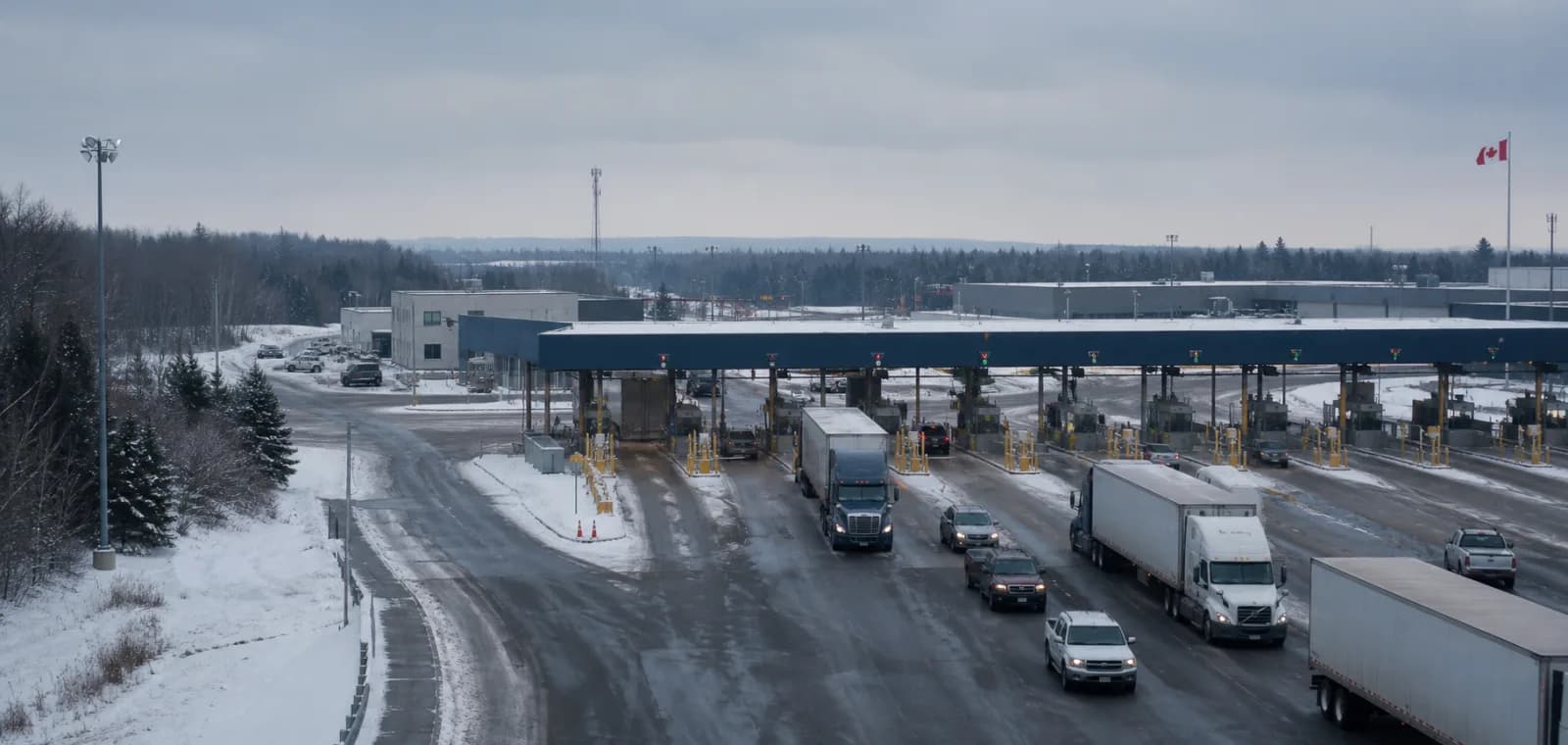
Border conditions in the latest CBP/CBSA pull are quiet on the measured wait-time side: there are no active wait time data points in the last two hours, so there is no lane-level congestion signal to anchor a current border-delay assessment. That absence matters operationally. It means the main short-term friction points in today’s feed come from weather, aviation, and trade-policy context rather than from live port-of-entry queue data.
The most immediate pressure is weather-driven and geographically uneven. The strongest alerts are concentrated in the West and Northern tier: a High Wind Warning covers San Diego County through 8:00 PM PDT, another High Wind Warning remains in effect for Great Falls through midnight MDT, and Tucson is under a Wind Advisory through 2:00 PM MST. A Heat Advisory also remains active for San Diego County through 8:00 PM PDT, while Buffalo is under a Freeze Warning through Saturday morning and Austin/San Antonio has a Flood Warning continuing into Sunday night. These are not border-crossing data points by themselves, but they are relevant to dispatch planning because they can affect road access, yard operations, and transfer timing around nearby crossings and airport nodes. The feeds do not identify a single causative chain, so any operational impact should be treated as location-specific and weather-dependent rather than generalized across the border network.
Air cargo and special-mission aviation are also constrained at one major Southern California node. San Diego International Airport is reporting a closure for non-scheduled transient general aviation aircraft, with an exception for PPR, per the FAA notice: “SAN AD AP CLSD TO NON SKED TRANSIENT GA ACFT EXC PPR 619-298-7704 2610011633-2701010800.” For logistics planners, that is a material airport-access restriction rather than a broader commercial-airline delay indicator. It suggests transient GA movements tied to expedited cargo support, charter, or repositioning activity may need alternate routing or prior permission, while the feed does not indicate disruption to scheduled airline operations.
Trade-policy activity remains dense, but the documents in today’s packet are explicitly caveated and should be treated as policy context only, not as live border operating evidence. The notices are all dated October 19, 2026 in the feed and include a range of antidumping and countervailing duty actions: Polyethylene Terephthalate Film, Sheet, and Strip from India; Citric Acid and Certain Citrate Salts from Colombia; Diamond Sawblades and Parts Thereof from China, including a covered merchandise referral and inquiry tied to a CBP investigation; Perfluoroalkoxy Alkane from India with postponement of a preliminary determination; Truck Bed Covers from China with a final affirmative countervailing duty determination; Forged Steel Fluid End Blocks from Italy with final antidumping results; Thermal Paper from Korea; and two separate softwood lumber actions from Canada, including final CVD and final AD administrative review results. The explicit caveat matters here: these are raw current policy-document context rows, not normalized policy facts or legal advice, and they should not be used to infer current lane conditions or immediate enforcement intensity. Their operational value is directional only—namely, that trade-remedy attention remains broad across chemicals, lumber, steel-related products, and manufactured consumer/industrial goods—but the feed does not support claims about present-day border behavior.
Crossing delays and lane-level figures
There are no active wait-time figures in the last two hours, and the feed does not provide lane-specific measurements for any crossing today. As a result, there is no current numeric basis to compare passenger versus commercial lanes, standard versus FAST/SENTRI/NEXUS processing, or northbound versus southbound directionality. For dispatch and appointment planning, the practical takeaway is limited but useful: absent live queue data, do not assume a border delay problem is present based on this morning’s feed alone. If a shipment is time-sensitive, the better operational check is to monitor the specific port and lane feed later in the day rather than rely on the aggregate “no active wait time data” condition.
Significant 24-hour changes
The clearest 24-hour change is the shift in what the feed is able to measure. The latest pull is fresh—4 minutes old—but it contains no active wait-time observations within the last two hours. That is a materially different operating picture from a congested border day, and it lowers confidence in any claim of ongoing crossing delay. By contrast, the weather picture is active and immediate, with multiple severe and moderate alerts now in force across California, Arizona, Montana, New York, and Texas. No cause is identified in the current feeds for any absence of border queue data, so the proper interpretation is data silence rather than confirmed relief.
Trade-policy documents and caveats
The policy docket is active enough to warrant attention, but the claim caveat is important. These notices are raw-current policy-document context only; they should not be treated as a normalized policy source or as evidence of real-time border disruption. The China-diamond sawblade referral stands out because it explicitly ties CBP involvement to a Commerce inquiry concerning alleged evasion, but the feed does not provide an operational border impact estimate. Similarly, the Canada softwood lumber determinations may be important for importers and customs brokers, yet the feed gives no evidence that they are already changing current crossing times. For today’s operational purposes, the correct use of these notices is planning and compliance monitoring, not queue forecasting.
Aviation and airport conditions
SAN is the only airport condition in the feed, and it is specific: the airport is closed to non-scheduled transient GA aircraft except with prior permission. That restriction can matter for expedited logistics teams using charter or transient general aviation as a connector between border-adjacent facilities and inland distribution points. Because the notice is narrowly written, it should not be overextended to scheduled airline freight or to general commercial airport operations. The feed does not report broader FAA delay programs or airport congestion elsewhere.
Weather alerts and notable crossing conditions
The weather picture has the greatest near-term potential to disturb border-adjacent operations. San Diego County is simultaneously under a High Wind Warning and a Heat Advisory, an unusual combination that signals both wind exposure and heat stress risk through the afternoon/evening window. Tucson’s Wind Advisory and Great Falls’ High Wind Warning suggest localized travel difficulty and possible impacts on high-profile freight moves. Buffalo’s Freeze Warning may affect early-morning yard operations and temperature-sensitive cargo handling, while the Flood Warning for Austin/San Antonio remains the most consequential inland movement hazard in the Texas corridor through Sunday night. Separately, the feed notes Sault Ste. Marie is freezing at -0.8°C, a condition that is worth watching for cold-chain handling and pavement risk, though the feed does not identify any associated crossing delay.
Community intelligence context
No community intelligence items were supplied in this data context. There is therefore no retired or diagnostic community signal to weigh against the official feeds.
Macro and economic indicators
The macro backdrop remains mixed and, in places, expensive for transport users. Energy prices are elevated in the latest observations: Brent crude is 126.55 as of 2026-10-14 and WTI is 101.91 on the same date. Diesel remains high across regions, with U.S. Diesel Retail at 6.18 on 2026-10-12; regional diesel series are also elevated, including GASDESGCW at 5.81, GASDESMWW at 6.26, and GASDESWCW at 7.24, all as of 2026-10-12. Currency and trade-weighted indicators are stable enough to matter for cross-border landed cost calculations: USD/CAD is 1.4269, USD/MXN is 18.3990, and the Trade Weighted Dollar stands at 121.60, all as of 2026-10-09. On the trade and price side, BOPGSTB is -57,347.00 as of 2026-02-01; IR is 152.20, PCU484121484121 is 219.38, PCUOMFGOMFG is 287.13, and PPIACO is 295.71, all as of 2026-09-01. TOTALSA is 16.38 on 2026-09-01. These figures do not point to a border-specific disruption on their own, but they do support a higher-cost operating environment for freight, especially where long-haul fuel burn and inventory carry time are already under pressure.
Outlook and operational watch list
The near-term outlook is shaped less by border queue congestion and more by weather exposure, airport access limits, and a busy trade-policy calendar. With no live wait-time data in the last two hours, the immediate watch items are where weather and transport constraints intersect.
- Monitor San Diego County for wind and heat impacts, especially where border-adjacent trucking and airport support overlap.
- Track the Texas flood warning through Sunday night for possible inland routing delays.
- Watch Buffalo and Great Falls for cold/wind operational effects on early shifts and exposed freight.
- Use SAN’s non-scheduled transient GA restriction as a planning constraint for charter and special-mission aviation.
- Treat the trade-policy notices as compliance context, not as evidence of current crossing slowdown.