

US Border Logistics Briefing - October 14, 2026
Prepared 6:00 AM PDT
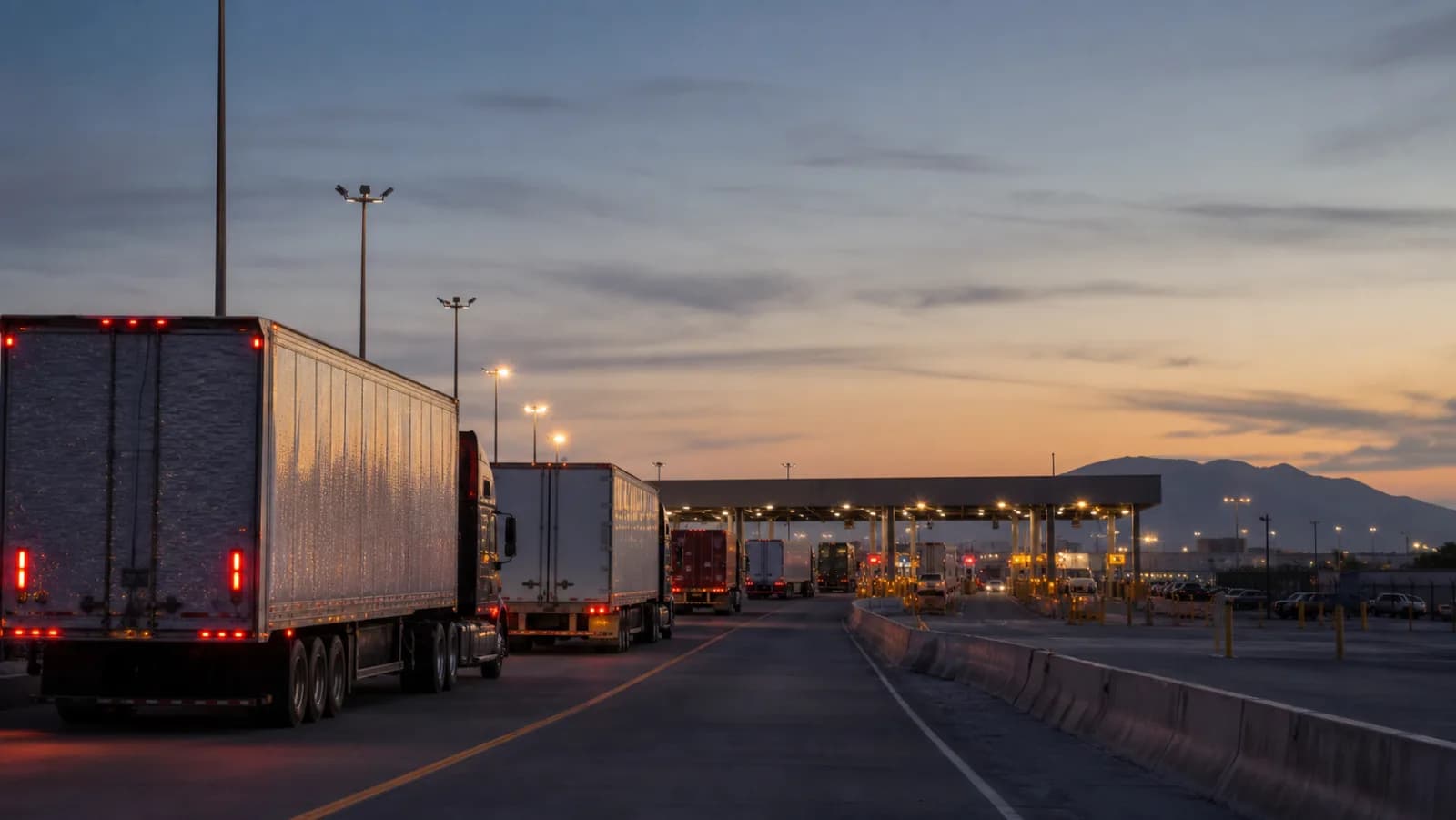
Border conditions are relatively quiet on the crossing side this morning, but the absence of live wait data is itself the main operational feature. The latest CBP/CBSA border pull is only four minutes old, yet there are no active wait-time readings from the last two hours, so dispatchers should treat lane timing as effectively unobserved in the current feed rather than assume friction is low. That leaves weather, airport conditions, and policy activity as the more visible sources of near-term operational risk.
The weather picture is concentrated in the Southwest and southern tier, where wind-related alerts remain the most relevant cross-border variable. The strongest direct condition in the border data is at the north_portal, where temperature is reported at -0.1°C, a freezing reading that could matter for early-day movement and equipment handling even though no linked crossing delay is posted. Elsewhere, San Diego’s airport status shows a non-trivial disruption, and several active watches and advisories point to a day where environmental conditions could matter more than border queue data.
Trade-policy traffic is also active, but the supplied notices are raw policy-document context only and should be treated as background intelligence, not current enforcement evidence. The day’s docket is heavy with antidumping and countervailing-duty actions across steel, chemical, packaging, and industrial categories. Operationally, that matters because it signals continued policy churn across import-sensitive commodities, even though the notices themselves do not tell us anything direct about border wait times or clearance conditions. The right reading is that the policy environment is active, not that a given lane or port is experiencing a documented control change.
Macro indicators continue to frame freight cost pressure as elevated. Fuel remains expensive by the latest readings, while the dollar is relatively strong against both Canadian and Mexican currencies on the observation dates provided. That combination can shape cross-border procurement, landed-cost calculations, and carrier pricing, but the data here does not establish any immediate causal link to today’s border operations. The key operational takeaway is to watch how those macro conditions interact with weather-sensitive corridors and any commodity-specific policy developments rather than expecting the border feed itself to reveal the effect in wait-time data.
Crossing Delays and Lane-Level Conditions
There are no active wait-time readings in the last two hours, so no lane-level delay figures are available to report for current crossings. That means there is no current observed evidence in this feed for northbound or southbound queue pressure at the sampled ports of entry. In practical terms, planners should avoid using the absence of wait data as a proxy for smooth flow; it simply means the feed does not currently provide measurable queue information.
The only crossing-adjacent condition explicitly reported is the north_portal temperature at -0.1°C. While the data does not tie that condition to a specific delay event, freezing temperatures can be operationally relevant where facilities or cargo are sensitive to cold exposure. Because no wait-time data accompanies the reading, any effect on throughput remains unobserved in current feeds.
Significant 24-Hour Changes
The most visible changes in the last day are weather and policy related rather than queue related. Multiple alerts were issued or remain in force today, including High Wind Watches for the El Paso TX/Santa Teresa NM area and for San Diego CA, a Flood Watch for Midland/Odessa TX, a Freeze Warning for Bismarck ND, a Wind Advisory for Phoenix AZ, and a Beach Hazards Statement and Heat Advisory for San Diego CA. The dates and issuance times matter because they show the Southwest and parts of the Plains under an active weather cycle across today and the next several days.
On the policy side, the trade docket expanded with a new set of notices dated October 14, 2026. The day’s entries include final or preliminary antidumping-duty results, a continuation of existing orders, and ITC activity. This is a material change in the information environment, but not evidence of a current border disruption. The source context explicitly says these are raw-current policy-document rows and should not be treated as normalized policy facts or legal advice.
Trade-Policy Documents and Explicit Caveats
Today’s policy notices span several product categories. Commerce issued final results for Certain Hot-Rolled Steel Flat Products From Japan and preliminary results for Xanthan Gum From the People’s Republic of China, Certain Steel Nails From Malaysia, Certain Paper Shopping Bags From Vietnam, and Polyethylene Terephthalate Film, Sheet, and Strip From India. Commerce also issued a continuation of the antidumping and countervailing duty orders on Boltless Steel Shelving Units Prepackaged for Sale From China.
The International Trade Commission notices are similarly active. The docket includes determinations on Linear Hydraulic Cylinders From Canada, China, India, Mexico, and South Korea; a notice of institution for Certain Vertical Power Delivery Systems, Components Thereof, and Computing Systems Containing the Same; Non-Refillable Steel Cylinders From China; and a notice of receipt of complaint and public-interest comments for Certain Spectral Flow Cytometry Systems and Components Thereof.
The caveat matters: these are policy-document context rows only. They can help logistics teams track where trade-remedy pressure is building by commodity family, but they do not, by themselves, show current border delays, inspection intensity, or customs behavior. No live claim should be drawn from them beyond the existence of the notices themselves.
Aviation and Airport Conditions
Aviation conditions are straightforward but operationally important: San Diego International Airport is closed to non-scheduled transient GA aircraft except with prior permission, per the FAA notice. The message is explicit that transient GA access is restricted and includes a contact number for permission. For freight planners, the significance is not broad commercial passenger disruption, but rather a constraint on unscheduled general aviation activity that could affect ad hoc movement, executive transport, or time-sensitive smaller-aircraft operations tied to cross-border logistics.
Given the concurrent weather alerts for San Diego, the airport restriction should be read in the context of a broader coastal weather environment rather than as an isolated administrative event. The data supplied does not state a cause for the closure, so cause should be treated as unidentified in current feeds.
Weather Alerts and Notable Crossing Conditions
The weather alert set is broad enough to merit operational attention. In the El Paso TX/Santa Teresa NM area, High Wind Watches were issued at 6:19 AM MDT and, in a separate bulletin, at 10:49 PM MDT the prior evening, both running until October 16 at 6:00 PM MDT. That dual issuance suggests sustained concern over wind conditions, though no border-delay claim follows from it in the current data.
San Diego CA has a High Wind Watch issued at 1:53 AM PDT and an earlier one at 9:25 PM PDT the prior evening, both extending to October 18 at 12:00 AM PDT. The same area also has a Beach Hazards Statement and a Heat Advisory, giving the corridor a mixed weather profile. For freight operations, the most relevant implication is that local road and air activity may face weather-related variability even if border wait data is not currently posted.
Midland/Odessa TX is under a Flood Watch from 5:19 AM CDT through October 16 at 7:00 AM CDT. Bismarck ND has a Freeze Warning that expired at 9:00 AM CDT today, plus a Special Weather Statement issued at 6:26 AM CDT. Phoenix AZ is under a Wind Advisory through October 16 at 3:00 PM MST. None of these alerts are tied in the feed to specific crossing delays, but they do flag areas where over-the-road movement may need tighter monitoring.
Community Intelligence Context
No community intelligence, scanner chatter, or retired/raw diagnostic evidence was provided in today’s context. Accordingly, there is no community-sourced context to weigh against the official weather, policy, or airport feeds.
Macro and Economic Indicators
The latest macro indicators continue to suggest a relatively costly operating backdrop. Brent crude is 125.44 as of 2026-10-06, and WTI is 96.24 on the same date. Diesel is also elevated: US Diesel Retail is 6.20, with regional series reading 5.82, 6.29, and 7.23 on 2026-10-05. For border and freight operators, that is a direct input into linehaul cost and fuel surcharge planning.
Currency readings as of 2026-10-09 show USD/CAD at 1.4269, USD/MXN at 18.3990, and the Trade Weighted Dollar at 121.60. Those values point to a strong dollar environment relative to both Canada and Mexico, which can influence cross-border pricing and working capital assumptions. The data does not support any more specific claim than that.
Industrial and trade indicators are mixed but still worth watching: BOPGSTB is -57,347.00 as of 2026-02-01; IR is 150.80 as of 2026-08-01; PCU484121484121 is 207.64, PCUOMFGOMFG is 279.70, and PPIACO is 287.93, all as of 2026-08-01; and TOTALSA is 16.38 as of 2026-09-01. These are not border-delay indicators, but they help frame the broader cost environment for transport, warehousing, and industrial supply chains.
Outlook and Operational Watch List
The near-term outlook is driven more by weather and aviation restrictions than by observed crossing congestion, because the border feed currently has no active wait-time readings. The absence of queue data reduces visibility, so operators should lean on weather alerts, airport status, and commodity-policy developments as the most reliable signals available this morning.
- Watch the El Paso/Santa Teresa and San Diego wind-related alerts for downstream road and airport impacts.
- Monitor San Diego International Airport’s transient GA restriction for any effect on ad hoc air movements.
- Treat the north_portal freezing reading as a local operational condition, even though no wait-time impact is shown.
- Track the day’s trade-remedy notices for commodity-specific planning, but keep them in the policy-background category unless separate claim-bearing evidence appears.
- Recheck the border feed later today for the return of active wait-time data before drawing any conclusions about flow.