

US Border Logistics Briefing - October 3, 2026
Prepared 6:00 AM PDT
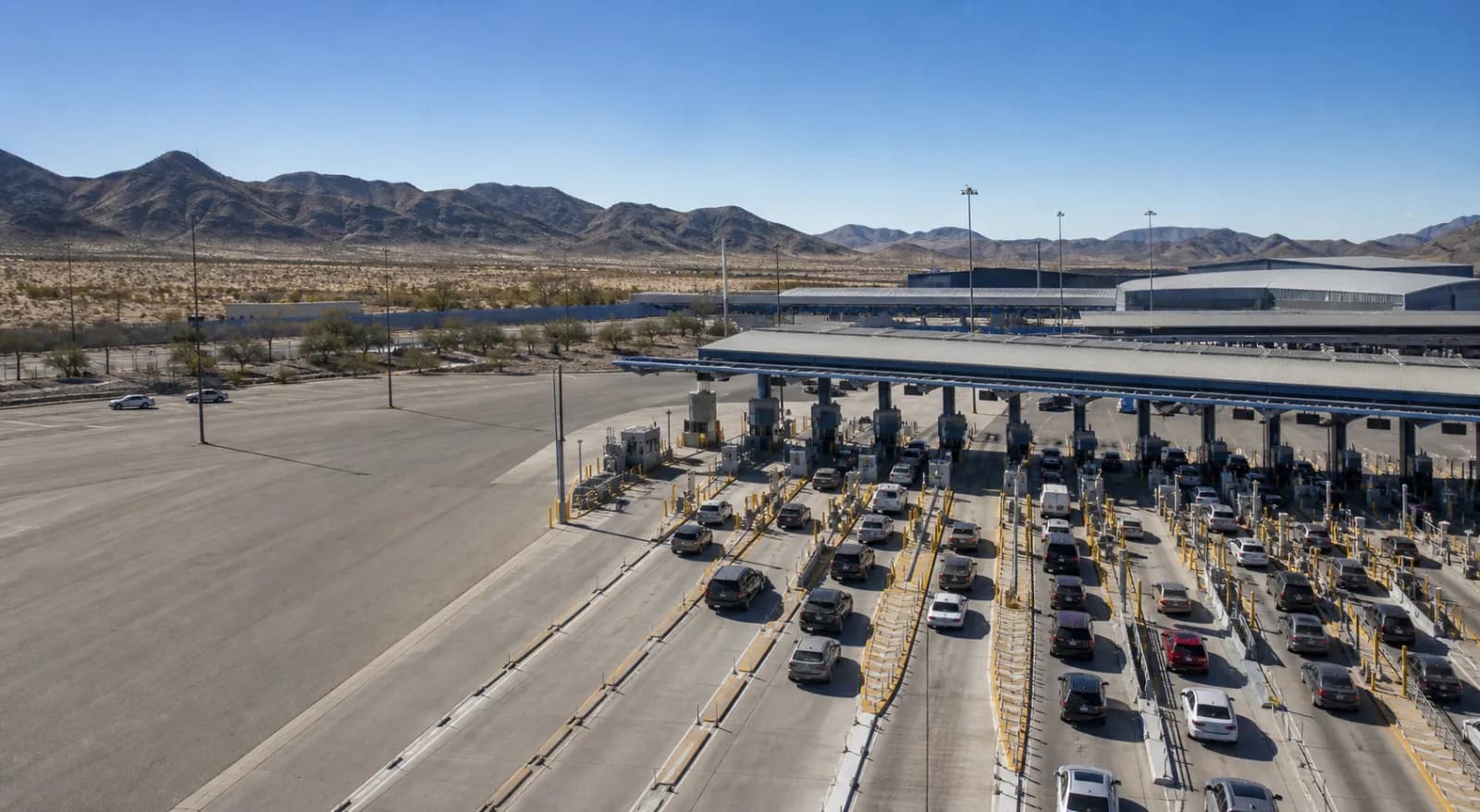
U.S. border and logistics conditions start the day with a notably sparse operational picture: CBP/CBSA reported no active wait-time data in the last two hours, so there is no current lane-level congestion signal to anchor dispatch decisions. That absence is itself important. It means today’s briefing is driven more by weather, airport disruption, policy calendar, and macro cost conditions than by measured border queue pressure. The latest border pull is fresh, at 2026-10-03T12:48:08.732Z, or 12 minutes old, so the lack of wait data should be treated as a current-feed condition rather than a stale snapshot.
The most immediate cross-border operating risk is weather. Extreme Heat Warnings are in force for the San Diego area through October 8 at 8:00 PM PDT, with duplicate alert entries issued at 4:01 AM PDT on October 3 and 9:13 PM PDT on October 2. A Wind Advisory is also active through 6:00 PM PDT today, again with duplicate issuance records at the same two times. For border operations, that combination matters because even without measured queue data, heat and wind can affect yard dwell, driver comfort, equipment handling, and airside/roadside exposure around the San Diego corridor. The data does not identify any direct border-delay cause, so any operational implication should be framed as weather exposure only, not as confirmed congestion causation.
Aviation conditions are likewise constrained at San Diego International. FAA data shows SAN is closed to non-scheduled transient general aviation aircraft except with prior permission, and the notice carries a validity window of 2610011633-2701010800. In practical terms, this is a meaningful restriction for transient GA movements into and out of the airport area, though the feed does not indicate broader commercial airline disruption. Because the notice is airport-specific and not a general aviation network event, the operational impact is concentrated rather than systemwide. Still, for cargo, executive travel, or expedited logistics support that depends on transient GA access, the closure should be treated as an active planning constraint.
Trade-policy activity remains dense in the Federal Register feed, but the provided context explicitly limits these items to raw-current policy-document context only. They are not normalized policy source facts and are not legal advice, so they should be used as situational awareness rather than as a basis for compliance conclusions. Even so, the document list signals continuing trade-remedy activity across several sectors. The Commerce Department has final or preliminary actions on melamine from China, mattresses from Poland, methionine from France/Japan/Spain, large diameter welded pipe from Türkiye, passenger vehicle and light truck tires from Vietnam, certain cut-to-length carbon steel plate from China and Russia, corrosion inhibitors from China, and oil country tubular goods from Ukraine. USTR is also opening a public consultation process ahead of the 2027 USMCA annual joint review, which is a notable policy-calendar marker for North American supply-chain planning. The International Trade Commission has instituted antidumping and countervailing duty investigations on railway tank cars and parts from Mexico. The operational significance is not immediate border delay, but potential downstream compliance and sourcing attention for shippers tied to those product lines. The explicit caveat remains: these are notice summaries only, and the feed does not provide a confirmed current enforcement action at the border.
Macro conditions continue to point toward elevated transport-cost pressure rather than relief. The latest energy and currency data show Brent crude at 113.96 and WTI at 96.16, both as of 2026-09-29. Diesel remains expensive across regional measures: U.S. diesel retail is 6.38 as of 2026-09-28, with Gulf Coast at 5.96, Midwest at 6.53, and West Coast at 7.36, all for the same date. For cross-border trucking, the West Coast diesel level is especially relevant because it compounds operating cost sensitivity in the southern California corridor. FX also remains an important backdrop: USD/CAD is 1.4140 and USD/MXN is 17.6932, both as of 2026-09-25, while the Trade Weighted Dollar is 120.33 on the same date. These are not border-delay indicators, but they do shape landed-cost calculations, especially where northbound and southbound freight flows are price-sensitive.
The remaining economic indicators reinforce a still-tight freight-cost environment, though their observation dates are more dated than the border and weather feeds. The goods and services trade balance metric shown as BOPGSTB is -57,347.00 as of 2026-02-01. Industrial and producer-price measures also remain elevated: PCU484121484121 is 207.64, PCUOMFGOMFG is 279.70, and PPIACO is 287.93, all as of 2026-08-01. IR is 150.80 as of the same date. TOTALSA is 16.38 as of 2026-09-01. Because these indicators are not current-day operating evidence and some are several weeks old, they should be treated as backdrop only. Their practical value here is directional: they support a view of continuing cost pressure in transportation and related supply-chain categories, not a live disruption diagnosis.
Community intelligence is not providing a live claim-bearing signal in this packet. No retired raw diagnostic row was supplied, so there is nothing to incorporate beyond that note. The broader point is that, in the absence of active wait times, any community chatter would need to be treated as diagnostic context only unless corroborated by current border or incident feeds. That safeguard matters today because the verified dataset is thin on lane-level observations and strong on weather and policy context.
The grounded outlook is therefore straightforward. There is no current measured border queue to manage, but San Diego-area weather and airport restrictions create localized operational friction, while trade-policy activity continues to build the compliance background noise for North American and selected sector-specific freight. The most useful assumption for dispatch teams is not that border processing is impaired, but that surrounding logistics conditions are less forgiving than the absence of wait data might suggest. Monitor the San Diego weather alerts for any extension or intensification, watch whether the SAN general-aviation restriction is amended, and keep an eye on whether fresh CBP/CBSA wait data appears later today.
Operational watch list:
- Check for the first valid lane-level wait-time update; there is currently no active data in the last two hours.
- Track San Diego weather alerts through the afternoon, especially the Wind Advisory ending at 6:00 PM PDT.
- Verify whether SAN’s transient GA closure remains in effect for any scheduled support movement.
- Flag trade-remedy notices involving Mexico-linked railway tank car parts, China-linked industrial inputs, and USMCA consultation timing for planning teams.
- Reassess fuel and FX exposure if today’s routing depends on West Coast trucking or cross-border price-sensitive loads.