

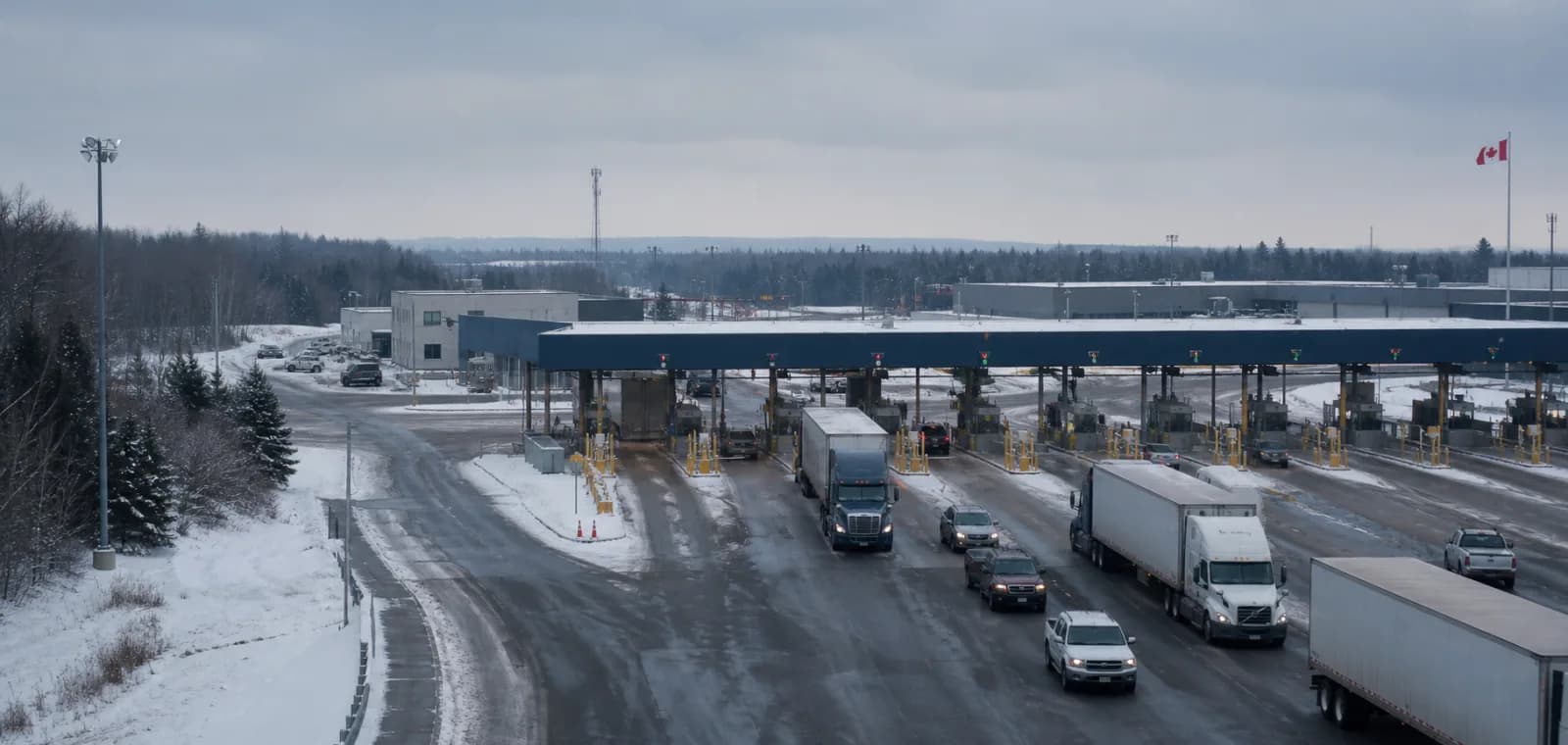
US Border Logistics Briefing - September 29, 2026
Prepared 6:00 AM PDT
Border monitoring this morning is defined less by active queue reporting than by weather and transportation disruption around key southwest and north-central approaches. The latest CBP/CBSA pull is fresh at 12 minutes old, but it shows no active wait-time data in the last two hours, so there is no current lane-delay reading to anchor throughput assessments. That absence matters operationally: dispatchers should treat the border picture as weather-led and conditions-sensitive rather than congestion-led until fresh crossing measurements reappear.
The most immediate pressure point is the El Paso–Santa Teresa corridor, where severe hydrometeorological alerts stack across both flash-flood and flood-watch products. Those warnings are not the same as a confirmed border delay, but they do raise the likelihood of localized access issues, reduced surface speed, or interruptions to normal staging and circulation near port approaches. Farther west and north, wind and fog alerts are also present in ways that can affect regional trucking, airport operations, and interchange reliability even where the crossings themselves are not yet reporting waits.
Aviation conditions add a second layer of operational friction. Phoenix is reporting a ground delay tied to thunderstorms with an average 37-minute delay, which can spill into late inbound/outbound logistics and time-sensitive cargo schedules. San Diego also has a closure condition for non-scheduled transient general aviation aircraft, with an exception for PPR at the listed airport contact number. That is not a broad commercial-airport closure statement, but it does indicate a constrained operating environment that should be checked before any irregular air movements or ad hoc lift planning. Taken together, the air picture reinforces a cautious stance on same-day schedule recovery in the Southwest.
Trade-policy activity remains active, but the documents in today’s feed are raw current policy-context material and not normalized legal or enforcement facts. They should be treated as situational awareness only, not as claim-bearing evidence about shipment disruption. Still, the volume of notices is notable: CBP published approvals and accreditations for Intertek USA, Inc. in Carteret, NJ and Chelsea, MA, as well as Laboratory Services, Inc. in Kemah, TX, all tied to gauging petroleum and testing petroleum or related products. The ITC also issued several notices, including full five-year reviews on methionine from France, Japan, and Spain; determinations on oil country tubular goods from India, South Korea, Turkey, Ukraine, and Vietnam; a Section 337 finding and remedial orders involving certain ink cartridges and components; institution of antidumping and countervailing duty investigations on wooden fence pickets from China; determinations on boltless steel shelving units prepackaged for sale from China; and an investigation notice concerning powered rocker-recliner and glider-recliner mechanisms and seating units. CBP also proposed withdrawing the international airport designation of Chalk Seaplane Base. These are policy signals, but the feed explicitly cautions that they are not to be treated as current operational evidence absent the required claim-bearing review conditions.
Crossing Delays and Lane-Level Readout
There are no active wait-time records in the last two hours, so there is no verified lane-level delay set to report for today’s current border crossing snapshot. That means no northbound or southbound queue minutes are available from the live feed, and no lane-type distinctions are present to compare across ports. For logistics teams, the practical implication is that the crossing system is currently blind from a queue standpoint: routing decisions should lean on weather, local access, and any private telemetry rather than on published wait metrics.
Because no lane data is active, there are also no cross-port comparisons to support a ranking of delays by facility. This is important for dispatch because, in the absence of fresh wait figures, the absence of evidence should not be mistaken for evidence of smooth operations; it simply means the current feed is not reporting measured queue conditions.
Significant 24-Hour Changes
The biggest day-over-day change is the transition from a potentially monitorable border queue environment to a no-active-wait-state environment in the live crossing feed. That change reduces visibility more than it reduces risk. The operational center of gravity has shifted toward weather and airport disruptions, especially along the El Paso–Santa Teresa area and in Phoenix.
On the policy side, several notices are dated today, September 29, signaling an active federal publication cycle. However, because the supplied context marks those rows as raw-current policy-document material only, their significance is informational rather than evidentiary for real-time freight conditions. The key change to watch is not immediate enforcement impact; it is the continuing cadence of trade case activity around metal products, textiles or home goods, and specialized industrial goods.
Trade-Policy Documents and Explicit Caveats
Today’s notices include CBP accreditations for gauging and laboratory work at Intertek USA in Carteret and Chelsea and Laboratory Services in Kemah. Those entries suggest routine administrative approvals in the petroleum-testing space, but the context explicitly limits them to policy-document awareness.
The ITC notices span multiple investigations and determinations: methionine from France, Japan, and Spain will undergo full five-year reviews; oil country tubular goods from several countries received determinations; wooden fence pickets from China were placed into antidumping and countervailing duty investigations; and a Section 337 matter involving ink cartridges and components resulted in a limited exclusion order and cease-and-desist orders. Additional notices cover boltless steel shelving units from China and a new investigation involving rocker-recliner mechanisms and seating units. The feed also includes a proposed CBP action to withdraw the international airport designation of Chalk Seaplane Base.
These items carry an explicit caveat: they are raw-current policy-document context only and are not to be treated as normalized policy facts or legal advice. They should not be cited as evidence of current freight disruption unless supported by claim-bearing source review.
Aviation and Airport Conditions
Phoenix Sky Harbor is operating under a ground delay with an average 37-minute delay due to thunderstorms. That is a meaningful schedule impact for freight and passenger-cargo connections, especially for time-sensitive shipments connecting into the Southwest. The exact delay figure matters because it quantifies the operational drag: even modest averages can cascade into missed turns, late driver rendezvous, and reduced recovery time later in the day.
San Diego International shows a closure condition for non-scheduled transient general aviation aircraft, with a PPR exception and a published contact number. The closure language is specific and limited, not a blanket statement about all airport activity. Still, it is a material constraint for irregular air logistics and should be checked against any planned ad hoc flight movements.
Weather Alerts and Notable Crossing Conditions
The most consequential weather area is the El Paso Tx/Santa Teresa NM forecast zone. Two flash flood warnings are active, issued at 6:46 AM MDT and 6:20 AM MDT, ending at 9:45 AM MDT and 8:45 AM MDT respectively, alongside a flood watch running from 5:38 AM MDT today until 6:00 AM MDT tomorrow. A separate wind advisory for the same area runs from 4:23 AM MDT today until midnight MDT tonight. That combination is the clearest potential operational disruptor in the feed and warrants close attention for road access, standing water, and staging reliability.
In Arizona, Tucson has a flood watch from 4:34 AM MST through 11:00 PM MST. In the Pacific Northwest, Seattle is under a wind advisory from 4:26 AM PDT until 2:00 PM PDT. In Montana, Great Falls has a high wind warning until noon MDT. In North Dakota, Bismarck has two dense fog advisories issued at 6:03 AM CDT and 6:01 AM CDT, both expiring at 10:00 AM CDT, and Grand Forks has a special weather statement issued at 7:09 AM CDT. These alerts are not border-specific by themselves, but they can affect feeder routes, yard operations, and aviation reliability in the connected regions.
Community Intelligence Context
No community intelligence items were supplied as live claim-bearing evidence. If such material exists in retired or raw diagnostic form, it should be treated only as background context and not used to assert current border conditions.
Macro and Economic Indicators
The macro backdrop remains elevated on energy and freight cost measures. Brent crude is 114.89 as of 2026-09-22, and WTI is 96.41 on the same date. Diesel pricing remains high across the supplied regional series: US Diesel Retail is 6.53 as of 2026-09-21, with gas/diesel indices at 6.18 for GASDESGCW, 6.68 for GASDESMWW, and 7.46 for GASDESWCW on the same observation date. Those levels support continued cost sensitivity for cross-border trucking and domestic repositioning.
FX remains relevant for import and export flows: USD/CAD is 1.4008 and USD/MXN is 17.2454, both as of 2026-09-18, while the trade-weighted dollar stands at 119.51 on that date. The goods and industrial series are dated August 1: IR is 150.80, PCU484121484121 is 207.64, PCUOMFGOMFG is 279.70, and PPIACO is 287.93. The BOPGSTB is -57,347.00 as of 2026-02-01, and TOTALSA is 17.19 as of 2026-08-01. The dates matter: these are not same-day releases, so they should be read as macro context rather than immediate catalysts.
Outlook and Operational Watch List
The near-term outlook is dominated by weather, not congestion. With no active wait-time data in the last two hours, the border picture is currently under-observed on queue conditions, while the El Paso–Santa Teresa area faces the most acute weather-driven risk. Aviation disruptions in Phoenix and restrictions in San Diego add a secondary operational burden.
Watch items for the next operational cycle:
- Refresh live border queue feeds for any new lane-level wait times, especially southwest ports.
- Monitor El Paso/Santa Teresa flood and wind products for access or staging impacts.
- Recheck Phoenix delays for thunderstorm persistence and schedule recovery.
- Verify San Diego GA restrictions before any irregular air movements.
- Track whether new policy notices remain administrative or begin to affect specific commodity flows.