

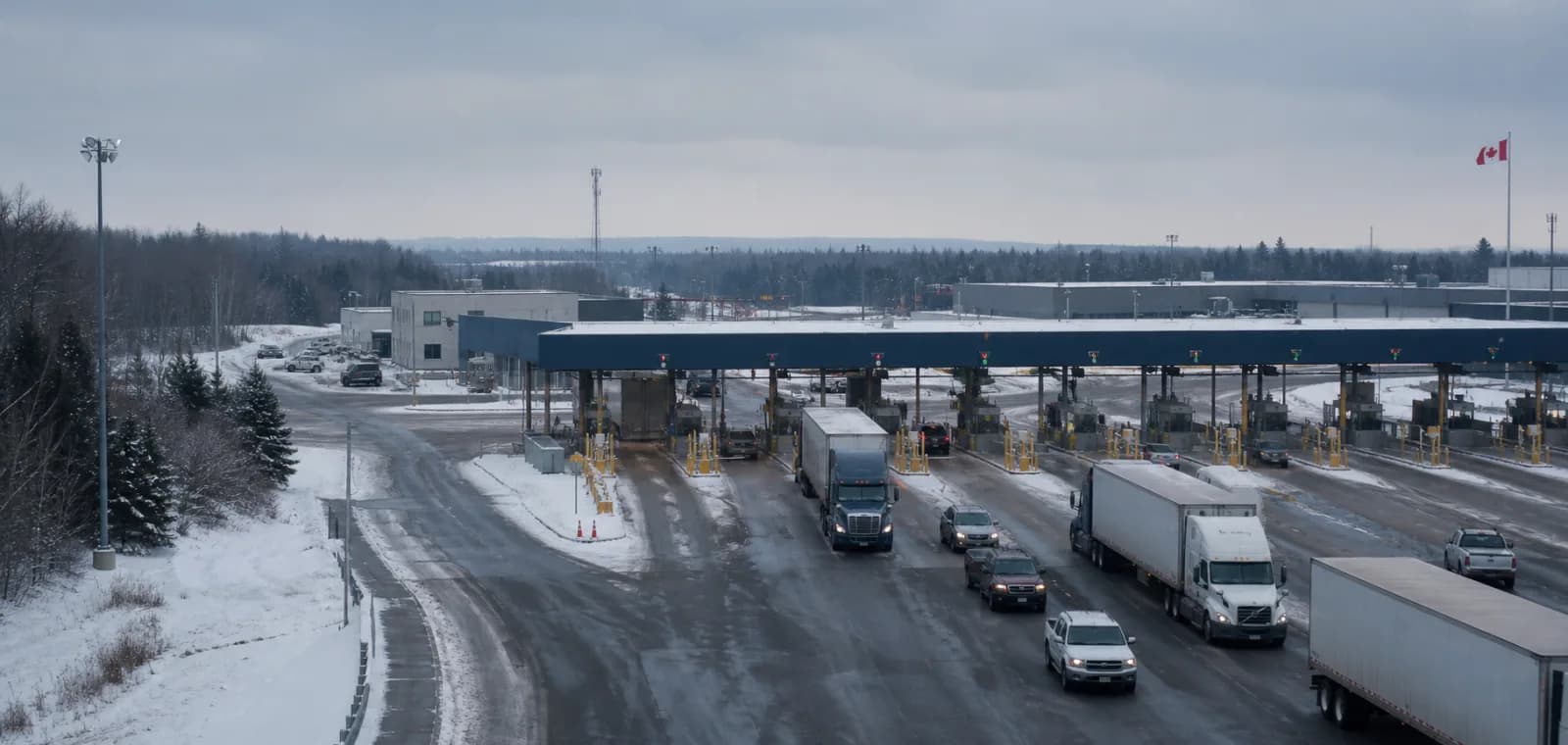
US Border Logistics Briefing - September 17, 2026
Prepared 6:00 AM PDT
# Dunvale Morning Briefing — Thursday, September 17, 2026
Border operations are opening the day without active wait-time postings in the last two hours, so the immediate lane picture is effectively a data gap rather than a clean all-clear. For logistics teams, that shifts attention away from measured queue pressure and toward the conditions most likely to change flow before midday: weather advisories in the Southwest and Upper Midwest, a limited airport closure in San Diego, and a steady stream of trade notices that may affect compliance and documentation workflows but do not, in this feed, indicate an immediate crossing disruption. The latest CBP/CBSA pull is recent at 14 minutes old, so the absence of wait-time data appears current within the limits of the feed.
The most operationally relevant near-term risk is weather. A severe Flood Watch remains in effect around El Paso and Santa Teresa, with one watch running from 4:48 AM MDT today until 6:00 AM MDT today and a second extending from 4:48 AM MDT today through 6:00 AM MDT on September 18. That extended window matters because it covers more than one dispatch cycle and could affect access routes, staging areas, and cross-border timing even though the feed does not provide lane-specific impacts. In the Upper Midwest, Dense Fog Advisories issued by NWS Bismarck at 4:14 AM CDT and 6:07 AM CDT both run until 11:00 AM CDT. Those alerts are shorter-lived than the flood watch, but they are still relevant for early-day highway approaches and local terminal movements where visibility can slow truck arrivals and yard turns.
Aviation conditions are comparatively narrow but worth noting for mixed-mode operators. San Diego International (SAN) shows a closure notice for non-scheduled transient GA aircraft, with an exception for prior permission required; the notice reads: “SAN AD AP CLSD TO NON SKED TRANSIENT GA ACFT EXC PPR 619-298-7704 2603181300-2610010800.” The restriction is aviation-specific and does not, by itself, indicate a freight airport outage. Even so, for shippers and forwarders using San Diego as a regional touchpoint, the restriction may matter for ad hoc aircraft movements, contingency lift, or time-sensitive transfers that depend on general aviation access. No other airport delays were supplied.
Crossing Delays and Lane-Level Figures
No active wait time data was reported in the last two hours, so there are no current lane-by-lane delay figures to compare across ports of entry. That absence is itself the day’s most important crossing signal: without active postings, there is no confirmed queue pressure in the current feed to anchor a dispatch decision. For planning purposes, operators should treat this as “no current wait-time visibility” rather than “no delay risk.” The source is fresh, but the dataset simply does not include active crossing numbers this morning.
Because there are no live wait-time rows, there are also no distinct lane-level values to highlight for passenger, commercial, SENTRI, Ready Lane, FAST, or other categories. Any corridor-level assessment must therefore come from the weather and transport advisories rather than from posted border queues.
Significant 24-Hour Changes
The largest day-over-day change visible in the supplied data is the emergence of current weather and aviation restrictions rather than a quantified swing in border waits. The flood-watch situation around El Paso/Santa Teresa is notable because one watch is short and expiring early, while the second extends into tomorrow morning; that extension increases the chance that disruptions outlast the initial alert window. In Bismarck, the dense-fog advisories are both time-bounded to 11:00 AM CDT, implying a morning-only visibility issue.
On the trade-policy side, today’s notices show a heavier-than-usual docket, including new or updated Commerce and ITC actions dated September 17 and September 16. Those are not port-delay signals in themselves, but they do matter for documentation, classification, and compliance calendars. The feed does not state that any of these actions are currently disrupting specific flows at the border.
Trade-Policy Documents and Their Caveats
Today’s trade-policy feed contains several notices that should be treated as raw-current policy-document context only, not as normalized legal guidance. The supplied caveat is explicit: these rows are not to be treated as claim-bearing policy facts or legal advice.
The most immediately dated items are an International Trade Administration final result on oil country tubular goods from Vietnam, an ITC notice involving certain balloon dilation devices and related components, and a CBP information-collection revision on exportation of used self-propelled vehicles, all dated September 17. Also in the past seven days are multiple Commerce actions dated September 16, including L-lysine from China, utility scale wind towers from Korea, and crystalline silicon photovoltaic cells from Laos and from India, along with duty-free-entry and antidumping/countervailing duty determinations. The operational takeaway is not that a crossing is blocked, but that compliance-sensitive shipments in these product lines may need closer paperwork review and tariff classification discipline.
The caveat is important: these are document notices and summaries, not verified live enforcement changes at specific ports. No source evidence in this context supports a claim that these notices are causing current border delays.
Aviation and Airport Conditions
Beyond the SAN closure notice, no broader airport disruption is reported in the provided feed. The SAN restriction is limited to non-scheduled transient general aviation aircraft, with prior permission required for exceptions. For logistics teams, this is most relevant when planning courier aircraft, charter moves, or contingency cargo lift. It is less relevant to scheduled commercial freight unless a shipment depends on a general aviation workaround.
No weather-related airport closures or network-wide FAA delay patterns were supplied. As a result, the aviation picture remains localized rather than systemic.
Weather Alerts and Notable Crossing Conditions
The weather picture is the clearest operational variable in the current feed. The flood watch around El Paso and Santa Teresa stands out because it is the only severe-level alert and because it directly overlaps a major border corridor. The alert’s dual timing—one expiring at 6:00 AM MDT today and one remaining active until 6:00 AM MDT on September 18—suggests continued monitoring is warranted across multiple shift changes.
Dense fog in Bismarck is a second, more transient issue. The advisory window to 11:00 AM CDT indicates the main impact should be concentrated in the morning travel period. No direct crossing condition was supplied alongside the fog advisory, so any effect on border operations remains an operational possibility rather than a confirmed current delay.
Community Intelligence
No community intelligence rows were provided in the current feed. Accordingly, there is no retired, raw diagnostic context to incorporate, and no claim-bearing operational signal should be inferred from the absence of those rows.
Macro and Economic Indicators
The macro backdrop remains mixed for transportation costs and cross-border trade. Crude benchmarks are still elevated on the latest available observations, with Brent at 130.80 and WTI at 107.02 as of 2026-09-15. Those are two-day-old observations relative to today’s date, but they still point to a fuel-sensitive cost environment. Diesel pricing is also high: U.S. diesel retail is 6.29 as of 2026-09-14, with regional diesel series showing 5.75 for GASDESGCW, 5.95 for GASDESMWW, and 6.99 for GASDESWCW, all as of 2026-09-07. For carrier planning, that combination continues to support cautious attention to fuel surcharges and margin-sensitive lanes.
Currency remains relevant for transborder cost comparisons. The USD/CAD rate is 1.3864 and USD/MXN is 16.9704, both as of 2026-09-11, while the Trade Weighted Dollar stands at 118.21 on the same date. Those levels matter for import and export pricing, especially where carrier contracts or landed-cost models are currency-sensitive. The BOPGSTB reading is -57,347.00 as of 2026-02-01, but because that observation is materially older than the rest of the macro series, it should be treated as a historical data point rather than a current operational indicator.
Industrial price measures also remain elevated in the latest August observations. IR is 150.80, PCU484121484121 is 207.64, PCUOMFGOMFG is 279.70, and PPIACO is 287.93, all as of 2026-08-01. TOTALSA is 17.19 on that same date. The feed does not provide interpretation, but the broad pattern suggests persistent price pressure across transport and manufacturing inputs.
Outlook and Operational Watch List
With no current wait-time postings, the near-term operating posture is cautious monitoring rather than delay management. The day’s watch hinges on whether weather-adjacent corridor issues begin to show up in later border pulls or adjacent traffic feeds. If they do, El Paso/Santa Teresa deserves the closest attention first, followed by morning visibility impacts in the Bismarck region. SAN’s general-aviation restriction is a separate but manageable aviation constraint.
Operationally, the priorities for the next update cycle are straightforward: monitor for any new wait-time postings, track whether the flood watch around El Paso/Santa Teresa begins to affect approach routes or queue formation, and confirm whether the Bismarck fog advisories have cleared by late morning. Compliance teams should also continue to track the day’s trade notices, especially where commodity-specific AD/CVD or ITC actions intersect with shipment documentation.