

US Border Logistics Briefing - September 15, 2026
Prepared 6:00 AM PDT
Border-crossing operations are quiet in the latest CBP/CBSA pull, with no active wait-time data reported in the last two hours. That means the day’s operating picture is being shaped less by measured queue pressure and more by adjacent conditions: a weather alert in South Texas, a continuing airport restriction in San Diego, and a set of trade notices that are policy-relevant but not traffic evidence. The source is fresh — the latest border pull is 14 minutes old — but the absence of live wait readings limits how far current conditions can be assessed from crossing data alone.
The most immediate logistics implication is that there is no lane-level congestion signal to work from today. In practical terms, that removes one of the main early-warning indicators for dispatch planning at the border and shifts attention to supporting variables: whether weather evolves in the Rio Grande corridor, whether airport constraints affect air cargo-adjacent movements in Southern California, and whether trade notices create documentation or compliance work for importers, brokers, and laboratory services. Cause for any observed changes is not identified in current feeds.
The policy stream is active, but the documents posted today are claim-caveated raw notices rather than normalized policy facts. They are useful as context for the trade environment, not as direct evidence of current operational disruption at crossings. The same is true of the economic indicators: they help frame cost pressure and cross-border demand, but they do not themselves describe border throughput. The result is a mixed picture: no measured crossing delays, but enough adjacent signals to justify close monitoring through the day.
Crossing Delays and Lane-Level Conditions
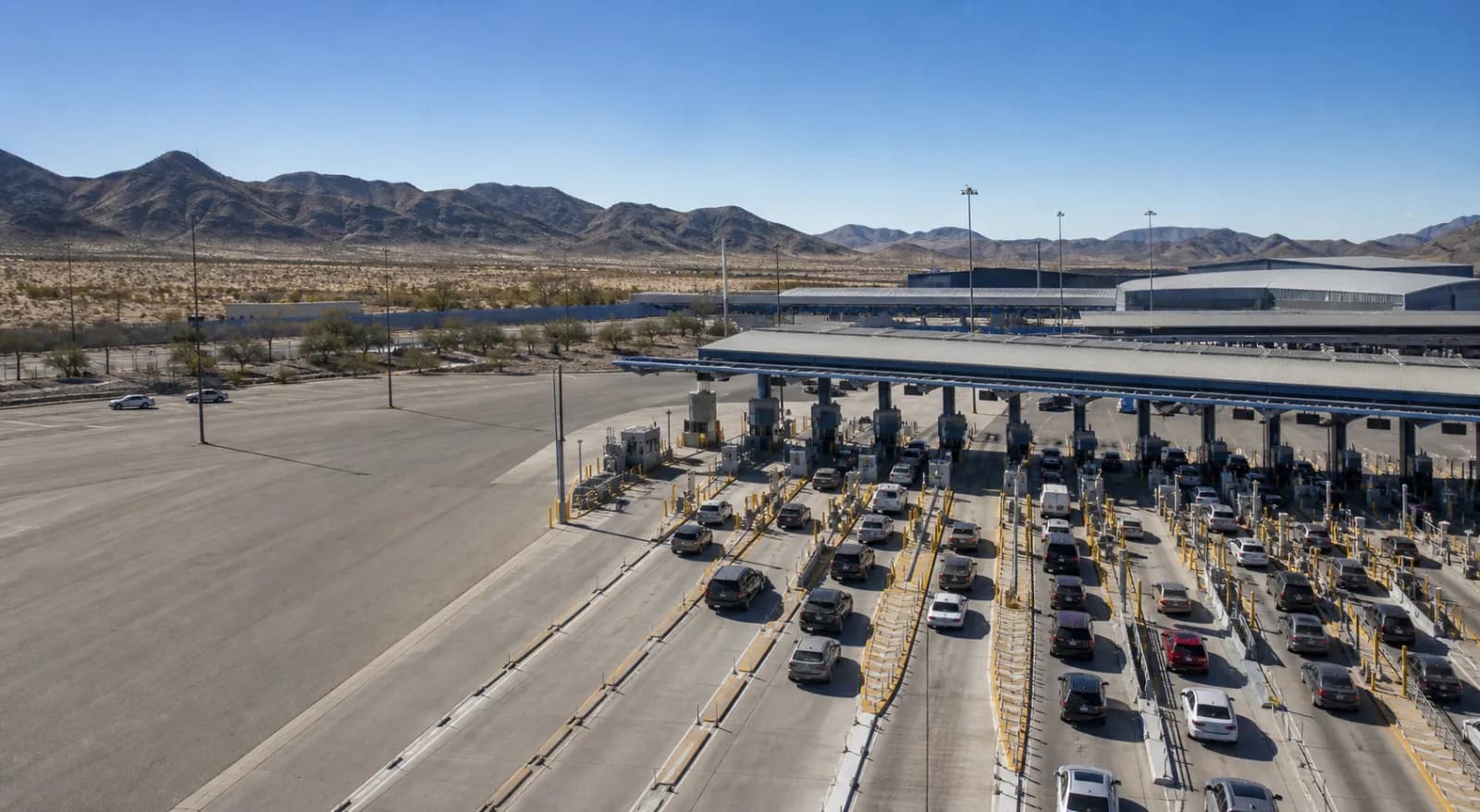
There are no active wait-time observations in the last two hours, so no current lane-level delay figures are available for reporting. Because of that, there is no basis in today’s feed to say whether passenger, commercial, or dedicated lanes are under pressure at any specific port. For planners, the operational consequence is not that crossings are clear, but that the usual queue signal is missing and should be treated as an information gap rather than a clean bill of health.
That absence matters most where dispatch decisions are time-sensitive. Without live lane readings, route selection and appointment timing must rely on local carrier intelligence or direct port updates rather than border wait telemetry. Current feeds do not identify a cause for the missing wait data.
Significant 24-Hour Changes
The only clearly time-sensitive operational change in the border-adjacent dataset is the weather alert in Brownsville, Texas: a Moderate Special Weather Statement issued September 14 at 10:21 PM CDT by NWS Brownsville TX. No storm, flood, or closure detail accompanies the alert in the supplied data, so the report should stop at the existence and level of the warning. For cross-border freight moving through the Lower Rio Grande area, that makes weather the main near-term variable to watch, even though the feed does not specify impacts at any particular crossing.
On the airport side, San Diego International (SAN) remains under a closure advisory for non-scheduled transient general aviation aircraft except PPR. The notice reads: “!SAN 03/071 SAN AD AP CLSD TO NON SKED TRANSIENT GA ACFT EXC PPR 619-298-7704 2603181300-2610010800.” This is a dated operational restriction, but it is still relevant for aviation logistics planning because it constrains that slice of airport access through October 1, 2026. The notice does not speak to airline passenger operations or cargo services directly, so it should be treated as an airport-condition constraint rather than a broader aviation disruption.
Trade-Policy Documents and Claim Caveats
Today’s trade-policy feed is active and broad, but every item in it carries the explicit caution that it is raw-current policy-document context only and should not be treated as normalized policy-source fact or legal advice. That caveat matters because the notices are official publications, yet this briefing is limited to the supplied summaries and cannot elevate them into claim-bearing operational evidence for border flow.
The day’s notices include CBP approvals for Saybolt LP as a commercial gauger and laboratory in Deer Park, Texas, and in Pittsburgh, Pennsylvania. Those approvals indicate customs-technical capacity updates, but the feed does not claim any immediate operational effect on border crossings, nor does it provide evidence of throughput change. The International Trade Administration notices are more consequential for trade administration context: preliminary results on oil country tubular goods from Türkiye; final results and partial rescission for steel racks and parts from China; preliminary affirmative countervailing duty determinations for tin mill products from China, including a preliminary affirmative critical circumstances determination; final results for glycine from India; continuation of antidumping duty orders and a countervailing duty order on silicon metal from Bosnia and Herzegovina, Iceland, Malaysia, and Kazakhstan; and final results and partial rescission on OCTG from Korea. The ITC also posted determinations involving steel concrete reinforcing bar from Bulgaria, Egypt, and Vietnam.
Operationally, these notices matter because they can shape importer documentation, duty exposure, and supply-chain sourcing decisions, especially in metals and industrial inputs. But the feed does not state that they are already changing border processing times today, and no such inference should be made from the notices alone.
Aviation and Airport Conditions
The only airport condition supplied is the SAN restriction on non-scheduled transient GA aircraft, except with prior permission required. This is a targeted airfield limitation, not a general airport shutdown, and the notice includes a validity window extending from March 18, 2026 through October 1, 2026. For logistics teams that use business aviation or ad hoc support aircraft around Southern California, the operational implication is straightforward: access is constrained for that aircraft class unless PPR is obtained.
No other airport delay or closure data is provided in the current feed.
Weather Alerts and Notable Crossing Conditions
The weather picture is limited but important. A Moderate Special Weather Statement remains active for the Brownsville, Texas area, issued by NWS Brownsville TX late on September 14. Because no detailed hazard type or threshold is included in the supplied text, the statement itself should be treated as a caution flag rather than a quantified border-impact event. Still, Brownsville is the only explicitly weather-affected corridor in today’s data, so it is the most relevant weather item for border shippers to watch.
No crossing-specific weather impact, closure, or delay is reported in the supplied data, and there are no active wait readings to connect the statement to a port-level effect.
Community Intelligence
No community intelligence, retired notes, or raw diagnostic commentary was supplied. There is therefore no additional corroborating context to incorporate, and no live claim-bearing use should be made of any external anecdote absent source-backed evidence.
Macro and Economic Indicators
The macro backdrop remains inflationary and freight-cost sensitive, though the figures are dated and should be read by observation date. Brent crude was 109.51 on 2026-09-09, while WTI crude was 97.26 on the same date. Diesel remains elevated in the latest readings: GASDESGCW at 5.75 on 2026-09-07, GASDESMWW at 5.95 on 2026-09-07, GASDESWCW at 6.99 on 2026-09-07, and U.S. Diesel Retail at 5.97 on 2026-09-07. Those levels remain operationally important for over-the-road cross-border movements because fuel is still a material cost driver.
Exchange rates also support a relatively strong dollar picture. USD/CAD was 1.3834 and USD/MXN was 16.8630, both as of 2026-09-04, while the Trade Weighted Dollar stood at 118.21 on 2026-09-11. That combination matters for cross-border pricing, invoicing, and carrier cost comparison, although the supplied data does not tie it to any specific border volume change.
Industrial pricing signals remain firm. PCU484121484121 was 207.64 and PCUOMFGOMFG was 279.70, both as of 2026-08-01. PPIACO was 287.93 on 2026-08-01, and TOTALSA was 17.19 on the same date. The balance of these indicators suggests ongoing cost pressure in transport-adjacent manufacturing and supply-chain inputs, but the feed does not provide a direct read on current border throughput.
The BOPGSTB figure is -57,347.00 as of 2026-02-01, which is a dated macro reference rather than an immediate operational signal. It adds context, not a same-day logistics read.
Outlook and Operational Watch List
With no active wait-time data, the near-term outlook is stable but information-limited. The main watch item is whether the Brownsville weather statement evolves into a more specific disruption signal. The second is whether the SAN non-scheduled transient GA restriction remains the only airport constraint in view or whether additional aviation notices appear. The third is whether today’s trade notices begin to show up in customs, broker, or laboratory workflows, especially for metals and petroleum-related products.
For dispatch and brokerage teams, the practical watch list is simple:
- Monitor Lower Rio Grande weather updates for any port-adjacent impact.
- Check for fresh CBP/CBSA wait-time reads before committing border timing assumptions.
- Treat the SAN notice as a standing access constraint for non-scheduled transient GA.
- Track duty and antidumping/countervailing notices for metals and industrial inputs that may affect shipment documentation and landed cost planning.
In short, today’s report shows no measured crossing congestion, but it does show enough adjacent operational friction to justify caution. The biggest limitation is not a detected problem at the border; it is the absence of live lane data where one would normally expect it.