

US Border Logistics Briefing - September 5, 2026
Prepared 6:00 AM PDT
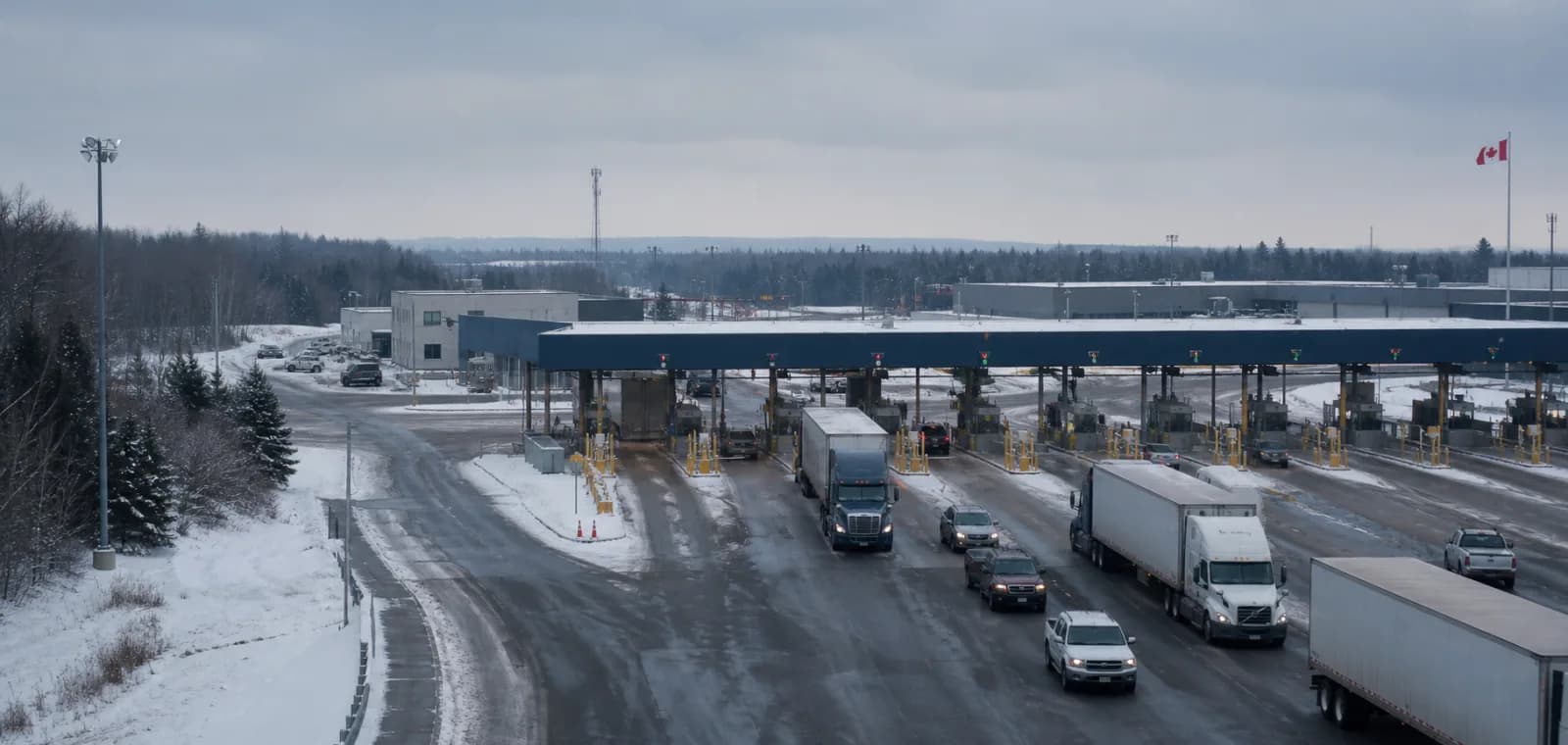
Border conditions this morning are comparatively quiet in the live crossing feed, but the absence of active wait-time reports should be treated as a data limitation rather than proof of friction-free operations. The latest CBP/CBSA pull is fresh at 14 minutes old, yet it contains no active wait time data in the last two hours. That means there is no lane-level congestion picture to anchor dispatch decisions today, and planners should rely on the weather, airport, and policy context below until crossing reports reappear.
The most operationally relevant live disruption is in Southern California aviation rather than at the land border itself. San Diego International is under a closure notice for non-scheduled transient general aviation aircraft, except by prior permission requested at 619-298-7704, through 2026-10-01 08:00. For logistics users that matters mainly as a diversion and repositioning constraint for smaller aircraft movements tied to urgent freight, charter, or support traffic; the notice does not, by itself, indicate broader commercial passenger disruption.
Weather is also part of the picture, but the alert inventory is limited. A Moderate Special Weather Statement was issued by NWS Brownsville, Texas, at 7:46 AM CDT on September 5. The alert headline signals localized attention in the Brownsville corridor, which is relevant because nearby border crossings and regional trucking routes can be sensitive to short-lived weather changes. No additional weather alerts were listed in the feed, so current operational emphasis should remain on monitoring whether this statement develops into a more specific hazard product or remains advisory in nature.
Trade-policy monitoring this morning is dominated by raw notice traffic rather than immediate enforcement or tariff changes. The supplied policy items are explicitly caveated as raw-current policy-document context only and must not be treated as normalized policy facts or legal advice. Several notices are dated September 8, 2026, which makes them future-dated planning context for today’s report and not current evidence. The forward-dated items include a final results and revocation notice for certain walk-behind lawn mowers and parts from China and Vietnam, a preliminary antidumping review for brass rod from Brazil, an ITC decision not to review an initial determination involving certain foreign-fabricated semiconductor devices and related components, and an ITC notice on L-lysine from China. Because these are future-dated, they should be treated as non-current planning context only.
The September 4 notices are current only in the sense of being recent publications, but the supplied material still provides only headline-level descriptions. Commerce has initiated administrative reviews of various antidumping and countervailing duty orders with July anniversary dates, while Commerce also received scope ruling applications seeking determinations on whether identified products fall within the scope of AD/CVD proceedings. In parallel, Commerce issued final results for certain frozen warmwater shrimp from India and for narrow woven ribbons with selvedge from Taiwan. For supply chain teams, the practical takeaway is not an immediate border delay signal but a reminder that classification, scope, and review activity remains active and may alter landed-cost assumptions for affected commodities. The feeds do not provide implementation timing, rate specifics, or operational hold instructions here, so no stronger claim is warranted.
On the aviation side, the SAN closure is the only airport condition reported. The notice is specific: “AD AP CLSD TO NON SKED TRANSIENT GA ACFT EXC PPR.” That language indicates a narrow restriction on non-scheduled transient general aviation aircraft rather than a blanket airport shutdown. Operationally, this matters if teams are routing time-sensitive parts, expedited documents, or personnel movements through charter/GA channels tied to San Diego; commercial airline cargo and passenger operations are not described in the notice and should not be assumed affected.
Border crossing conditions remain data-poor. There are no active wait times in the last two hours, and the feed provides no lane-level figures to distinguish passenger, commercial, SENTRI, Ready Lane, or pedestrian performance. Because of that, there is no factual basis today to say a specific crossing is under pressure or that any one lane type is outperforming another. The correct operational read is that live border congestion is currently unobserved in the provided feed, not that it is absent.
Community intelligence is unavailable in current claim-bearing form and should be treated only as retired or raw diagnostic context if it appears elsewhere in internal workflows. Nothing in today’s supplied context should be used as live evidence from community feeds, and there are no community-derived claims here that can support dispatch decisions. In other words, no action should be taken on the basis of implied anecdote or legacy notes in this briefing.
The macro backdrop remains relevant for cost and routing sensitivity even without a border queue signal. The latest Brent crude is 96.02, with WTI at 91.48, both as of 2026-09-01. Diesel remains elevated: GASDESGCW is 5.36 and GASDESMWW is 5.57 as of 2026-08-31, with US Diesel Retail at 5.60 and GASDESWCW at 6.50 on the same date. Those levels still matter for over-the-road cost pressure, especially on cross-border hauls where fuel burn and transit variability compound quickly.
Currency and trade-value readings likewise frame near-term competitiveness. USD/CAD is 1.3895, USD/MXN is 17.0430, and the Trade Weighted Dollar is 118.75, all as of 2026-08-28. The U.S. trade balance in goods and services, BOPGSTB, is -57,347.00 as of 2026-02-01. Industrial and input-price indicators are also dated and should be read accordingly: IR is 149.60, PCU484121484121 is 195.57, PCUOMFGOMFG is 274.28, and PPIACO is 284.06, each as of 2026-07-01. TOTALSA is 17.19 as of 2026-08-01. These figures do not point to a border-specific event, but they do reinforce a cost environment that remains sensitive to any additional delay or rerouting.
The grounded outlook is straightforward: today’s live border picture is inconclusive because the feed is fresh but empty of active wait times, while the only concrete operational interruption is the SAN GA closure and a moderate weather statement near Brownsville. The trade-policy stream is active but mostly future-dated or procedural at the notice level, so it should be watched for commodity-specific implications rather than treated as immediate congestion evidence. With no verified current crossing delays, the near-term task is monitoring for any reappearance of lane data, especially if the Brownsville weather statement expands or if airport restrictions affect urgent aviation movements tied to supply chain support.
Operational watch list:
- Recheck CBP/CBSA lane data for any return of wait-time reporting, since current feeds show no active data in the last two hours.
- Monitor Brownsville-area weather for escalation beyond the current Special Weather Statement.
- Treat SAN’s GA closure as a routing constraint for non-scheduled transient aircraft through 2026-10-01 08:00.
- Track September 4–8 trade notices for product-specific landed-cost or scope impacts, especially where reviews and final results affect import classification or duty exposure.
- Keep fuel and FX assumptions tight, given elevated crude, diesel, and USD/MXN levels.