

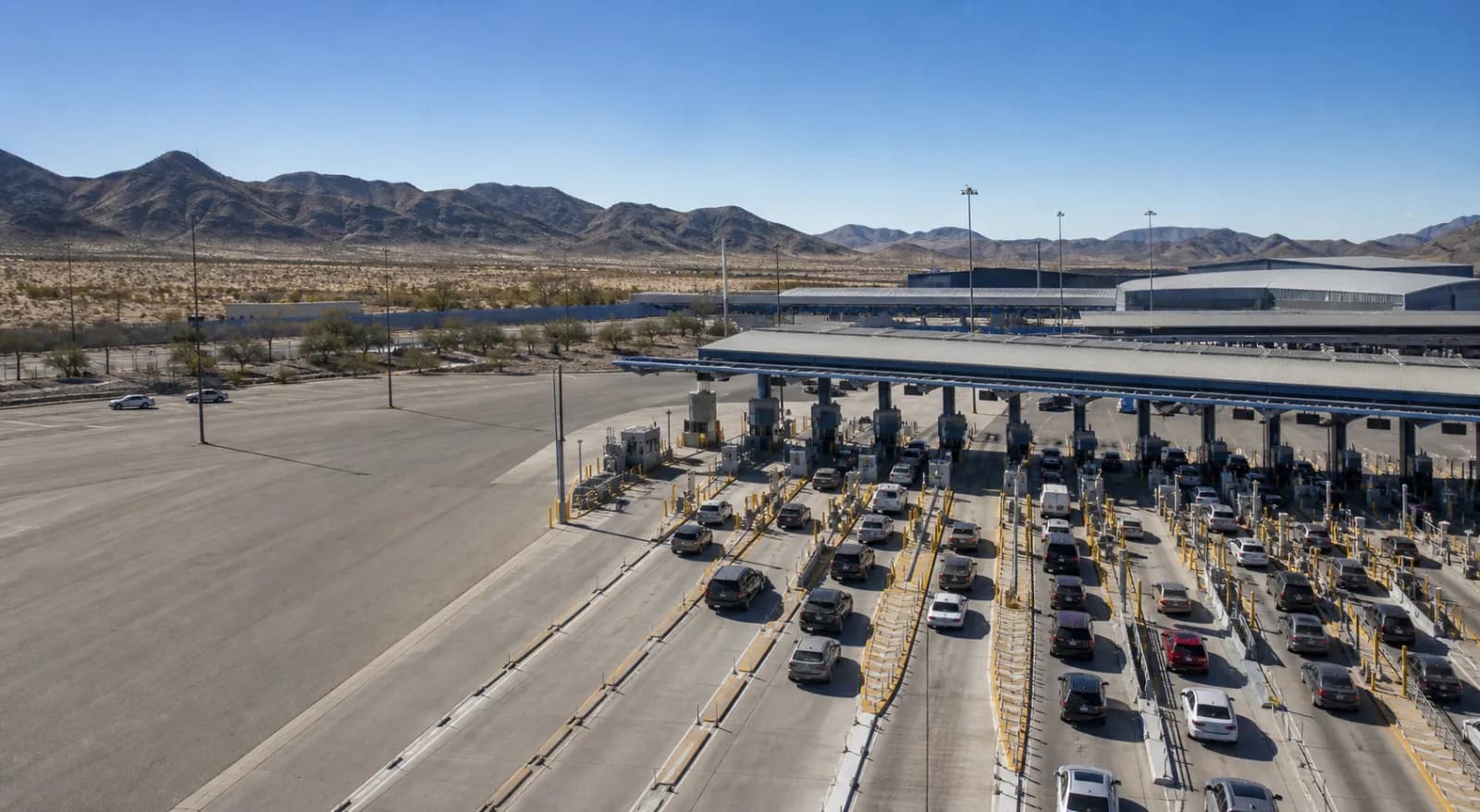
US Border Logistics Briefing - September 3, 2026
Prepared 6:00 AM PDT
US border-crossing conditions are quiet in the latest CBP/CBSA pull, but that quiet should be read as a data condition rather than a demand signal: there are no active wait-time readings in the last two hours, and the source refresh is recent at 14 minutes old. That makes the current operating picture unusually thin on lane-level congestion evidence, so readers should treat the absence of active waits as a visibility limitation, not as proof of friction-free crossings.
The most concrete operational pressure in today’s feeds is outside the land ports themselves. A Heat Advisory remains in effect for the Brownsville, Texas area through 6:00 PM CDT today, which matters because even when border lanes are not reporting measurable queues, heat can still affect yard rhythm, driver scheduling, and local movement planning around the corridor. At the same time, FAA data shows a continuing closure at San Diego International for non-scheduled transient GA aircraft, with operations restricted except by prior permission, which is relevant for airside logistics and time-sensitive repositioning but does not indicate a broader commercial airline disruption.
On the policy side, the day’s trade notices are numerous but should be treated as raw-current policy-document context only. The mix is weighted toward antidumping and countervailing duty actions, including steel and metal products, which can matter for import documentation, landed-cost expectations, and timing around customs classification review. The important distinction is that these notices are not normalized policy source facts or legal advice in this briefing; they are current docket items that warrant follow-up by compliance teams, but any operational impact has to be validated against the underlying filings and the specific product lines in your network.
From a macro standpoint, the latest indicators continue to signal a higher-cost freight environment. Diesel remains elevated across regions, with U.S. diesel retail at 5.60 as of 2026-08-31, East Coast Gulf diesel at 5.48 as of 2026-08-24, Midwest diesel at 5.57 as of 2026-08-31, and West Coast diesel at 6.50 as of 2026-08-31. Currency and commodity readings are also consistent with a firm cost backdrop: USD/CAD is 1.3895 and USD/MXN is 17.0430, both as of 2026-08-28, while Brent crude is 96.02 and WTI is 91.48, both as of 2026-09-01. Those are not border-delay readings, but they shape carrier pricing, cross-border fueling economics, and the incentive structure for shippers balancing routed volume between truck, air, and inventory buffers.
Crossing Delays and Lane-Level Conditions
There are no active wait-time data points reported in the last two hours, which means there are no current lane-by-lane delay figures to quote from the live border feed. In operational terms, this creates a monitoring gap: dispatchers cannot use today’s pull to validate whether northbound or southbound crossings are normal, improving, or deteriorating. Because the feed is recent, the absence of data is more likely a reporting limitation than a long-duration network shutdown, but the cause is not identified in current feeds.
When wait-time data is absent, the most useful reading is corridor-level discipline rather than lane selection. Teams moving freight through high-volume border gateways should avoid assuming fluidity and instead confirm appointments, staging, and driver ETAs against the latest port-specific feeds before releasing loads.
Significant 24-Hour Changes
The principal day-over-day change in today’s package is the sharp reduction in border visibility: the system moved from having a live border pull to having no active wait-time data within the last two hours. No causal explanation is supplied. That means the meaningful change is informational rather than operational—there is less evidence available to measure friction, not necessarily less friction itself.
A secondary change is the addition of today’s trade notices, which expand the compliance watch set around metals and industrial product categories. Since these are published as raw-current policy items, the key operational implication is to screen them for product matches, export origin exposure, and any filing calendar impacts rather than treating them as settled commercial outcomes.
Trade-Policy Documents and Claim Caveats
Today’s trade-policy packet includes multiple notices from the International Trade Administration and one from the International Trade Commission. The Commerce notices cover stainless steel flanges from India, certain oil country tubular goods from Austria, certain non-refillable steel cylinders from India, heavy walled rectangular pipes and tubes from Mexico, finished carbon steel flanges from Spain, chlorinated isocyanurates from Spain, non-oriented electrical steel from Japan, and certain steel nails from Korea, Malaysia, Oman, Taiwan, and Vietnam. The ITC item concerns certain mobile electronic devices and a commission determination to review part of a final initial determination, with written submissions requested on issues under review, remedy, public interest, and bonding.
These items all carry the same caution: the feed explicitly marks them as raw-current policy-document context only and says they must not be treated as normalized policy source facts or legal advice. For logistics teams, that means the notices are best used as compliance triage inputs. They may be relevant to shipments, supplier contracts, and customs records, but any claim about tariff effect, duty rate change, or immediate operational consequence would require validation from the underlying Federal Register text and counsel review.
Aviation and Airport Conditions
FAA data shows one active airport condition of note: San Diego International Airport is closed to non-scheduled transient general aviation aircraft except with prior permission, using the instruction listed in the notice. The closure window runs from 2603181300 to 2610010800, indicating a standing restriction that remains in force through early October. The operational consequence is limited to that aircraft category; the notice does not say that scheduled commercial service is affected, and no broader airport disruption is reported in the feed.
For logistics planners, this means San Diego is not a candidate for ad hoc transient GA recovery or short-notice repositioning without checking permissions first. If your operation uses business aviation for expedited parts movement, crew transport, or executive travel tied to supply-chain oversight, this restriction should stay on the short list.
Weather Alerts and Notable Crossing Conditions
The only active weather alert in the package is the Heat Advisory for Brownsville, Texas, issued September 2 at 10:34 PM CDT and valid until September 3 at 6:00 PM CDT. Brownsville is a border-relevant location, so this alert matters even without live wait times. Heat advisories can affect driver comfort, loading windows, and local stop-and-go movement around a port area. The data does not tie the advisory to specific lane delays, and no crossing condition is directly attributed to the weather in the feed.
Because no live wait times are currently posted, the most prudent operational stance is to watch for any lag in yard turnover or local delivery timing in the Brownsville corridor, while treating the weather alert as a planning constraint rather than proof of current congestion.
Community Intelligence Context
No community intelligence or retired/raw diagnostic reports were supplied in today’s context, so there is nothing to carry forward here. In the absence of those inputs, the briefing relies only on the current feed items above.
Macro and Economic Indicators
The latest macro set points to a still-pressured cost environment rather than a relief phase. Fuel remains elevated across all reported regional diesel series, with the West Coast highest at 6.50 as of 2026-08-31. Oil prices remain firm at 96.02 for Brent and 91.48 for WTI as of 2026-09-01. Currency levels as of 2026-08-28 show USD strength against both the Canadian dollar and Mexican peso, at 1.3895 and 17.0430 respectively, while the trade-weighted dollar stands at 118.75.
Other indicators are older but still useful as background markers: BOPGSTB is -57,347.00 as of 2026-02-01; IR is 149.60, PCU484121484121 is 195.57, PCUOMFGOMFG is 274.28, PPIACO is 284.06, and TOTALSA is 16.76, all as of 2026-07-01. These figures do not directly describe border throughput, but they reinforce a broad picture of elevated transportation and manufacturing cost pressure.
Outlook and Operational Watch List
The near-term outlook is steady but information-light. With no active border wait times in the last two hours, today’s main risks are not visible queue spikes but rather incomplete signal coverage, weather-related local friction in South Texas, and document-driven compliance checks in metals and industrial categories. The source freshness is good, so the absence of queue data is the key operational limitation, not stale timing.
Watch list for the next operating cycle:
- Confirm any Brownsville-area movement plans against the Heat Advisory window through 6:00 PM CDT.
- Re-check border feeds before dispatching loads through major crossings, since no current wait-time readings are available.
- Route compliance review for shipments tied to today’s steel, OCTG, and metal-product trade notices.
- Verify San Diego airport permissions before any transient GA movement tied to logistics support.
- Keep a close eye on diesel and currency levels, as they continue to shape cross-border transport economics.