

US Border Logistics Briefing - August 28, 2026
Prepared 6:00 AM PDT
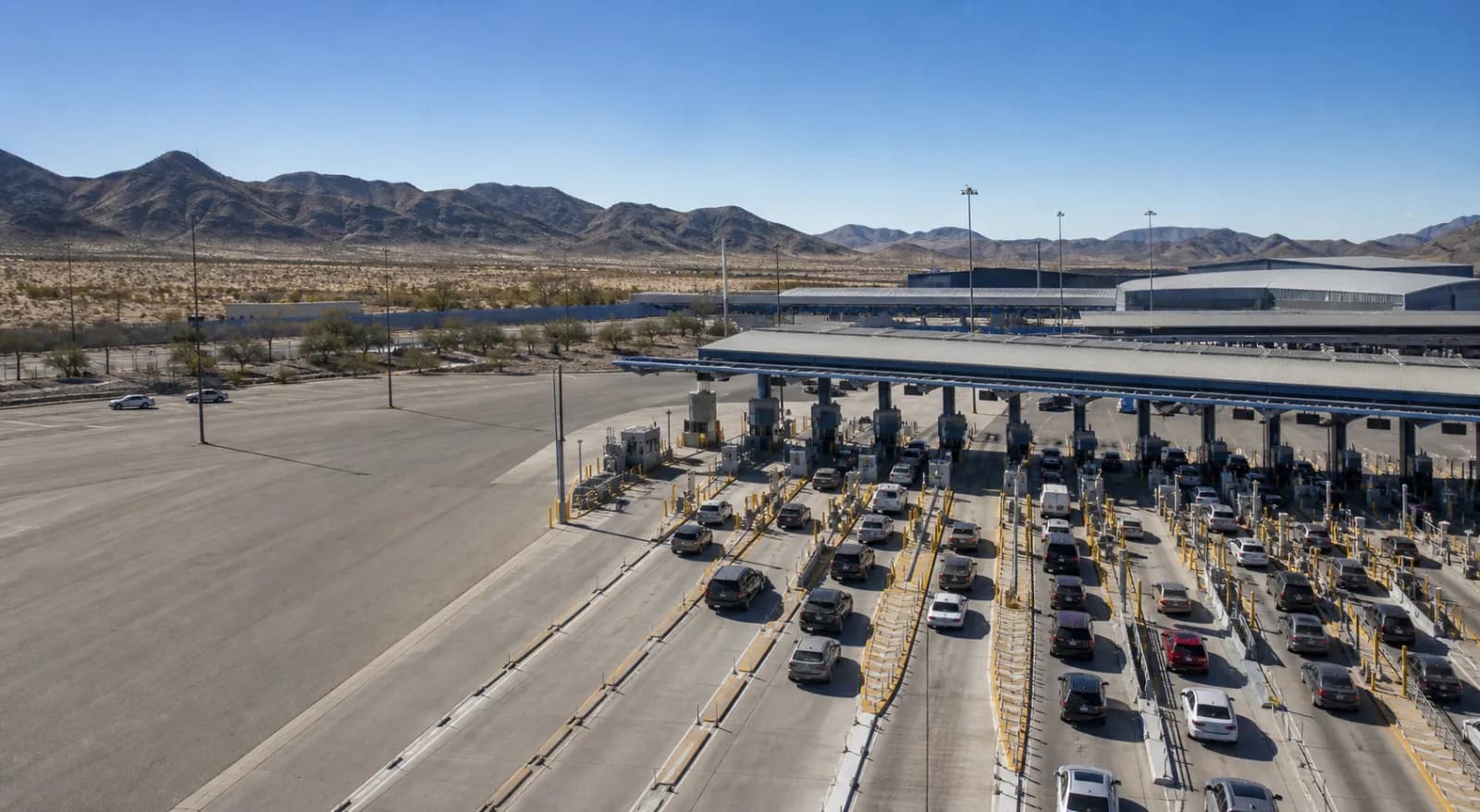
Border conditions are quiet in the available CBP/CBSA pull, but that quiet is information in itself: there are no active wait-time postings in the last two hours, so the dataset does not show a live queue build-up at this time. The source pull is fresh, timestamped 2026-08-28T12:55:38.208Z, just four minutes old, so the absence of wait data is a current limitation rather than a stale-data artifact.
The more immediate operational pressure is weather-related. Extreme heat warnings are active across the Southwest border corridor, including San Diego, Tucson, and Phoenix, with overlapping Heat Advisories in the San Diego area. These alerts do not, by themselves, prove crossing disruption, but they do matter for dispatch timing, driver comfort, equipment stress, and dwell management at exposed facilities. Readers should treat the heat footprint as the dominant near-term operating variable in the absence of queue data.
Trade-policy activity is also elevated today, with a cluster of Federal Register notices spanning antidumping, countervailing duty, court-remand, and review actions. Because these are raw policy-document context rows only, they should be treated as planning and compliance context rather than direct evidence of present border flow. Still, the breadth of notices touching hardwood plywood, hot-rolled steel flat products, steel wire rod, steel nails, PTMEG, pipe fittings, and OCTG suggests a busy compliance calendar for importers and customs teams. The operational implication is not a specific lane effect that can be claimed from this feed, but rather a need to keep documentation, classification, and tariff-scope checks aligned with fast-moving trade remedies.
On the transportation side, there is no current aviation or airport disruption data in the supplied context, and no active border wait observations to anchor a lane-level congestion assessment. That means there is no basis in today’s feed to claim pressure at any one port of entry, commercial lane, or airport cargo node. The most defensible read is that exposure remains weather-sensitive and policy-active, while the live queue picture is currently blank.
Border Crossing Delays and Lane-Level Conditions
No active wait-time data were posted in the last two hours, so there are no current lane-level delay figures to report. That includes no distinguishable passenger, SENTRI, Ready Lane, commercial, or standard-lane measurements in the present feed. Operationally, this means dispatchers and brokers cannot use the border dataset today to identify a specific corridor bottleneck or to justify a port-by-port re-routing decision based on measured wait times.
Because there are no live delay observations, any claim about congestion intensity, staffing, inspection posture, or customs processing behavior would be speculative. The correct read is simply that the system has no current queue signals to evaluate.
Significant 24-Hour Changes
The major 24-hour change is not in border timing data but in the weather and policy environment. The weather stack has sharpened in Southern California and Arizona, with extreme heat warnings and advisories issued on August 28 and still active through the evening. San Diego shows both an Extreme Heat Warning and a Heat Advisory issued at 5:03 AM PDT, both expiring at 8:00 PM PDT on August 28. Tucson is under an Extreme Heat Warning issued at 4:43 AM MST through 8:00 PM MST on August 29, and Phoenix is under an Extreme Heat Warning issued at 12:22 AM MST through 8:00 PM MST on August 29.
On the policy side, today’s notices add to the compliance workload without, in this feed, indicating immediate border-line disruption. The notices were all dated August 28 or August 27, meaning today’s regulatory load is fresh. The operational change to watch is not a measured delay but a denser rule-and-review environment for steel and industrial imports.
Trade-Policy Documents and Explicit Claim Caveats
These rows are raw-current policy-document context only; they are not normalized policy-source facts and should not be treated as legal advice or as proof of present cargo impacts.
Among today’s notices, Commerce announced final determinations of no shipments for certain hardwood plywood products from China in antidumping and countervailing duty administrative reviews covering 2024 and 2020–2021. Commerce also issued a notice of a court decision not in harmony with the results of an antidumping administrative review for certain hot-rolled steel flat products from Japan, together with amended final results. Another Commerce notice states that it is reopening and intending to reconsider the final results of the 2023–2024 antidumping review for carbon and alloy steel wire rod from South Korea.
The ITC also published a scheduling notice for expedited five-year reviews involving certain steel nails from Malaysia, Oman, South Korea, Taiwan, and Vietnam. Commerce separately postponed preliminary determinations in less-than-fair-value investigations for polytetramethylene ether glycol from China, South Korea, Taiwan, and Vietnam, and for oil country tubular goods from Austria, Taiwan, and the United Arab Emirates. Finally, Commerce issued a notice tied to a court decision affecting certain carbon steel butt-weld pipe fittings from China, with an amended covered-merchandise determination.
Taken together, these notices indicate active trade-remedy churn across steel, pipe, and chemical categories. What they do not provide is a claim-bearing basis to say border throughput is currently disrupted. The safe operational conclusion is that import compliance teams should expect continued documentation sensitivity, especially where scope, antidumping/countervailing duty treatment, or review status may affect landed cost or entry strategy.
Aviation and Airport Conditions
No aviation or airport condition data were supplied in the current feed. There are no airport delay, diversion, cargo flow, or ground-stop observations to report. Accordingly, there is no evidence here of air-cargo spillover into border operations or of airport-related freight congestion affecting cross-border logistics today.
Weather Alerts and Notable Crossing Conditions
Weather is the clearest current operational hazard in the dataset. The Southwest border is under persistent heat stress:
- San Diego, CA: Extreme Heat Warning issued August 28 at 5:03 AM PDT until August 28 at 8:00 PM PDT; Heat Advisory issued at the same time and valid to the same expiration. A separate San Diego Extreme Heat Warning and Heat Advisory were also issued August 27 at 9:05 PM PDT, both expiring August 28 at 8:00 PM PDT.
- Tucson, AZ: Extreme Heat Warning issued August 28 at 4:43 AM MST until August 29 at 8:00 PM MST.
- Phoenix, AZ: Extreme Heat Warning issued August 28 at 12:22 AM MST until August 29 at 8:00 PM MST.
The border feed does not attach these alerts to a specific crossing or lane, so there is no evidence of a port-specific condition beyond geographic exposure. Still, for freight movements through the Southern California and Arizona corridors, the practical implications are clear: thermal load on drivers and equipment will be elevated, and any unreported dwell will be more operationally costly under these temperatures. The current dataset does not identify a crossing where heat is already causing delay; it only shows the environmental conditions that could magnify any future delay.
Community Intelligence
No community intelligence rows were supplied. There is no retired, raw diagnostic, or anecdotal context to incorporate.
Macro and Economic Indicators
The latest macro indicators reinforce a backdrop of elevated transport and input cost sensitivity, but the observation dates vary and should be noted explicitly. Brent crude is 88.24 and WTI is 83.90, both as of 2026-08-25. USD/CAD stands at 1.3765, USD/MXN at 16.8909, and the Trade Weighted Dollar is 118.06, all as of 2026-08-21. Diesel pricing remains high across the supplied series: GASDESGCW is 5.48, GASDESMWW is 5.64, US Diesel Retail is 5.65, and GASDESWCW is 6.41, all as of 2026-08-24.
Other indicators are older but still relevant context. BOPGSTB is -57,347.00 as of 2026-02-01. Industrial production-related and price series show IR at 149.60, PCU484121484121 at 195.57, PCUOMFGOMFG at 274.28, PPIACO at 284.06, and TOTALSA at 16.76, all as of 2026-07-01. For logistics planners, the main takeaway is that fuel and foreign-exchange conditions remain active cost variables, while the more dated production and price series should be treated as background context rather than real-time signals.
Outlook and Operational Watch List
The near-term outlook is straightforward: the border picture is data-light on live wait times, but weather is materially active and trade-policy churn remains elevated. With no current queue data, there is no supported basis to call congestion at any specific crossing. With no aviation data, there is also no supported basis to call spillover from airports. The strongest operational watch item is the Southwest heat footprint, which could become more consequential if live queue data reappears later today.
Watch list:
- Monitor for any return of active wait-time postings, especially if they appear in the Southern California or Arizona corridors.
- Track the Extreme Heat Warnings in San Diego, Tucson, and Phoenix through their expiration windows.
- Keep compliance teams aligned on today’s Commerce and ITC notices affecting steel, pipe, plywood, and related industrial categories.
- Recheck fuel and FX levels before dispatch decisions, given current diesel, Brent/WTI, USD/CAD, and USD/MXN readings.