

US Border Logistics Briefing - August 22, 2026
Prepared 6:00 AM PDT
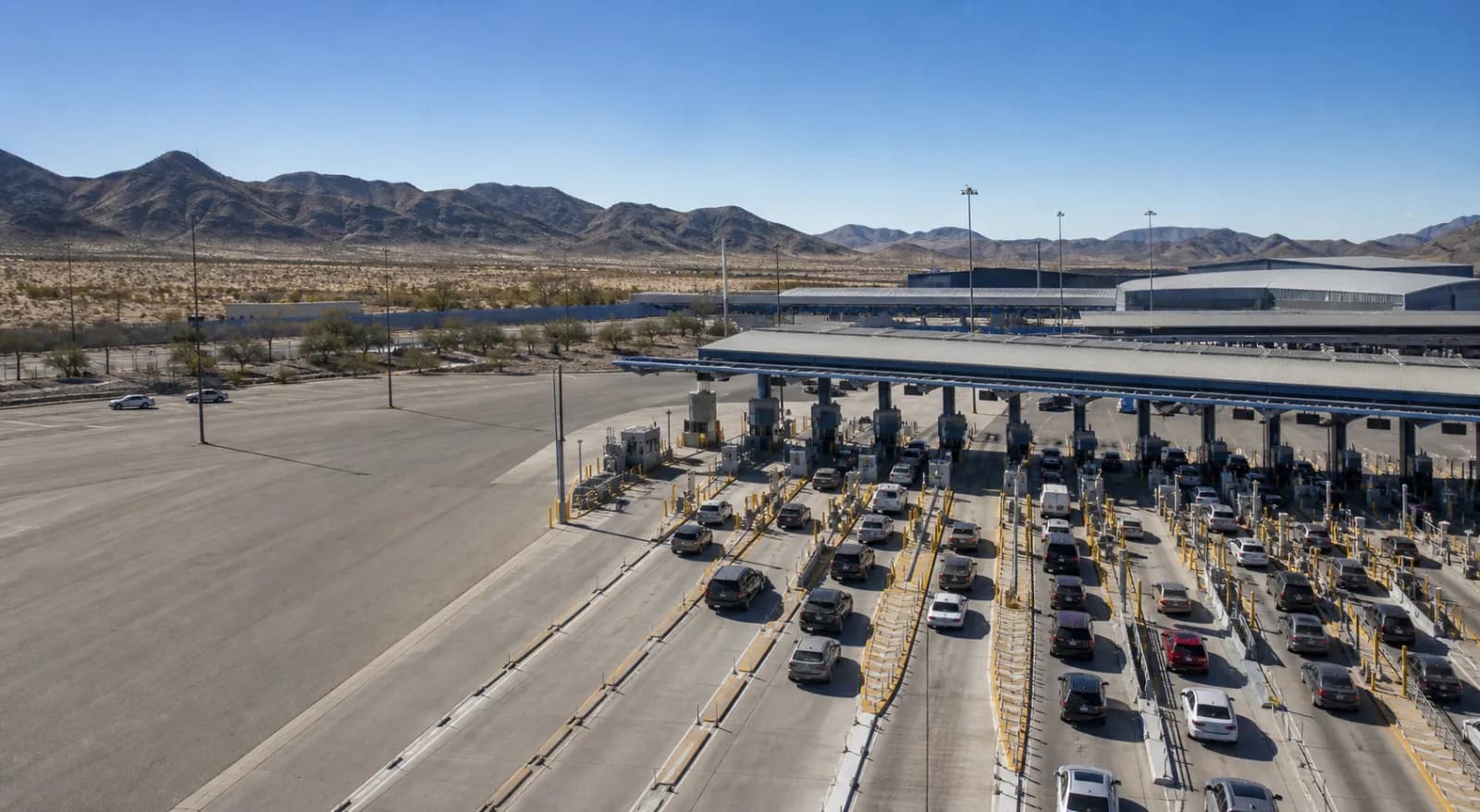
Border-monitoring conditions this morning are defined more by absence of active crossing queues than by congestion: the latest CBP/CBSA pull is fresh, but there are no active wait-time observations in the last two hours. That means the immediate lane picture is thin, and dispatch decisions should lean more heavily on weather, airport disruption, and policy context than on current port-of-entry delay readings.
The operational pressure point in the data is weather, not border processing. Extreme heat remains the most consequential cross-border operating factor, with warning coverage in southern Arizona and an extended heat advisory footprint in southern California. Those alerts do not themselves prove border slowdowns, but they do matter for driver fatigue, equipment stress, and schedule fragility on desert and Southwest corridors. In parallel, Seattle’s airport is reporting a ground delay tied to low ceilings, which is a separate but relevant air-cargo constraint for time-sensitive freight.
Trade-policy activity also remains active, but the sources are explicitly caveated as raw current policy-document context only. Several notices touch sectors that matter to logistics planners, including silicon metal, oleoresin paprika, Wi‑Fi equipment, batteries, and a CBP proposal affecting an international airport designation. These are not current operational facts about border lanes, but they are timely indicators of possible tariff, customs, or classification attention in the weeks ahead.
With no live crossing queues to anchor the lane picture, the right read is a cautious one: today’s border flow story is mostly about environmental stress and policy signals rather than measurable border-delay escalation. The most relevant watch items are whether heat advisories translate into freight schedule slippage in the Southwest, whether the Seattle ground delay persists into connecting cargo bank periods, and whether the trade notices begin to affect importer planning or customs documentation timing.
Crossing Delays and Lane-Level Conditions
There are no active wait-time data points in the last two hours, so no lane-level congestion figures are available for this briefing period. That absence matters operationally: it means there is no current evidence in the feed of sustained queue pressure at specific crossings, but it also limits confidence in any assumption that conditions are broadly normal. For dispatch, the appropriate stance is neutral-to-cautious rather than celebratory, because the data window is simply too thin to support a stronger conclusion.
The source freshness is strong — the latest CBP/CBSA border pull is timestamped 2026-08-22T12:55:39.372Z and is four minutes old — but freshness does not substitute for volume. In practical terms, this is a high-confidence “no active observations” snapshot, not a blanket clearance signal for all lanes.
Significant 24-Hour Changes
The most important change over the past day is the weather posture, particularly the escalation and persistence of heat alerts in the Southwest. NWS Tucson issued an Extreme Heat Warning at 1:51 AM MST on August 22, effective until 8:00 PM MST the same day. NWS Phoenix issued a separate Extreme Heat Warning at 12:45 AM MST on August 22, with a longer run extending through August 28 at 8:00 PM MST. Those are materially different durations, and the Phoenix-area warning is the longer operational concern because it points to a multi-day heat burden rather than a single-day spike.
In Southern California, NWS San Diego shows a Heat Advisory issued at 2:56 AM PDT on August 22 that runs until August 24 at 8:00 PM PDT, alongside an older advisory issued August 21 at 9:35 PM PDT with the same end time. The duplication suggests continuing heat coverage rather than a new escalation, but the practical effect is the same: persistent hot-weather exposure for trucking and yard operations.
Elsewhere, NWS Detroit/Pontiac issued a Special Weather Statement at 8:47 AM EDT on August 22, and NWS Brownsville issued a Special Weather Statement at 4:20 AM CDT on August 22. The data does not identify the specific hazards in those statements, so they should be treated as cautionary context rather than as evidence of border disruption. Cause not identified in current feeds.
Trade-Policy Documents and Explicit Caveats
The trade-policy feed is active, but the context repeatedly warns that these are raw current policy-document rows and should not be treated as normalized policy facts or legal advice. That caveat is important: these entries are useful for awareness, but not for drawing current operational conclusions about lane behavior or enforcement posture.
Among the most material items, Commerce issued countervailing duty orders on silicon metal from Australia and Norway on August 21, and antidumping duty orders on the same product the same day. That combination makes silicon metal a notable tariff-compliance item for importers and downstream manufacturers. Also on August 21, Commerce made a preliminary affirmative determination on fresh winter strawberries from Mexico, postponing the final determination and extending provisional measures. For supply chains touching produce, that implies the issue remains live, but the feed does not provide a current impact estimate.
Commerce also made a final affirmative determination on oleoresin paprika from India and a final affirmative countervailing duty determination, including a final affirmative critical circumstances determination in part, on the same product. Separately, the International Trade Commission announced a notice of extension of the deadline for public-interest submissions in a Wi‑Fi equipment matter, and it also published a notice of institution in a case involving certain secondary cylindrical batteries, components, and products containing the same. These are important sectoral signals, but the supplied text does not support broader claims about immediate border throughput effects.
One CBP notice deserves operational attention: a proposed withdrawal of the international airport designation of Chalk Seaplane Base, now operating as Miami Seaplane Base. The summary says the proposal is based on evidence presented by CBP, but the feed does not supply the full evidentiary record or outcome. Treat it as a planning watch item only, not as a current operational change.
Aviation and Airport Conditions
Aviation conditions are currently constrained at Seattle-Tacoma International Airport. FAA data shows a ground delay with an average delay of 39 minutes, attributed to low ceilings. That is a concrete, current operational constraint and is especially relevant to cargo and passenger movements tied into domestic distribution networks, Asian freight connections, or time-sensitive inbound schedules.
No other airport delays are listed in the supplied data. Even so, SEA’s ground delay should be watched for ripple effects into connecting freight and same-day recovery plans. The feed does not say whether the delay is worsening or easing, so the safe interpretation is simply that arrival and departure planning at SEA should allow for roughly 40 minutes of added delay on average until conditions improve.
Weather Alerts and Notable Crossing Conditions
The most consequential weather issue is extreme heat across the desert Southwest. Tucson and Phoenix are under Extreme Heat Warnings, with Phoenix’s warning lasting the longest into next week. San Diego remains under Heat Advisory coverage through August 24. These conditions matter for border operations because they can affect driver comfort, trailer integrity, yard dwell time, and schedule reliability, even though the feed does not tie them directly to specific crossings.
The Detroit/Pontiac and Brownsville special weather statements are worth noting as situational alerts, but the data does not spell out the hazard type. Because the claim content is incomplete, these should be treated as monitoring cues only. No current wait times are available to connect weather to lane delays, so any operational linkage remains unproven in the present feed.
Community Intelligence, Retired Context Only
There is no community-intelligence content in the supplied dataset that can be used as live evidence. If any retired, raw, or diagnostic chatter exists behind the scenes, it should be treated only as historical context and not as claim-bearing support. In this briefing, no community item is being used to assert a current crossing condition, cause, or duration.
Macro and Economic Indicators
The macro backdrop remains mixed and relatively expensive for fuel-sensitive freight. Brent crude is listed at 95.29 as of 2026-08-18, while WTI crude is 86.48 as of the same date. That keeps the fuel environment elevated enough to matter for linehaul budgeting, especially on long-haul routes feeding the border and intermodal network.
Currency levels also remain relevant for cross-border trade planning. USD/CAD is 1.3933 as of 2026-08-07, and USD/MXN is 17.0120 as of 2026-08-14. The trade-weighted dollar is 118.90 as of 2026-08-14. Those readings suggest a still-firm dollar environment, but the feed does not permit causal claims about import volumes or customs behavior.
Fuel and freight cost indices remain elevated. US diesel retail is 5.45 as of 2026-08-17, with regional diesel series at 5.24 for GASDESGCW, 5.43 for GASDESMWW, and 6.20 for GASDESWCW, all as of 2026-08-17. Industrial and producer-price indicators are dated 2026-07-01: IR at 149.60, PCU484121484121 at 195.57, PCUOMFGOMFG at 274.28, PPIACO at 284.06, and TOTALSA at 16.78. The balance of the economic feed is dated or stale enough that it should be used as background, not as a current directional signal.
The BOPGSTB reading is -57347.00 as of 2026-02-01. Because it is substantially older than the rest of the economic series, it should be treated as a lagging macro reference only.
Outlook and Operational Watch List
The near-term outlook is stable at the border lane level only because no active wait-time observations are present, not because all conditions are benign. The practical risks visible in the feed are heat exposure in the Southwest, low-ceiling disruption at SEA, and the accumulation of trade-policy notices that may matter for shippers in affected product classes.
What to watch next:
- Any renewed CBP/CBSA wait-time posts, especially if they appear on Southwest crossings during the heat warnings.
- Whether the Phoenix and Tucson heat warnings translate into freight schedule compression or equipment dwell issues.
- Whether SEA’s 39-minute ground delay persists beyond the current low-ceiling period.
- Follow-on detail from the silicon metal, strawberries, oleoresin paprika, Wi‑Fi device, and battery-related trade notices, with attention to effective dates and filing deadlines.
- Any updated CBP action on the proposed withdrawal of the Miami Seaplane Base international designation.