

US Border Logistics Briefing - August 16, 2026
Prepared 6:00 AM PDT
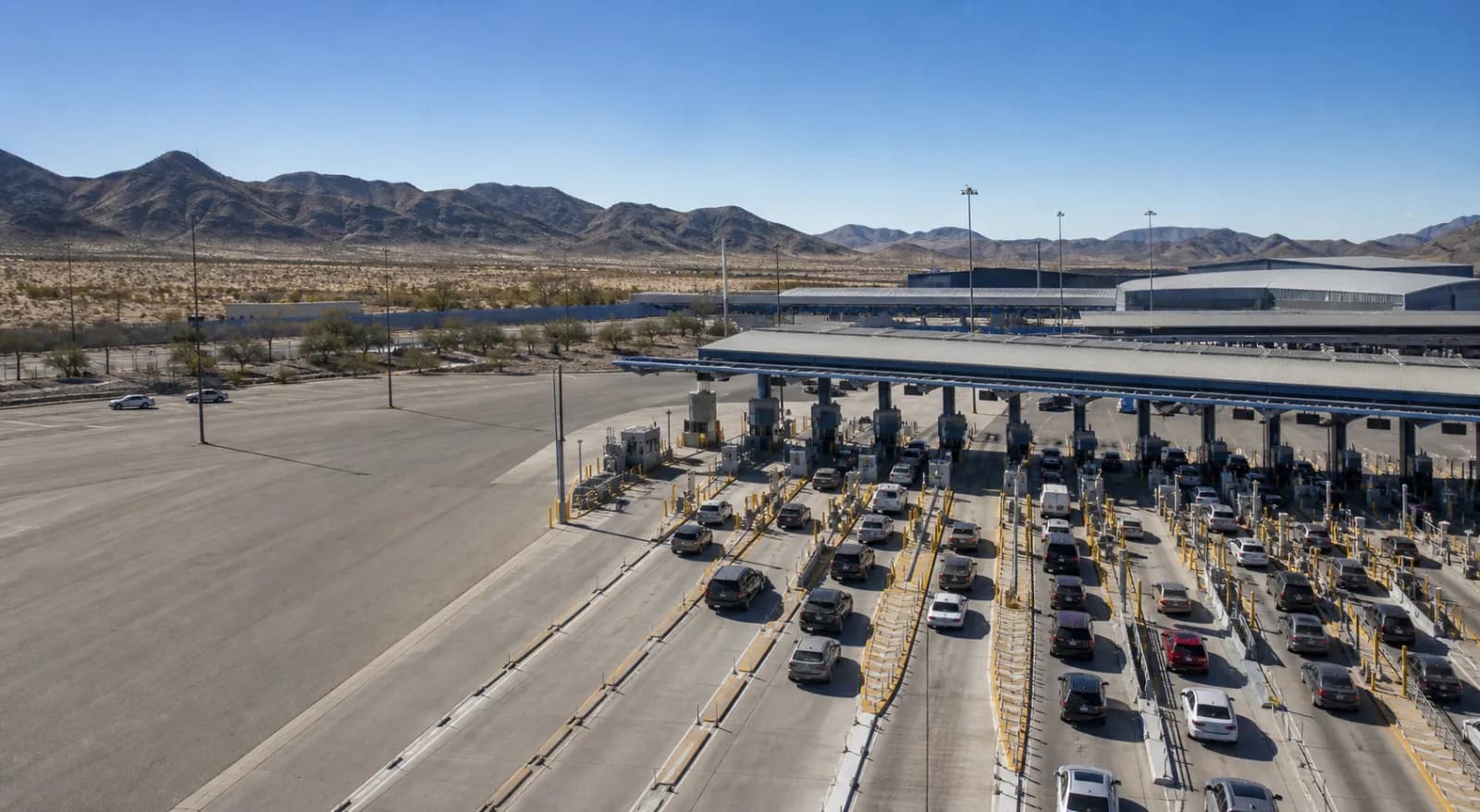
Border-monitoring conditions are quiet in the current CBP/CBSA feed, but the absence of active wait-time data is itself the main operational fact for this cycle: there are no active crossing delays posted in the last two hours, and no lane-level border metrics are available to anchor a live congestion read. With source freshness at three minutes old, this briefing is current on what the feed does and does not show, but it cannot support a claim of easy flow beyond the limited scope of the reported data.
The near-term operational picture is instead being shaped by non-border constraints that can still affect dispatch timing and asset handling. The dominant risk in the dataset is weather, with extreme heat warnings in the Southwest and a special weather statement near the lower Texas border. In parallel, the only airport operational issue surfaced by FAA data is a San Diego closure affecting non-scheduled transient general aviation traffic. None of these items directly states a border delay, but each can alter routing, staging, and schedule reliability around the affected corridors.
Trade-policy activity remains active, but the documents provided here are raw notice summaries only and should be treated as current awareness, not as normalized policy conclusions or legal advice. The macro backdrop is also mixed: diesel remains elevated, the dollar is firm against the Canadian dollar and Mexican peso, and recent commodity and producer-price readings remain high enough to keep transport-cost sensitivity on the radar. Taken together, the data points to a watchful but not congested border day, with weather and cost inputs more salient than queue pressure.
What follows is a grounded read on each material signal, with explicit caveats where the feed is limited.
Border crossings: no active wait-time postings in the last two hours
The current CBP/CBSA pull contains no active wait time data in the last two hours. That means there are no lane-by-lane crossing figures available in this snapshot for current corridor comparison, no posted wait-minute values to benchmark, and no evidence in this feed of a live border queue event at the time of collection.
Operationally, this should be read as a visibility gap rather than a performance signal. Because the feed is silent on active waits, dispatch planning should avoid assuming that the absence of posted delays equals absence of disruption; it only means the current dataset does not show one. If movement-sensitive loads are scheduled through major ports of entry today, the practical implication is to monitor for the next border pull rather than infer normality from the lack of entries.
Significant 24-hour changes: no crossing-change data surfaced
There are no active wait observations in the last 24 hours either, so there is no day-over-day crossing change to quantify from this dataset. No specific lane improvement, deterioration, or port-level shift can be measured here, and no cause can be identified in current feeds.
That absence matters because it limits any trending analysis for operations teams. Where crossing metrics are missing, the best use of the day is to treat route timing assumptions as provisional and keep contingency windows flexible, especially for loads that would be vulnerable to downstream appointment misses.
Trade-policy documents: active notices, but raw context only
The recent trade-policy stream is populated by notices and review actions from the U.S. International Trade Commission and the International Trade Administration, but the supplied record explicitly cautions that these are raw-current policy-document context only. They are not normalized policy facts and should not be treated as legal advice or as a direct operating instruction for this morning’s freight moves.
Within that caveated context, the notable items include a notice of receipt of complaint from the International Trade Commission concerning certain dynamic random access memory devices, products containing the same, and components, dated 8/17/2026. Commerce also published final results of an antidumping duty administrative review on aluminum extrusions from China, likewise dated 8/17/2026. From 8/14/2026, the feed includes an ITC notice of institution involving certain mobile electronic devices, a public-interest request related to certain polyvinylidene fluoride resins, and Commerce final results on passenger vehicle and light truck tires from China, plus preliminary results for large diameter welded pipe from Greece and final results for large power transformers from Korea. From 8/13/2026, there are preliminary results for carbon and alloy steel wire rod from Korea and a quarterly update to the annual listing of foreign government subsidies on certain cheese articles.
For logistics users, the operational takeaway is limited but real: the policy calendar remains active in sectors tied to electronics, metals, tires, pipe, transformers, steel wire rod, and cheese. The feed, however, does not provide a live freight restriction, border enforcement action, or shipment-specific directive. Any supply-chain implication should therefore be treated as sector awareness only, not as a current crossing condition.
Aviation and airport conditions: SAN closure for non-scheduled transient GA
FAA data shows one airport condition of note: San Diego International (SAN) is closed to non-scheduled transient general aviation aircraft, except with prior permission request (PPR) via 619-298-7704, under notice `!SAN 03/071 SAN AD AP CLSD TO NON SKED TRANSIENT GA ACFT EXC PPR 619-298-7704 2603181300-2610010800`. The notice is active through 2026-10-01 08:00.
This is an aviation-specific restriction rather than a commercial air-cargo delay, and the data provided does not indicate a broader SAN commercial airline disruption. Even so, it is relevant to border-adjacent logistics because San Diego is an important node for cross-border and regional movement, and any limitation on transient GA can affect ad hoc business travel, charter movements, and time-sensitive support traffic around the corridor.
Weather alerts and notable crossing conditions
Weather is the clearest live operational constraint in this dataset. The most significant alerts are two Severe Extreme Heat Warnings: one issued by NWS Tucson AZ at 12:41 AM MST on August 16 and valid until August 21 at 8:00 PM MST, and another issued by NWS Phoenix AZ at 10:48 PM MST on August 15 with the same expiration. A Moderate Special Weather Statement from NWS Brownsville TX was issued at 10:06 PM CDT on August 15.
Because the feed does not tie these alerts to specific queue conditions, any border implication should be stated carefully. What can be said is that these weather products cover corridor areas that matter to logistics: the Arizona warnings affect the Southwest border environment, while Brownsville’s statement is relevant to the lower Texas border. The operational concern is heat exposure and possible schedule friction, not a documented wait-time spike, since no wait data is active in this pull. Cause of any future slowdown would need to be identified in a later feed; it is not identified here.
Community intelligence: retired/raw diagnostic context only
No community-intelligence claims are presented as live evidence in this packet. The report therefore does not rely on retired, raw, or diagnostic commentary for current operational judgments. In practical terms, there is nothing in this category that should be used to override the primary data sources above.
Macro and economic indicators: elevated costs, firm dollar, older observation dates
The macro backdrop remains supportive of cost vigilance. Brent crude is listed at 93.26 as of 2026-08-11, while WTI is 81.96 as of 2026-08-03. Fuel pricing remains high by recent standards: GASDESGCW is 5.04, GASDESMWW is 5.18, US Diesel Retail is 5.26, and GASDESWCW is 6.03, all as of 2026-08-10. Those observations matter operationally because they affect linehaul, drayage, and reefer cost planning even when border queues are quiet.
Currency and broader price indicators are also relevant. The USD/CAD rate is 1.3933 and the USD/MXN rate is 17.1357, both as of 2026-08-07, while the Trade Weighted Dollar stands at 119.06 on the same date. On the inflation and industrial side, PPIACO is 284.06 and PCUOMFGOMFG is 274.28, both as of 2026-07-01, with PCU484121484121 at 195.57 for the same observation date. TOTALSA is 16.78 as of 2026-07-01, IR is 150.80 as of 2026-06-01, and BOPGSTB is -57347.00 as of 2026-02-01.
The main analytical point is not any single number, but the combination: energy remains expensive, the dollar remains firm, and producer-price readings are elevated enough to keep transport cost sensitivity high. Because several of these indicators are not same-day observations, they should be used as context rather than as a real-time trigger.
Outlook and operational watch list
The present day looks less like a border-congestion story and more like a visibility-and-weather story. With no active wait-time postings, the largest operational risks are not documented lane backups but the possibility that heat and corridor conditions in Arizona and south Texas complicate timing, driver comfort, and local handling. The aviation item is narrower, affecting transient GA at SAN rather than commercial cargo operations, but it is still worth noting for regional coordination. Trade-policy notices remain active in several manufactured-goods categories, though the supplied text is explicit that these are raw notices only.
What to watch next:
- the next CBP/CBSA border pull for any return of active wait-time postings and lane-level figures;
- whether the Southwest heat warnings translate into any documented corridor impacts in later feeds;
- whether Brownsville-area weather products intensify or remain advisory-level context;
- any new FAA notices affecting Southern California airport access;
- follow-on trade notices in electronics, metals, tires, pipe, and steel categories for sector awareness only.