

US Border Logistics Briefing - August 10, 2026
Prepared 6:00 AM PDT
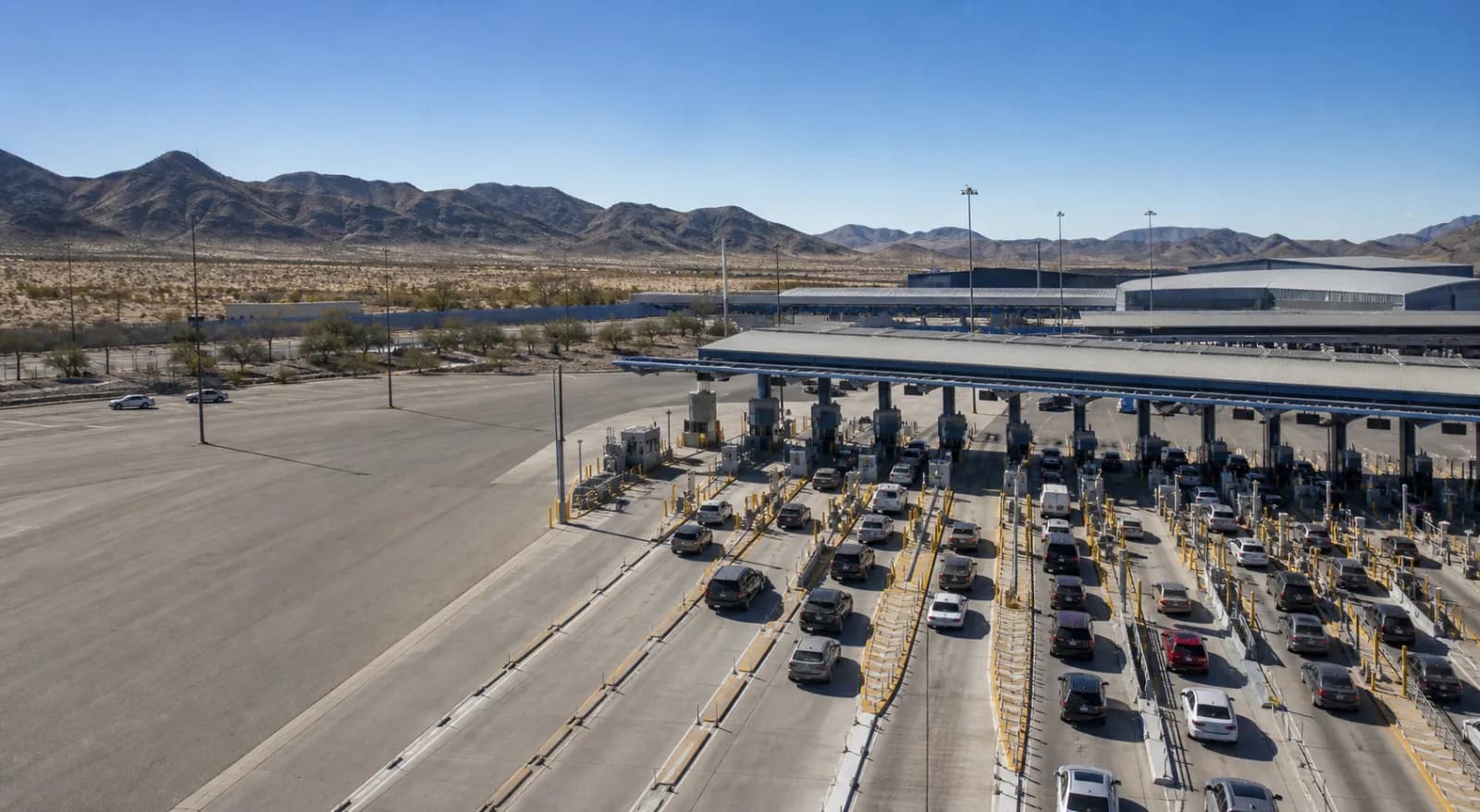
Border conditions are concentrated in the southwest today, with the heaviest passenger pressure showing at San Ysidro and the El Paso corridor, while the sharpest 24-hour deterioration is also centered there. San Ysidro is the longest current passenger delay in the feed at 115 minutes on the standard lane and 110 minutes on Ready lanes. El Paso’s Paso del Norte port has moved into a materially slower posture as well, with standard at 100 minutes and Ready at 90 minutes. The same feed shows Nogales Deconcini at 95 minutes standard, while Brownsville’s bridge is still notable at 60 minutes on both passenger standard and Ready. These are the lanes most likely to shape dispatch timing and traveler throughput during the morning window.
What changed most over the last day is uneven rather than broad-based. El Paso Paso del Norte jumped from 20 to 100 minutes standard and from 20 to 90 minutes Ready, Nogales Deconcini rose from 30 to 95 minutes standard, and El Paso Bota increased from 40 to 82 minutes Ready. By contrast, Eagle Pass 2 standard collapsed from 90 to 1 minute, San Luis 1 standard fell from 120 to 60 minutes, Otay Mesa passenger Ready eased from 100 to 45 minutes, and Donna standard improved from 45 to 5 minutes. The pattern suggests corridor-specific volatility rather than a nationwide shift; cause not identified in current feeds.
Operationally, that means today’s concern is not just the absolute wait time but the speed of change. The same border system is simultaneously showing relief at some crossings and sudden compression at others, which argues for lane-specific routing decisions rather than corridor averaging. For commercial planners, the most useful implication is that a crossing that looked manageable yesterday may not be so now, especially where the 24-hour changes exceeded 40 to 80 minutes. Because source freshness is only 12 minutes old, the crossing data is recent, but the underlying cause of the swings is not explained in the feed.
Weather and airport conditions reinforce the need for contingency planning, especially in Arizona and Southern California. There is an active Flood Watch in the Tucson forecast area from 2:24 AM MST through 10:00 PM MST today, and an Extreme Heat Warning in the Phoenix forecast area from 12:30 AM MST through 8:00 PM MST today. Separately, FAA delay information shows San Diego International (SAN) under a closure notice for non-scheduled transient GA aircraft, with the advisory stating the airport is closed to that class except by prior permission required, effective through 2026-10-01 08:00. That is a direct planning constraint for general aviation users and a reminder that airport-related disruptions can extend beyond commercial airline operations.
Crossing delays: where the pressure is concentrated
The longest waits in the current feed are all passenger lanes. San Ysidro is the most congested point, with 115 minutes on passenger standard and 110 minutes on passenger Ready. El Paso Paso del Norte follows at 100 minutes standard and 90 minutes Ready. Nogales Deconcini standard stands at 95 minutes, while El Paso Bota is at 84 minutes standard and 82 minutes Ready. The remaining high-delay passenger lanes include El Paso Ysleta Ready at 70 minutes and Brownsville/Brownsville Matamoros bridge lanes at 60 minutes on both passenger standard and Ready.
Those figures matter because they indicate that wait pressure is not confined to one lane type. Standard and Ready lanes are both affected at several crossings, which reduces the usual flexibility of shifting traffic to a faster processing option. For passenger movement, that raises the probability of queue spillover and schedule slippage. For freight-oriented operators monitoring passenger crossings as a proxy for local congestion, the signal is that the southwest border is under uneven but meaningful strain today.
Commercial delays are less broadly elevated in the current longest-wait list, but the change at Pembina shows that freight lanes can still move quickly. Pembina’s commercial standard wait increased from 4 to 45 minutes over 24 hours. That is a substantial day-over-day deterioration, even though the absolute number remains below the most pressured passenger crossings. The data does not identify a cause. In practical terms, this is the kind of change that can affect truck appointment reliability and northbound timing even when passenger queues dominate the headlines.
Twenty-four-hour changes: sharp improvements and deteriorations
The largest adverse moves are clustered in the El Paso and Nogales corridors, with a separate increase at Lacolle Route 221 and Pembina. El Paso Paso del Norte standard rose 80 minutes, from 20 to 100, while its Ready lane rose 70 minutes, from 20 to 90. Nogales Deconcini standard climbed 65 minutes, from 30 to 95. El Paso Bota Ready moved up 42 minutes, from 40 to 82. Lacolle Route 221 travellers increased from zero to 60 minutes. Pembina commercial standard increased 41 minutes, from 4 to 45.
The largest easements are also important for dispatch decisions. Eagle Pass 2 passenger standard fell 89 minutes, from 90 to 1. San Luis 1 passenger standard eased 60 minutes, from 120 to 60. Otay Mesa passenger Ready improved by 55 minutes, from 100 to 45. Donna passenger standard declined 40 minutes, from 45 to 5. Taken together, these changes show that border conditions are not uniformly worsening; instead, they are highly localized and can reverse quickly within a day.
Trade-policy documents: current notices, with caveats
This morning’s policy feed is active, but it is explicitly raw-current policy-document context only and should not be treated as normalized policy source facts or legal advice. Within that caveated frame, the most time-relevant notices are dated August 10 and center on new and continuing trade-remedy activity involving India, Türkiye, the UAE, China, and Taiwan. The International Trade Commission has issued a notice on Perfluoroalkoxy Alkane from India, instituting antidumping and countervailing duty investigations and scheduling preliminary phase investigations. The International Trade Administration also announced initiation of countervailing duty investigations for welded stainless line and pressure pipe from India and Türkiye, and less-than-fair-value investigations for the same product from India, Türkiye, and the United Arab Emirates.
The policy calendar also includes the initiation of antidumping and countervailing duty administrative reviews, which may matter for firms tracking order coverage and compliance timing. The ITC has scheduled the final phase of countervailing duty and antidumping duty investigations on truck bed covers from China. More recent finalized actions from August 7 include sunset review outcomes revoking antidumping duty orders on carbazole violet pigment 23 from India and China, final results on polyethylene retail carrier bags from Malaysia, postponement of a preliminary determination in tin mill products from Taiwan and Türkiye, preliminary results of an administrative review on circular welded carbon steel standard pipe and tube products from Türkiye, and final results of an administrative review on polyethylene retail carrier bags from China. Because these are policy notices rather than operational border facts, they should be used as context for trade compliance monitoring, not as evidence of today’s crossing conditions.
Aviation and airport conditions
FAA information is limited in this feed but operationally clear. San Diego International is under a closure advisory for non-scheduled transient GA aircraft, with prior permission required. The notice is valid through 2026-10-01 08:00. No other airport delay or closure items are present in the supplied data. For aviation users, the immediate implication is restricted GA access at SAN rather than a broad commercial airport disruption. For logistics teams that use small aircraft for time-critical movements or regional transfers, this constraint should be treated as active planning input.
Weather alerts and crossing context
Two severe weather alerts are relevant to southwest border operations. The Flood Watch in the NWS Tucson AZ area runs from 2:24 AM MST through 10:00 PM MST today, and the Extreme Heat Warning in the NWS Phoenix AZ area runs from 12:30 AM MST through 8:00 PM MST today. The border data does not state which crossings are directly affected by weather, so any linkage should be treated cautiously. Still, both alerts matter because the affected geography overlaps major Arizona freight and passenger corridors, and heat plus flood potential can complicate dwell time, traveler flow, and local access patterns even when no specific crossing closure is reported.
Community intelligence: retired diagnostic context only
No community intelligence or retired/raw diagnostic rows were supplied in a way that can be used as live evidence. None are incorporated here as claim-bearing information.
Macro and economic indicators: latest observed values and dates
The macro tape remains mixed, and the data freshness varies materially by series. The latest BOPGSTB reading is -57,347.00 as of 2026-02-01. Energy remains elevated: Brent crude is 88.90 and WTI is 81.96, both as of 2026-08-03. Fuel and trucking cost indicators are also firm, with GASDESGCW at 5.14, GASDESMWW at 5.26, US Diesel Retail at 5.35, and GASDESWCW at 6.13, all as of 2026-08-03. The USD/CAD rate is 1.4028, the USD/MXN rate is 17.3235, and the Trade Weighted Dollar is 119.70, all as of 2026-07-31. Industrial price series are dated 2026-06-01: IR at 150.80, PCU484121484121 at 204.62, PCUOMFGOMFG at 275.70, and PPIACO at 286.83. TOTALSA is 16.78 as of 2026-07-01. These indicators do not explain today’s lane changes, but they frame the cost environment for cross-border transport and downstream planning.
Outlook and operational watch list
The immediate outlook is one of localized volatility rather than a single-system disruption. The most pressing watchpoints are the El Paso and Nogales passenger lanes, San Ysidro’s sustained long waits, and the possibility that weather conditions in Arizona could add friction to already pressured corridors. Because the largest changes occurred over just 24 hours and the feed does not identify causes, dispatchers should assume that lane performance can change again quickly.
Operationally, the best next checks are:
- San Ysidro passenger standard and Ready for persistence above the 110-minute range.
- El Paso Paso del Norte standard/Ready for whether the 80-minute and 70-minute day-over-day increases continue.
- Nogales Deconcini standard for whether the 95-minute level stabilizes or extends.
- Pembina commercial standard for whether the 45-minute jump holds.
- Tucson-area crossing conditions under the Flood Watch and Phoenix-area movements under the Extreme Heat Warning.
- Any changes to SAN’s GA access restrictions if aviation routing is part of the plan.