

US Border Logistics Briefing - August 4, 2026
Prepared 6:00 AM PDT
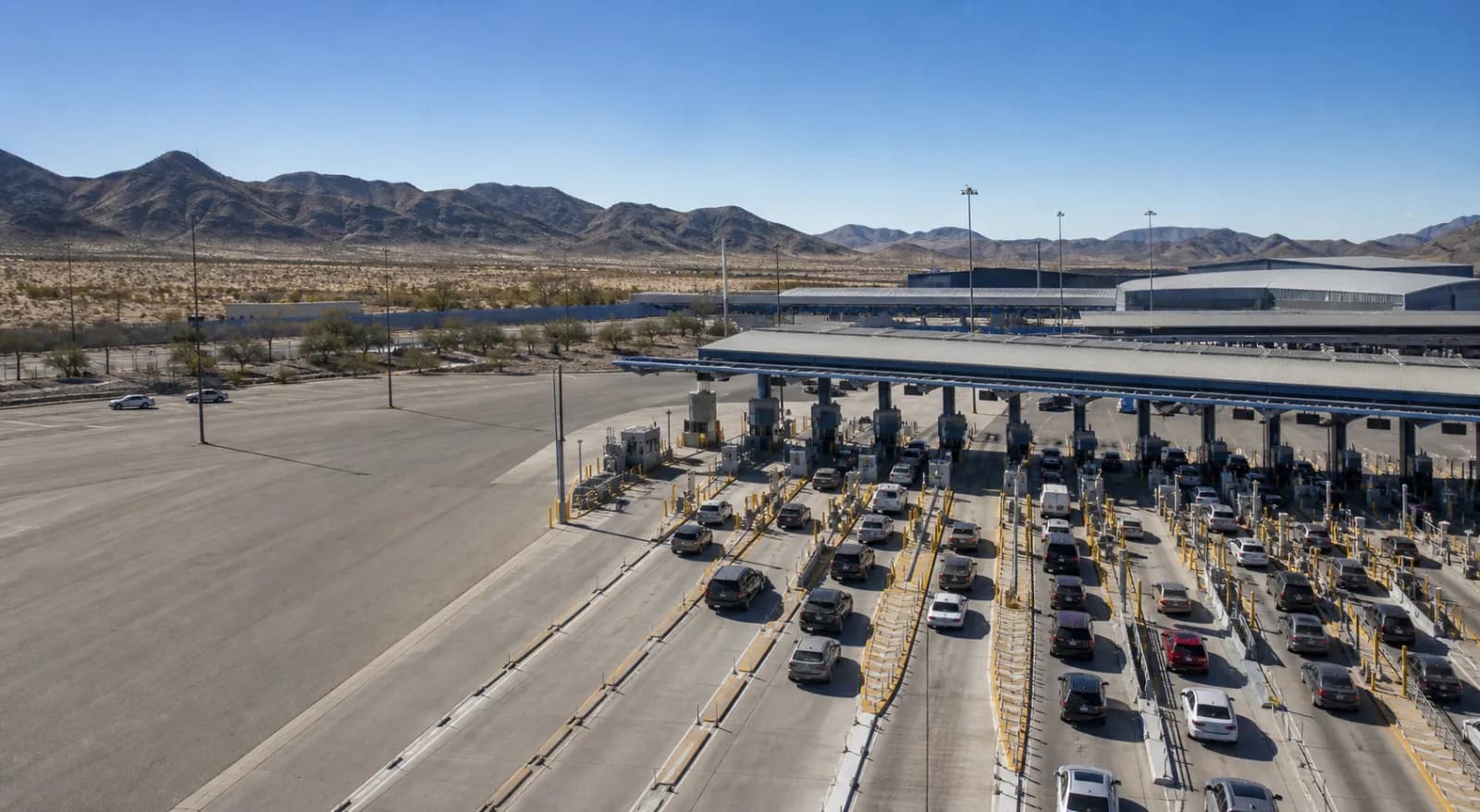
Border pressure remains concentrated in the California and Texas corridors, with the heaviest friction still showing up on high-volume passenger lanes rather than across the board. San Ysidro is the most constrained crossing in today’s feed at 115 minutes on the passenger standard lane, while Otay Mesa is not far behind with 110 minutes on both passenger ready and passenger standard, plus 60 minutes on pedestrian standard. Tecate’s passenger standard lane is also elevated at 90 minutes. Farther east, El Paso/Bota remains active at 65 minutes on passenger standard and 60 minutes on passenger ready, while Laredo 2 is at 60 minutes on passenger standard and 55 minutes on passenger ready. The picture is one of localized congestion, not systemwide deterioration.
The most important change over the last 24 hours is that several crossings improved sharply, even as a few bottlenecks persisted. San Ysidro’s passenger ready lane fell from 110 to 11 minutes, Nogales DeConcini’s passenger standard dropped from 90 to 25 minutes, and Calexico West pedestrian standard moved from 60 to 0 minutes. Eagle Pass 1 passenger standard eased from 90 to 30 minutes and San Luis 1 passenger standard from 60 to 5 minutes. Those moves matter operationally because they show the queue burden is not fixed at every port; dispatchers can still find meaningful relief by shifting to the right lane and crossing point where routing flexibility exists.
At the same time, the current longest-wait list shows the corridor stress points that remain active right now. The West Coast passenger network is the most delayed cluster in the data, with San Ysidro, Otay Mesa, and Tecate carrying the longest posted waits. South Texas remains firm but less severe than the California border, while the 24-hour improvement in some commercial lanes suggests freight processing pressure is not uniform. Port Huron commercial standard and Pharr commercial standard both dropped to zero, which is a notable easing for cargo flows, even though the data does not identify a cause. In short, the operational story is mixed: passenger crossings in the Southwest are still the main friction point, but lane selection and crossing choice continue to matter.
Crossing Delays: Where the Pressure Is Concentrated
San Ysidro is the most delayed crossing in today’s feed, with passenger standard at 115 minutes and passenger ready at 11 minutes. That spread is operationally significant because it shows the queue burden is highly lane-specific. Otay Mesa is similarly uneven: passenger ready and passenger standard are both at 110 minutes, while pedestrian standard is 60 minutes. Tecate’s passenger standard lane sits at 90 minutes, keeping that crossing in the upper tier of delay. These are the names that matter most for same-day passenger and light-travel movements.
Elsewhere, El Paso/Bota is holding at 65 minutes on passenger standard and 60 minutes on passenger ready, which is elevated but below the California peaks. Laredo 2 is posting 60 minutes on passenger standard and 55 minutes on passenger ready, again showing moderate but persistent delay. Eagle Pass 2 is at 60 minutes on passenger standard. The practical takeaway is that the pressure is still unevenly distributed: the border is not uniformly backed up, but the high-delay lanes are numerous enough to affect dispatch timing and appointment discipline.
Significant 24-Hour Changes
The day-over-day moves are mostly favorable, and several are large enough to affect routing decisions. San Ysidro passenger ready dropped from 110 to 11 minutes, the largest improvement in the feed. Nogales DeConcini passenger standard fell from 90 to 25 minutes, while Nogales DeConcini pedestrian standard moved from 45 to 0 minutes. Calexico West improved materially on both pedestrian lanes, with pedestrian standard dropping from 60 to 0 minutes and pedestrian ready from 60 to 5 minutes. Eagle Pass 1 passenger standard eased from 90 to 30 minutes, and San Luis 1 passenger standard from 60 to 5 minutes.
Commercial lanes also improved in a few places. Port Huron commercial standard went from 40 to 0 minutes, and Pharr commercial standard and commercial fast both moved from 40/35 minutes to 0. Those reductions are notable for freight planners, although the feeds do not identify the cause. Because the improvements are selective rather than broad-based, routing decisions still need to be lane-specific; there is no basis in the current data to assume all crossings eased equally.
Trade-Policy Documents: Current Notices and Caveats
The past seven days include several new ITC and Commerce notices, but they are raw current policy-document context only and should not be treated as normalized policy facts or legal advice. Today’s notices include ITC actions on certain arrowheads with deploying blades and components, portable battery jump starters and components, computer cables/chargers/adapters/peripheral devices and packaging, portable power stations and packaging, and difluoromethane (R-32) from China. The notice package also includes Commerce final results on boltless steel shelving units prepackaged for sale from China and prestressed concrete steel wire strand from China, plus an administrative review opportunity notice and a CBP information collection notice concerning Guam-CNMI Visa Waiver Form I-736. The ITC also issued scheduling for the final phase of the fresh mushrooms from Canada investigations.
Operationally, these items matter as a policy-monitoring set rather than as immediate lane-disruption evidence. The explicit caveat is important: the supplied feed is not presenting a legal determination summary, and the notices themselves do not establish current border delay causality. For logistics teams, the actionable takeaway is to keep an eye on product classes that appear in the notices—especially consumer electronics accessories, portable energy products, and certain steel inputs—but any shipment-level implication would require separate, current claim-bearing source material beyond this raw notice list.
Aviation and Airport Conditions
Aviation conditions are limited in scope but clear for San Diego. FAA data shows SAN is closed to non-scheduled transient general aviation aircraft, except with prior permission required, with the closure notice running from 2026-03-18 13:00 through 2026-10-01 08:00. That is a persistent airport operating constraint rather than a short-duration delay advisory, and it matters for operators relying on transient GA access near the San Diego border complex. No passenger-airline delay or airport-wide commercial disruption is provided in the current feed, so the effect should be read narrowly: specific GA access is restricted, but broader aviation impacts are not established in the supplied data.
Weather Alerts and Notable Crossing Conditions
Weather is an important overlay today, especially for Southwest operations. The most significant alert is an Extreme Heat Warning issued by NWS Phoenix AZ at 12:34 AM MST on August 4, running until August 7 at 8:00 PM MST. The warning appears twice in the feed and should be treated as a single hazard rather than a separate escalation. In addition, NWS El Paso Tx/Santa Teresa NM has a Heat Advisory in effect from 4:24 AM MDT through 9:00 PM MDT today, and NWS Tucson AZ has a Blowing Dust Advisory in effect from 1:41 AM MST through 8:00 PM MST today. NWS Caribou ME also issued a Wind Advisory, but it is not operationally relevant to the border crossings in this dataset.
The crossing implication is straightforward and grounded in the alerts themselves: extreme heat and blowing dust can complicate outdoor queueing and roadway visibility in affected Southwest corridors. The feeds do not tie the alerts to a specific crossing delay cause, so that linkage should not be assumed. Still, the timing of the alerts aligns with the same general region where elevated waits persist, which makes weather an important watch item for dispatch timing and driver comfort, especially in pedestrian-heavy and open-lot environments.
Community Intelligence: Retired Context Only
No community intelligence inputs were supplied in this packet. There is therefore no retired or raw diagnostic commentary to carry forward, and no live claim-bearing evidence should be inferred from absent chatter.
Macro and Economic Indicators
The macro tape is giving a mixed but still operationally relevant backdrop, with most data points stale relative to today and therefore best used as context rather than real-time evidence. The latest BOPGSTB is -57,347.00 as of 2026-02-01. Energy remains expensive in the latest available weekly reads: Brent crude is 91.82 and WTI is 84.25, both as of 2026-07-27. Diesel remains elevated as well, with US Diesel Retail at 5.31, GASDESGCW at 5.09, GASDESMWW at 5.20, and GASDESWCW at 6.07, all as of 2026-07-27. Those levels matter for routing and fuel cost sensitivity, even though the data does not provide a same-day trend.
FX conditions also remain relevant for cross-border flows. USD/CAD is 1.4028 and USD/MXN is 17.3235, both as of 2026-07-31, while the Trade Weighted Dollar is 120.71 as of 2026-07-24. Industrial price data is older but still useful context: IR is 150.80, PCU484121484121 is 204.62, PCUOMFGOMFG is 275.70, and PPIACO is 286.83, all as of 2026-06-01. TOTALSA is 16.95 as of 2026-06-01. Because these indicators are not current-day readings, they should be used as background conditions rather than as evidence of immediate border behavior.
Outlook and Operational Watch List
The near-term outlook is one of selective relief with persistent pockets of congestion. The strongest wait times remain on San Ysidro, Otay Mesa, and Tecate, while several lanes in Nogales, Calexico West, San Luis, Pharr, and Port Huron improved sharply over the last 24 hours. That pattern suggests operators should continue treating wait times as lane-specific rather than port-wide. Weather adds a credible operational burden in the Southwest, but the feed does not identify any direct weather-caused crossing disruption, so the correct posture is heightened monitoring, not assumption of causality.
Watch list for the next cycle:
- San Ysidro passenger standard and Otay Mesa passenger lanes for whether the current 110-115 minute congestion persists.
- Tecate passenger standard and El Paso/Bota passenger lanes for spillover risk or further easing.
- Southwest weather alerts, especially heat and blowing dust, for any deterioration in queue comfort or visibility.
- San Diego airport access restrictions for operators using transient GA near the border region.
- Any new policy notices affecting electronics accessories, power products, steel inputs, or China-related trade actions.