

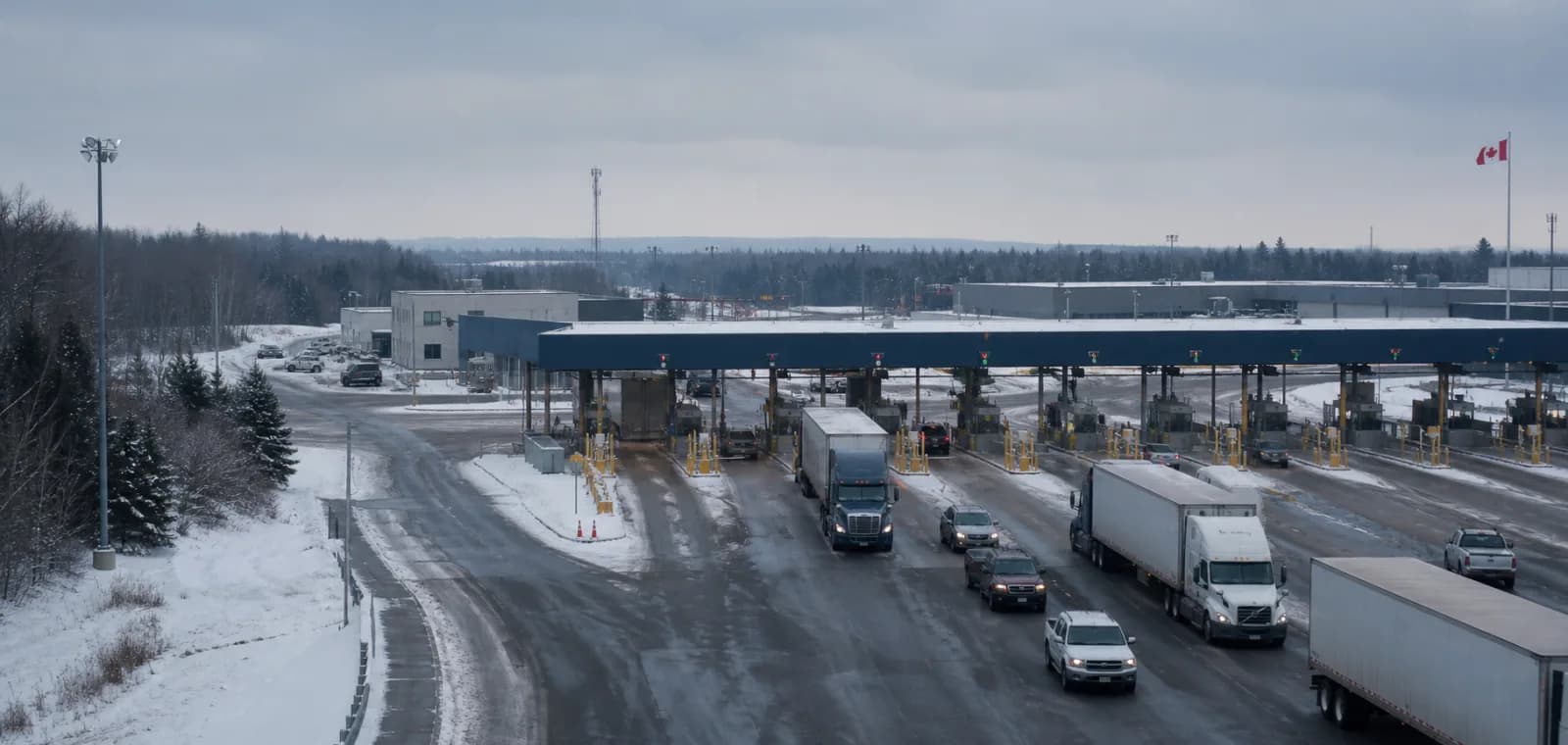
US Border Logistics Briefing - July 31, 2026
Prepared 6:00 AM PDT
Border crossing pressure is concentrated in Southern California and the Arizona-Sonora corridor, with the longest observed waits still clustering at Otay Mesa, San Ysidro, Calexico West, Eagle Pass, and El Paso. The freshest CBP/CBSA pull is 12 minutes old, so this is near-real-time operational context rather than a stale snapshot. The main story today is not a uniform systemwide deterioration; instead, the data show highly uneven lane-level stress, with some key passenger queues easing sharply in the last 24 hours while Eagle Pass 2 moved the other way and San Ysidro remained elevated despite partial relief.
The most operationally significant change is the concentration of long passenger waits at Otay Mesa. Both passenger_ready and passenger_standard are at 120 minutes, which is the top wait time in the feed and a meaningful delay for time-sensitive movements. San Ysidro remains the next major pressure point, with passenger_standard at 85 minutes and passenger_ready at 60 minutes. Calexico West is still holding at 60 minutes in both passenger_ready and passenger_standard, while Eagle Pass 2 has risen to 90 minutes on passenger_standard, making it the sharpest worsening among the major lanes tracked today.
That said, today’s 24-hour comparisons show some material easing in parts of the Southwest, especially on the San Diego and El Paso sides. Otay Mesa passenger_ready fell from 185 to 120 minutes and passenger_standard dropped from 180 to 120 minutes. San Ysidro passenger_ready improved from 120 to 60 minutes, and passenger_standard eased from 140 to 85 minutes. San Luis 1 passenger_standard improved from 90 to 30 minutes. On the Texas border, Pharr saw a large reduction in commercial delay, with commercial_fast moving from 55 to 5 minutes and commercial_standard from 60 to 10 minutes. El Paso crossings also improved on passenger lanes at PDN, where passenger_standard fell from 60 to 25 minutes and passenger_ready from 55 to 20 minutes. The exception is Eagle Pass 2, where passenger_standard jumped from 30 to 90 minutes. Cause not identified in current feeds.
Crossing Delays and Lane-Level Figures
The current longest waits show a clear split between the busiest Southern California passenger lanes and lower-delay commercial or secondary lanes elsewhere. Otay Mesa Passenger is the most constrained location in the feed, with both passenger_ready and passenger_standard at 120 minutes, and pedestrian_standard at 60 minutes. San Ysidro follows with passenger_standard at 85 minutes and passenger_ready at 60 minutes. Calexico West is steady at 60 minutes for both passenger_ready and passenger_standard. Eagle Pass 2 stands at 90 minutes on passenger_standard, while El Paso’s Bota lane shows 50 minutes on passenger_standard and Ysleta shows 50 minutes on passenger_ready.
Commercial conditions are notably better at the moment than passenger conditions in the same geographic corridors. The strongest example is Pharr, where commercial_fast is just 5 minutes and commercial_standard 10 minutes, despite the broader border being uneven. That suggests commercial throughput can still be relatively fluid even when nearby passenger corridors are under pressure, though no cause is identified in current feeds. Across the El Paso area, the shorter passenger waits at PDN and the moderate 50-minute reading at Bota indicate a mixed corridor rather than a singular congestion event.
Significant 24-Hour Changes
The most important day-over-day shifts are worth separating into easing and worsening. Easing is broad but not universal. Otay Mesa passenger_ready and passenger_standard each improved by 60 to 65 minutes, San Ysidro passenger_ready improved by 60 minutes, and San Ysidro passenger_standard improved by 55 minutes. San Luis 1 passenger_standard improved by 60 minutes, and the Pharr commercial lanes each dropped by 50 minutes. El Paso PDN also saw meaningful improvement in both passenger_ready and passenger_standard by 35 minutes.
The key worsening is Eagle Pass 2 passenger_standard, up 60 minutes from 30 to 90. That makes Eagle Pass one of the few notable deterioration points in an otherwise improving 24-hour picture. The feed does not identify a cause, so this should be treated as a local condition change to monitor rather than a broader trend.
Trade-Policy Documents and Explicit Claim Caveats
The trade-policy section is raw-current policy-document context only and should not be treated as normalized policy evidence or legal advice. The day’s notices are relevant mainly as directional signals for product categories rather than immediate border throughput impacts.
Today’s Commerce and ITC notices include final or preliminary actions on several product groups: certain vertical shaft engines between 99cc and 225cc and parts thereof from China, truck bed covers from China, boltless steel shelving units prepackaged for sale from China, certain preserved mushrooms from Chile, China, India, and Indonesia, circular welded carbon steel pipes and tubes from Thailand, common alloy aluminum sheet from Oman, and mattresses from Cambodia, Malaysia, Serbia, Thailand, Türkiye, and Vietnam. CBP also issued a notice on customs user fees being adjusted for inflation in fiscal year 2027. The list suggests a busy regulatory environment across manufactured goods, household goods, and food categories, but the data provided here do not support direct inference about same-day crossing delay causation.
The explicit operational caveat matters: these are notice summaries and claim-bearing use is restricted by the policy note in the feed. They are useful as monitoring context for trade compliance teams, not as evidence of current lane disruption.
Aviation and Airport Conditions
Aviation conditions are constrained at San Diego International. The FAA entry states: “SAN AD AP CLSD TO NON SKED TRANSIENT GA ACFT EXC PPR 619-298-7704 2603181300-2610010800.” In practical terms, SAN is closed to non-scheduled transient general aviation aircraft except with prior permission required. This is a planning and access constraint for GA operators, not a passenger airline delay note. No broader airport delay network is provided in the current feed.
Weather Alerts and Notable Crossing Conditions
Weather is the main environmental backdrop today, especially across the Southwest border. Multiple Extreme Heat Warnings are in effect for Tucson, San Diego, and Phoenix, with the San Diego warning running through August 2 at 8:00 PM PDT and Phoenix through August 3 at 8:00 PM MST. An additional Heat Advisory is posted for El Paso and Santa Teresa through 9:00 PM MDT today. Brownsville also has a Special Weather Statement. Outside the immediate border, Great Falls has a Fire Weather Watch and High Wind Watch in effect.
Operationally, the heat alerts matter because they coincide with several of the most delayed crossings in the Southwest. The data do not state that weather is the cause of the queue conditions, so that should not be assumed. Still, the overlap between severe heat alerts and elevated waits in San Diego-area and Arizona corridors is notable for dispatch planning, driver welfare, and dwell management. San Diego’s airport restriction also sits within the same region under heat-related alerting.
Community Intelligence Context
No community intelligence entries were supplied in this dataset. There is therefore no retired, raw diagnostic context to carry forward on this date.
Macro and Economic Indicators
Macro indicators are mixed and, in several cases, dated rather than current-to-the-hour, so they should be read as background rather than live market triggers. As of 2026-07-27, Brent crude is 91.82 and WTI crude is 84.25, with U.S. diesel retail at 5.31. Regional fuel series also remain elevated: GASDESGCW is 5.09, GASDESMWW is 5.20, and GASDESWCW is 6.07, all as of 2026-07-27. Those fuel levels remain operationally relevant for over-the-road carriers managing long-haul border moves and cross-border drayage.
Currency data as of 2026-07-24 show USD/CAD at 1.4078, USD/MXN at 17.4526, and the trade-weighted dollar at 120.71. These levels remain important for import/export planning, though no immediate causal link to today’s wait times is provided. The BOPGSTB reading is -57,347.00 as of 2026-02-01. Industrial and producer-price series are also dated to 2026-06-01: IR at 150.80, PCU484121484121 at 204.62, PCUOMFGOMFG at 275.70, PPIACO at 286.83, and TOTALSA at 16.95. These are useful for broad economic context but not for same-day border inference.
Outlook and Operational Watch List
The near-term outlook is for continued unevenness rather than a single border-wide pattern. The feed shows meaningful easing at several California and Texas points, but Otay Mesa and San Ysidro remain the most operationally sensitive corridors, and Eagle Pass 2 deserves attention after its sharp 24-hour deterioration. Severe heat remains the dominant environmental constraint across the Southwest, and SAN’s GA restriction is a separate operational limitation for air movements.
Watch list for the next cycle:
- Otay Mesa passenger_ready and passenger_standard, both at 120 minutes.
- San Ysidro passenger_standard at 85 minutes after a substantial but incomplete improvement.
- Eagle Pass 2 passenger_standard at 90 minutes after a 60-minute 24-hour increase.
- Calexico West, which remains at 60 minutes on both passenger_ready and passenger_standard.
- Pharr commercial lanes, where the sharp improvement is encouraging but should be confirmed in the next pull.
- Heat alerts across San Diego, Phoenix, Tucson, and El Paso/Santa Teresa for potential operational stress, with cause not identified in current feeds.