

US Border Logistics Briefing - July 26, 2026
Generated 6:00 AM PDT
Border conditions are uneven this Sunday morning, with the highest friction concentrated in a small set of passenger-oriented crossings rather than across the full network. The freshest CBP/CBSA pull is essentially current at 12:59 UTC, and the longest posted waits cluster in the Southwest and at one Canada-facing lane: El Paso’s Paso Del Norte and Ysleta complexes, Eagle Pass, Nogales DeConcini, Otay Mesa, and Lacolle Route 221. The operational picture is not one of broad systemic congestion so much as localized pressure at specific crossings and lane types, which matters for dispatch because alternate ports may still be materially faster even within the same corridor.
The most important 24-hour development is the sharp easing at several Texas entries. Del Rio and Hidalgo each saw large wait-time compressions, while Tornillo also improved materially. At the same time, Lacolle Route 221 moved in the opposite direction, going from no posted wait to a 60-minute traveler delay. That contrast suggests the network is not moving in a single direction; operators should treat each crossing as a separate queueing problem rather than assuming corridor-wide conditions. The current data do not identify a cause for the changes.
Weather is the other near-term operational variable. Extreme heat is in effect for the Phoenix area, while heat advisories cover San Diego and several Upper Midwest locations. For border operations, the heat products are most relevant where outdoor staging, inspection, and queue management expose freight and passengers to prolonged dwell times. San Diego also has an FAA closure affecting non-scheduled transient general aviation activity at SAN, which may matter for time-sensitive airport-adjacent cargo or repositioning even though it does not directly affect border lanes.
Trade-policy activity in the past week remains active, but the documents in this feed are claim-caveated raw notices and should be treated as context only, not as normalized policy evidence. The mix includes ITC complaint notices, Commerce sunset-review results, and tariff-order actions, indicating a busy enforcement and review calendar across batteries, child carriers, dermatological devices, phosphate fertilizers, mattresses, crepe paper products, pasta, sugar TRQ allocations, and lattice boom crawler cranes. For logistics planning, the actionable point is not to infer immediate border delay from these notices, but to recognize that trade-remedy items continue to move through the system and may matter for compliance, landed-cost planning, or sector-specific shipment risk.
Crossing delays and lane-level pressure
The longest posted waits are concentrated in passenger channels rather than commercial freight lanes in the provided feed. El Paso’s Paso Del Norte crossing leads the board at 65 minutes in both passenger_ready and passenger_standard. Eagle Pass shows 60 minutes on both passenger_ready and passenger_standard. El Paso’s Bota (BOTA) is also elevated at 60 minutes for passenger_standard and 50 minutes for passenger_ready. Nogales DeConcini is at 60 minutes for passenger_standard, Otay Mesa passenger_standard is also 60 minutes, and Lacolle Route 221 travelers is at 60 minutes. El Paso Ysleta passenger_ready is slightly lower at 55 minutes. Taken together, the current queue profile is highly specific by lane type: standard and ready passenger lanes are both affected, but the most visible pressure is still at a limited number of ports.
For routing decisions, the distinction between passenger_ready and passenger_standard matters. At El Paso’s Paso Del Norte, both lane types are equally delayed at 65 minutes, which reduces the value of switching between those two lane categories at that crossing. By contrast, El Paso Bota shows a 10-minute spread between passenger_standard at 60 minutes and passenger_ready at 50 minutes, suggesting some benefit to lane selection there, though not enough to eliminate delay risk. The report does not show comparable commercial wait figures in the longest-wait list, so no current broad freight-lane stress should be inferred from this dataset alone.
Significant 24-hour changes
The day-over-day movement is more striking than the absolute wait table. Del Rio is the clearest improvement: both passenger_ready and passenger_standard fell from 90 minutes to 5 minutes, an 85-minute reduction in each case. Hidalgo also improved sharply, with passenger_standard dropping from 90 to 20 minutes and passenger_ready from 85 to 15 minutes. Hidalgo Anzalduas moved down from 60 to 5 minutes for passenger_standard and from 55 to 3 minutes for passenger_ready. Tornillo passenger_standard dropped from 40 to 5 minutes. Houlton passenger_standard fell from 45 to 2 minutes. Alexandria Bay travelers cleared from 45 minutes to zero.
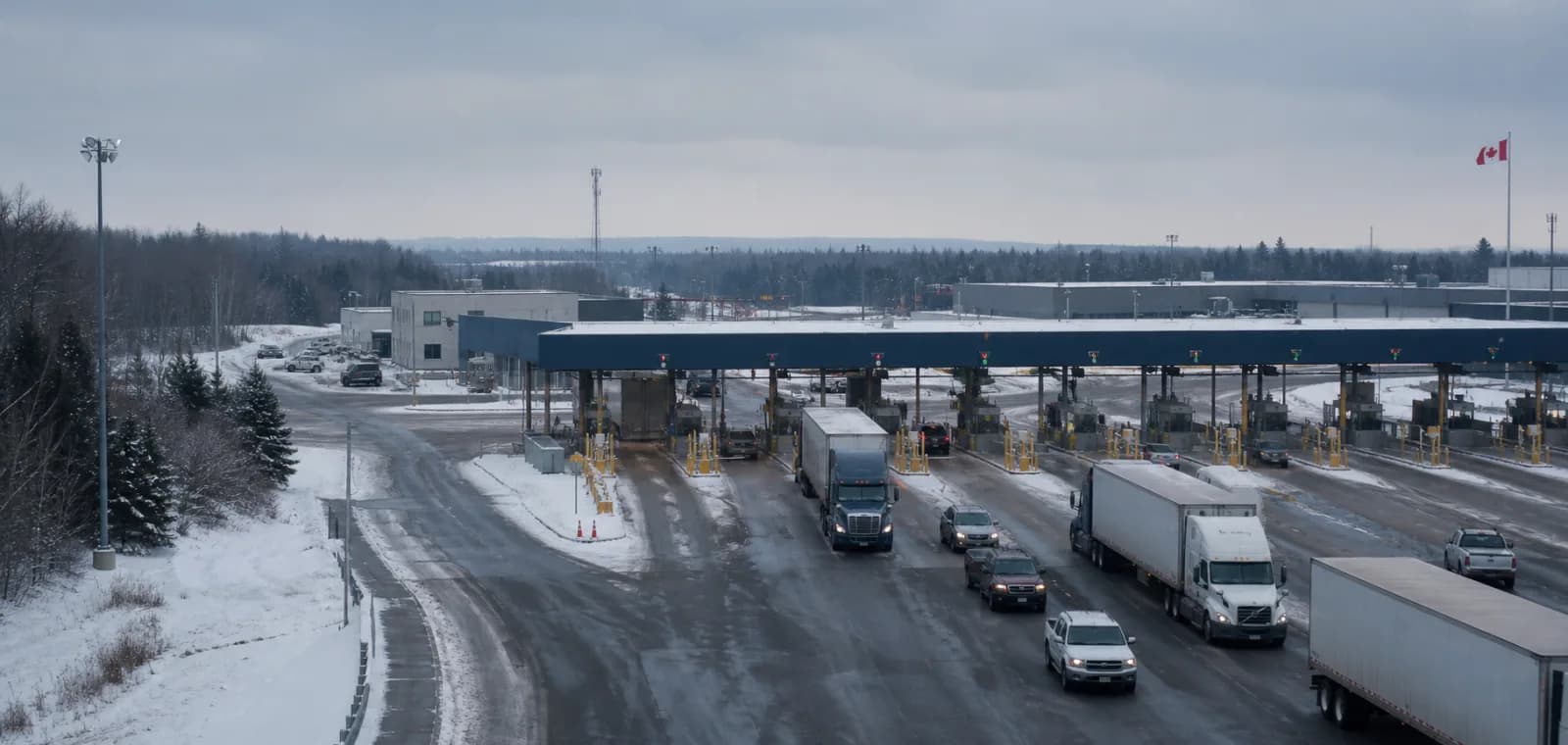
The main deterioration is at Lacolle Route 221, where travelers moved from 0 to 60 minutes. That is the largest negative swing in the feed and the only major worsening among the top changes. For cross-border dispatch, the practical implication is that northbound traveler flows at Lacolle may now require more buffer than they did a day earlier, while several Texas crossings appear far more fluid than they were yesterday. Because cause is not identified in current feeds, these changes should be treated as observed queue shifts rather than interpreted as operational posture changes.
Trade-policy documents and explicit caveats
The trade-policy feed is explicitly flagged as raw-current policy-document context only. These items should not be used as legal advice or as normalized policy facts, and they are not claim-bearing evidence for current operational conclusions about border traffic. Within that caveat, the past seven days include ITC notices for complaints involving secondary cylindrical batteries, adjustable child carriers, dermatological treatment devices, and anode materials for use in battery cells and batteries. Commerce issued preliminary sunset-review results for phosphate fertilizers from Morocco, final expedited sunset-review results for mattresses from China, a continuation of the antidumping duty order on certain crepe paper products from China, and final countervailing-duty administrative review results for certain pasta from Italy. USTR also published FY 2027 tariff-rate quota allocations for raw cane sugar, refined sugar, and sugar-containing products.
Operationally, these notices matter most for compliance teams, trade counsel, and importers managing sector-specific exposure. They do not, on their own, explain today’s wait times at the border. No policy item in the feed should be read as evidence of a current lane delay absent separate current operational reporting.
Aviation and airport conditions
FAA data show a closure at San Diego International Airport. The notice reads: “SAN AD AP CLSD TO NON SKED TRANSIENT GA ACFT EXC PPR,” with a contact number and validity window running from 2603181300 through 2610010800. The operational meaning is that non-scheduled transient general aviation aircraft are excluded unless prior permission is obtained. Because SAN sits near a major border logistics corridor and supports regional air mobility, this can matter for airside repositioning and short-notice passenger or executive travel. The feed does not provide any cargo-specific closure at SAN, and no broader airport disruption is indicated here.
Weather alerts and notable crossing conditions
Heat is the dominant weather theme. An Extreme Heat Warning is in effect for the Phoenix area from July 26 at 3:21 AM MST until July 27 at 8:00 PM MST. This is the most severe alert in the package and is operationally relevant to Arizona corridor crossings and any outdoor queue management in the region. San Diego has a Heat Advisory from July 26 at 5:23 AM PDT through July 27 at 8:00 PM PDT, and a Beach Hazards Statement extends from July 25 at 11:11 PM PDT through July 29 at 6:00 PM PDT. The heat advisory appears twice in the feed for San Diego, which is a duplication in the source context rather than two distinct hazards.
Additional Heat Advisories are posted for Grand Forks and Duluth, with multiple issuance times on July 26 and an effective window through 9:00 PM CDT. Great Falls, MT also has a Heat Advisory from July 25 at 10:40 PM MDT through July 26 at 9:00 PM MDT. While these are not border-adjacent in the same way as Arizona or San Diego, they can affect inland routing, driver fatigue management, and terminal operations in the northern network. No flood, snow, or storm-related border disruption is indicated in this feed.
Macro and economic indicators
The economic panel is useful here mainly as a backdrop, but several series are dated enough that readers should treat them as lagging indicators rather than live conditions. The latest balance-of-payments goods and services trade balance is -57,347.00 as of 2026-02-01. Brent crude is 86.99 and WTI is 84.38, both as of 2026-07-20, while U.S. diesel retail is 5.13 with related diesel series at 4.94, 4.99, and 5.88 on the same date set of July 20 observations. The USD/CAD rate is 1.4014, the USD/MXN rate is 17.5120, and the trade-weighted dollar is 120.53, all as of 2026-07-17.
Manufacturing and trade-price series are also dated to 2026-06-01. IR is 150.80, PCU484121484121 is 204.62, PCUOMFGOMFG is 275.70, PPIACO is 286.83, and TOTALSA is 16.95. The exact series labels are preserved here because the feed does not provide interpretation. Operationally, the combination of elevated diesel, firm dollar levels, and dated industrial-price inputs argues for caution in cost forecasting, but the dataset does not support a more specific conclusion about immediate border flow.
Outlook and watch list
The near-term border outlook is mixed but manageable. Current pressure is localized to a handful of passenger crossings, with several Texas ports having improved sharply over the last day. The largest operational risk signal in the feed is the sudden 60-minute delay at Lacolle Route 221, which warrants close monitoring for northbound traveler impacts. Heat remains the broadest environmental concern, especially in Arizona and San Diego, and the SAN GA closure may affect airside contingency planning.
What to watch next:
- Whether Lacolle Route 221 stays elevated or reverts toward prior no-wait conditions.
- Whether El Paso, Eagle Pass, Nogales, and Otay Mesa remain clustered around the 60-minute passenger mark.
- Whether the Texas improvements at Del Rio, Hidalgo, Hidalgo Anzalduas, and Tornillo hold through the next pull.
- Any escalation or extension of heat alerts in Arizona, San Diego, and the northern Plains.
- Any change to the SAN transient GA restriction window that could affect regional aviation movements.