

US Border Logistics Briefing - July 25, 2026
Generated 6:00 AM PDT
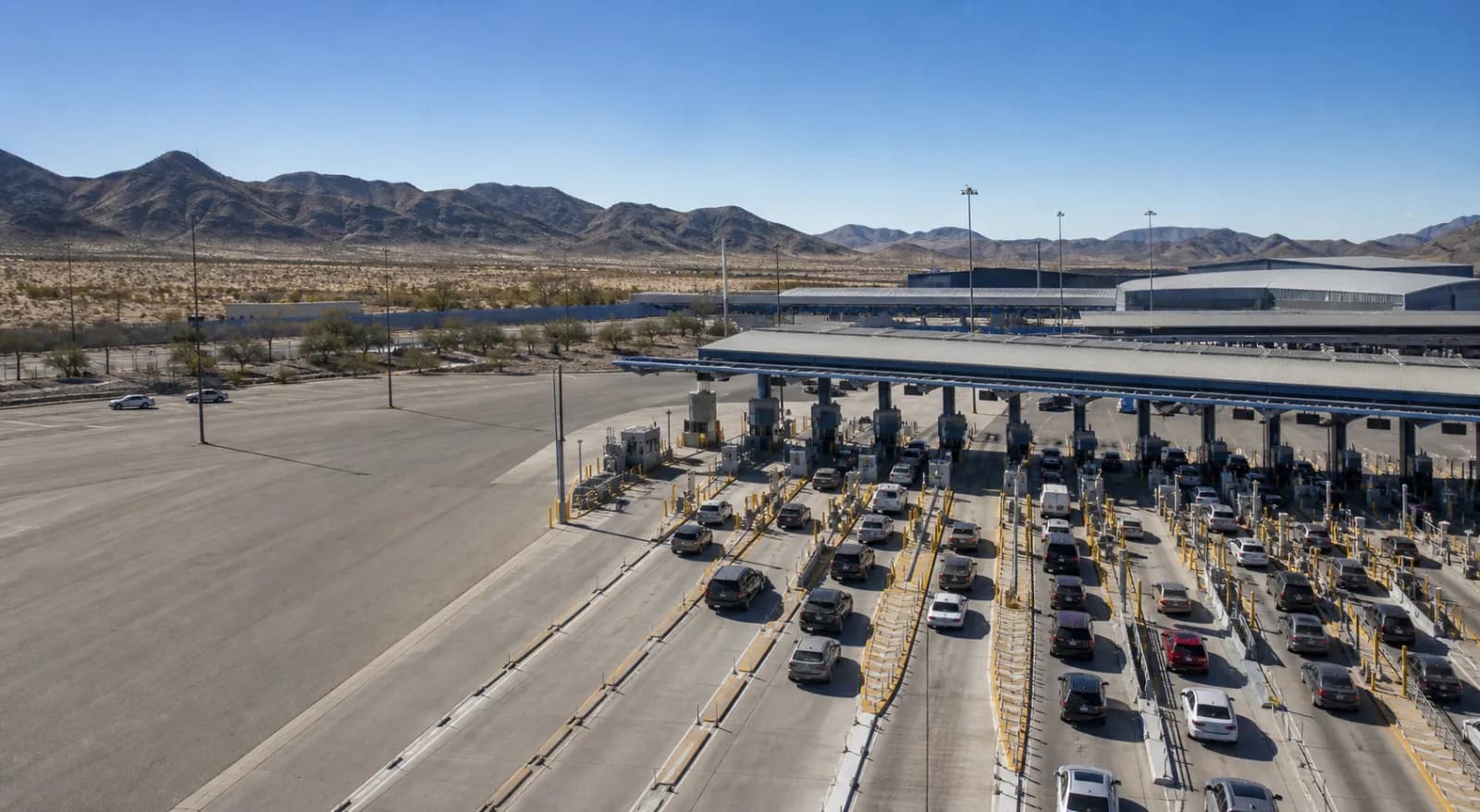
Border wait pressure is concentrated in a small set of passenger lanes rather than spread evenly across the network, with the longest observed delays clustered at South Texas and El Paso. The single-highest waits in today’s pull are 60 minutes at Brownsville Veterans passenger standard, Del Rio passenger ready, Del Rio passenger standard, and El Paso Ysleta passenger ready. Just below that, San Ysidro passenger standard is at 50 minutes, while El Paso PDN passenger standard is at 45 minutes, Highgate Springs passenger standard at 45 minutes, Eagle Pass 2 passenger standard at 40 minutes, El Paso Bota passenger standard at 40 minutes, and El Paso PDN passenger ready at 40 minutes.
What changed most over the last 24 hours is notable for its breadth on the Southwest border. Several of the lanes that were among the most delayed yesterday moved down sharply today, including El Paso PDN and El Paso Bota in both standard and ready channels, Hidalgo-Anzalduas in both channels, and San Ysidro pedestrian standard. The direction of travel is clear even where the cause is not identified in current feeds: queues compressed materially at multiple crossings, which should improve border-time variability for scheduled moves crossing through the El Paso, Hidalgo, Laredo, and San Ysidro corridors. At the same time, some locations remain operationally elevated despite the easing, and Del Rio and Brownsville still stand out as the longest passenger waits in the dataset.
Weather is the main macro operational condition affecting the border and adjacent logistics geography today. Extreme Heat Warnings are active for Phoenix and Tucson, with Tucson’s warning running through 8:00 PM MST today and Phoenix’s extending through July 27 at 8:00 PM MST. Additional heat-related alerts cover San Diego, Grand Forks, Great Falls, and Bismarck, indicating that heat stress is not isolated to the border region but is broad across western and northern corridors. The border-specific relevance is clearest in Southern California and Arizona, where the combination of sustained heat and busy crossings can complicate driver planning, dwell management, and yard operations even when wait times themselves are not rising.
Aviation conditions are comparatively limited but still relevant for San Diego-linked logistics. FAA data shows SAN has a closure notice for the airport’s transient general aviation accommodation: “SAN AD AP CLSD TO NON SKED TRANSIENT GA ACFT EXC PPR 619-298-7704 2603181300-2610010800.” Operationally, that means non-scheduled transient GA access is restricted unless prior permission is obtained during the published interval. For shippers that rely on business aviation, charter support, or urgent passenger repositioning via SAN, the constraint is a planning item even though it is not a commercial airline delay signal.
Trade-policy activity in the past week remains active, but the packet itself carries the explicit caveat that these are raw-current policy-document context items only and should not be treated as normalized policy facts or legal advice. The newest notices include several ITC institution actions dated July 27, 2026 in the feed: investigations covering certain dermatological treatment devices and components, certain adjustable child carriers and components, and a complaint involving secondary cylindrical batteries, components thereof, and products containing the same. Because these are document notices rather than implemented measures, they should be treated as early-stage policy signals, not as immediate border-flow drivers.
The most operationally salient policy items in the July 24–27 window are the trade remedy determinations affecting selected commodity and manufacturing categories. Commerce issued preliminary results of the first full sunset review for phosphate fertilizers from Morocco, final results of the countervailing duty administrative review for certain pasta from Italy, final results of the expedited first sunset review of the countervailing duty order on mattresses from China, and continuation of the antidumping duty order on certain crepe paper products from China. The Office of the U.S. Trade Representative also published FY 2027 tariff-rate quota allocations for raw cane sugar, refined sugar, and sugar-containing products. A July 23 notice issued the antidumping duty order on lattice boom crawler cranes from Japan. The explicit caveat remains important: these are policy-document notices, not live customs enforcement data, and the feed does not support inferential claims about checkpoint behavior or lane operations from these documents alone.
On the crossing side, today’s wait structure shows a mixed but generally improved picture versus yesterday. The most consequential reductions are large enough to matter for dispatch timing. Eagle Pass 2 passenger standard fell from 90 minutes to 40 minutes, a 50-minute decline. Pembina passenger standard dropped from 40 minutes to zero. Hidalgo-Anzalduas passenger ready moved from 55 to 15 minutes, while Hidalgo-Anzalduas passenger standard improved from 60 to 20 minutes. El Paso PDN passenger ready eased from 80 to 40 minutes and passenger standard from 85 to 45 minutes. El Paso Bota passenger ready moved from 75 to 35 minutes and passenger standard from 75 to 40 minutes. Laredo 2 passenger standard dropped from 45 to 10 minutes, and San Ysidro pedestrian standard improved from 45 to 10 minutes. These moves indicate substantially better throughput in several lanes, although the current absolute waits at Brownsville, Del Rio, San Ysidro, and El Paso still warrant caution for time-sensitive passenger or mixed-use crossings.
Community intelligence in this packet is not presented as live claim-bearing evidence and is therefore best treated as retired or raw diagnostic context only. No current corroborating community-item claims are supplied here, so nothing in that layer should be used to override the observed wait-time and weather data above. In practical terms, the feed is already sufficiently informative on its own: the main operational story is a real easing at a number of busy Southwest lanes, but with residual pressure still concentrated in a few crossings and with heat conditions likely to shape execution quality during the day.
The economic backdrop is mixed and, for several series, not especially fresh, so date discipline matters. The latest BOPGSTB reading is -57,347.00 as of 2026-02-01. Energy remains elevated, with Brent crude at 86.99 and WTI at 84.38 as of 2026-07-20. Currency indicators as of 2026-07-17 show USD/CAD at 1.4014, USD/MXN at 17.5120, and the trade-weighted dollar at 120.53. Diesel prices remain firm: GASDESGCW is 4.94, GASDESMWW 4.99, US Diesel Retail 5.13, and GASDESWCW 5.88, all as of 2026-07-20. Manufacturing and price data are older, with IR at 150.80, PCU484121484121 at 204.62, PCUOMFGOMFG at 275.70, PPIACO at 286.83, and TOTALSA at 16.95, all as of 2026-06-01. The operational implication is straightforward: freight is moving against a backdrop of firm fuel and dollar conditions, while the most immediate border friction today is localized rather than systemic.
The near-term outlook is constructive but uneven. The sharp 24-hour reductions suggest several major queues have already decongested, which should help carriers re-balance appointment risk and border dwell assumptions for today’s departures. However, Del Rio and Brownsville passenger delays remain at 60 minutes, San Ysidro standard remains elevated at 50 minutes, and El Paso still carries multiple 40–45 minute waits in key passenger lanes. Add the heat alerts in Arizona and Southern California, and the operational picture remains one where scheduling precision matters even in a more favorable queue environment.
Watch list for today:
- Brownsville Veterans, Del Rio, San Ysidro, and El Paso PDN/Bota for residual passenger-lane delay.
- Any reversal in the sharp 24-hour improvements at Eagle Pass 2, Hidalgo-Anzalduas, Laredo 2, and San Ysidro pedestrian.
- Heat-related execution risk in Arizona and Southern California corridors.
- SAN’s transient GA restriction if aviation support is part of the movement plan.
- Trade-remedy notices in selected industrial and consumer product categories as non-current but relevant policy context.