

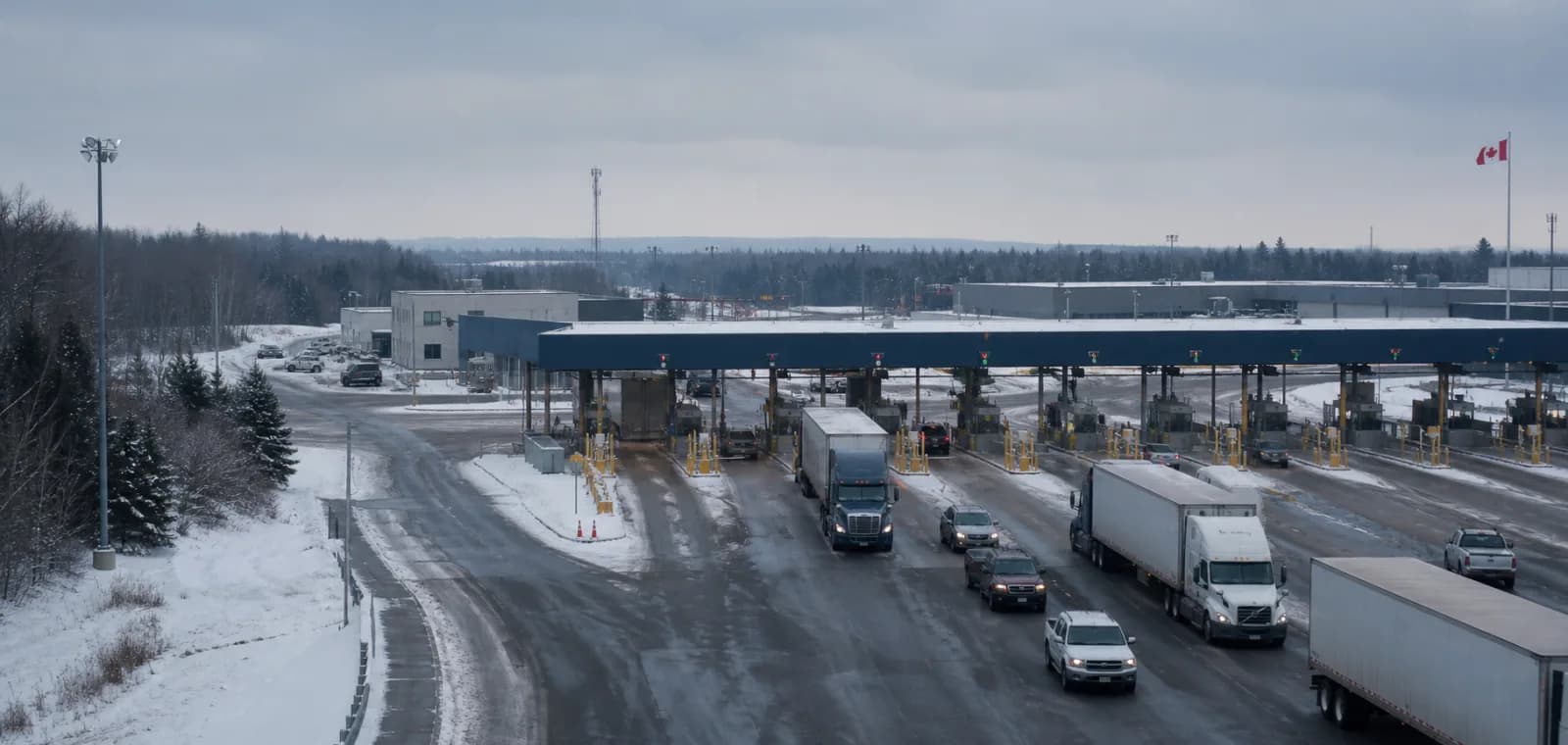
US Border Logistics Briefing - July 23, 2026
Generated 7:18 PM PDT
Border conditions are concentrated in the Arizona–Sonora and California–Baja corridors, with the longest passenger and pedestrian waits clustered at Nogales, San Ysidro, Douglas, Otay Mesa, and nearby Southwest ports. The operating picture is not uniform: several lanes that were under pressure in the prior day have eased sharply, while a smaller set of crossings have deteriorated enough to change dispatch decisions. The most consequential move is the jump at Nogales-Mariposa passenger standard, which rose to 150 minutes and now anchors the national delay picture.
This is happening against a backdrop of severe heat across the Southwest and active weather products that matter for driver comfort, equipment, and schedule reliability even when they do not directly close a port. Extreme heat warnings are in force for Phoenix and Tucson, and the reported temperatures at key crossings are high enough to plausibly affect dwell behavior, staging, and crew stamina. However, the feeds do not identify a cause for the wait spikes, so the correct posture is to treat the border delay changes as observed conditions without assuming staffing, inspection, or enforcement drivers.
The day’s pattern also shows meaningful relief in parts of California and Texas. Calexico West, Calexico East, El Paso Ysleta, and San Ysidro Ped West all improved materially over 24 hours, including sharp reductions in passenger-ready and commercial-fast lanes. That contrast matters operationally: carriers with flexible routing may still be able to salvage on-time moves by shifting to the lower-wait options, but the southwest corridor overall remains heat-stressed and uneven. Readers should watch whether the current surge at Nogales and Douglas persists into the next update or whether it normalizes as the rest of the corridor has.
Border crossing delays: where pressure is concentrated
The heaviest current waits are centered at Nogales-Mariposa, San Ysidro, and Douglas. Nogales-Mariposa passenger standard is the worst single lane in the feed at 150 minutes. San Ysidro is also elevated on both the passenger standard and pedestrian standard sides at 120 minutes each, with San Ysidro passenger-ready still long at 90 minutes. Douglas passenger standard stands at 110 minutes, and Otay Mesa passenger standard is 90 minutes. Outside that core, Sweetgrass passenger standard is also at 90 minutes, Tecate passenger standard is 70 minutes, Hidalgo passenger standard is 65 minutes, and Donna passenger-ready is 60 minutes.
Those figures point to a corridor pattern rather than a single-port event. In practical terms, the southern California and Arizona border nodes are carrying the most time risk for passenger and pedestrian movements, while the Texas-side lane burden is more mixed and mostly below the worst Arizona delays. For dispatchers, the distinction between passenger-standard, pedestrian-standard, passenger-ready, and commercial-fast remains important: the same port can present very different exposure depending on the lane type selected.
Largest 24-hour changes: gains and deterioration
The most important deterioration over the last day is at Nogales-Mariposa passenger standard, which moved from 40 minutes to 150 minutes, a 110-minute increase. Douglas passenger standard followed with a 90-minute increase from 20 to 110 minutes. San Ysidro pedestrian standard also worsened sharply, climbing from 45 to 120 minutes, a 75-minute increase. Those are the only three changes in the day’s top tier that moved decisively against shippers and travelers.
Against that, several lanes improved enough to matter operationally. Nogales Deconcini passenger standard fell from 120 minutes to 60 minutes, a 60-minute reduction. Calexico West passenger standard and passenger-ready both moved from 90 minutes to 40 minutes, each down 50 minutes. San Ysidro Ped West pedestrian standard improved from 80 to 30 minutes, also a 50-minute reduction. Calexico East passenger-ready declined from 90 to 45 minutes, El Paso Ysleta passenger-ready from 60 to 20 minutes, and Calexico East commercial-fast from 45 to 5 minutes, each better by 40 minutes.
The practical implication is a corridor that is still volatile but not uniformly deteriorating. Where the day’s worst pressure is concentrated, it is concentrated hard enough to affect departure sequencing and re-routing. Where lanes improved, the improvement was large enough to restore some usable capacity, especially for time-sensitive commercial movement in the Calexico area.
Weather alerts and border-adjacent conditions
The weather layer is dominated by heat. An Extreme Heat Warning for Phoenix, issued July 23 at 3:56 PM MST, runs until July 27 at 8:00 PM MST. Tucson has an Extreme Heat Warning issued July 23 at 12:13 PM MST through July 25 at 8:00 PM MST. El Paso/Tx–Santa Teresa, San Diego, and Great Falls are also covered by Heat Advisories, with San Diego under both a Beach Hazards Statement and Heat Advisory products. Great Falls additionally has a Red Flag Warning, but that is not a major border-crossing corridor for the current delay picture.
The notable measured conditions align with the warnings. Reported temperatures include PHX at 43.9°C, TUS at 41.1°C, Andrade at 44.6°C, Calexico East at 44.8°C, Calexico West at 45.0°C, San Luis 1 at 43.9°C, and San Luis 2 at 43.7°C. Those readings are high enough to be operationally relevant for road freight and pedestrian movement, especially where queues lengthen and vehicles idle in direct sun.
Operationally, this means border wait estimates should be read alongside heat stress rather than in isolation. The feeds do not state that heat is the cause of the delays, but they do confirm that the environment is unfavorable for long-stage or cross-border queueing. That should matter for trailer temperature management, driver scheduling, and buffer planning on routes feeding southern Arizona and the California border.
Aviation and airport conditions
FAA airport data shows a closure-related restriction at San Diego International (SAN): “SAN AD AP CLSD TO NON SKED TRANSIENT GA ACFT EXC PPR 619-298-7704 2603181300-2610010800.” This is a restriction on non-scheduled transient general aviation aircraft unless prior permission is obtained. It is not a commercial airline disruption in the provided feed, but it remains relevant to logistics users relying on ad hoc business aviation, time-sensitive charter, or aviation support flights into San Diego.
No other airport disruptions are supplied in the current data. Because the SAN notice is specific and dated, it should be treated as an explicit current operating limitation rather than a generalized alert.
Trade-policy documents: current actions and caveats
The trade-policy feed is populated, but it is raw-current policy-document context only and should not be treated as normalized policy or legal advice. The explicit caveat matters: these notices are useful as directional indicators for affected commodity flows, but they are not substitute legal authorities in this briefing.
Several Commerce actions were posted July 23. These include final affirmative countervailing duty determinations on L-lysine from China and preliminary affirmative countervailing duty determinations on certain fatty acids from Malaysia and Indonesia. Commerce also issued a final affirmative determination of sales at less than fair value for L-lysine from China and initiated both scope and circumvention inquiries on certain alkyl phosphate esters from China, including a deferral of a circumvention inquiry in one notice and a separate country-wide circumvention inquiry in another. Commerce also issued an antidumping duty order on lattice boom crawler cranes from Japan.
The feed also includes an International Trade Commission item on fresh tomatoes from Mexico, though no outcome detail is provided in the summary line here. Separately, a July 21 Commerce notice covers hardwood and decorative plywood from Vietnam with a final affirmative less-than-fair-value determination and a final negative critical circumstances determination.
For operators, the point is not to read immediate lane congestion into these notices, but to flag them as policy developments that may affect sourcing, classification review, and landed-cost planning. The feed does not provide implementation timing, specific affected entry points, or tariff-effective dates in a way that would justify more specific claims here.
Macro and economic indicators
The economic panel is mixed and, in some cases, dated enough that it should be used as background rather than real-time confirmation. The most recent trade balance figure shown is BOPGSTB at -57,347.00 as of 2026-02-01. Freight and industrial price indicators include IR at 150.80, PCU484121484121 at 204.62, PCUOMFGOMFG at 275.70, PPIACO at 286.83, and TOTALSA at 16.95, all as of 2026-06-01. These are useful context but not current-day border signals.
For transportation cost context, Brent crude is 86.99 and WTI is 84.38, both as of 2026-07-20. U.S. diesel retail is 5.13, with the diesel benchmark series also showing GASDESGCW at 4.94, GASDESMWW at 4.99, and GASDESWCW at 5.88, all as of 2026-07-20. Currency levels as of 2026-07-17 show USD/CAD at 1.4014, USD/MXN at 17.5120, and the trade-weighted dollar at 120.53. Those rates remain operationally relevant for cross-border purchasing, fuel exposure, and landed-cost sensitivity, but the feed does not provide a day-over-day move.
Outlook and operational watch list
The immediate outlook is for continued uneven border performance, with the highest risk concentrated in Nogales, San Ysidro, and Douglas until the next pull confirms whether the latest spikes persist. Heat remains a broad operational drag across the Southwest, and the measured temperatures suggest there is little environmental relief in the near term. The strongest improvement signals are at Calexico West, Calexico East, and El Paso Ysleta, where current lane times are now materially shorter than the prior day’s readings.
Watch list for the next operational cycle:
- Confirm whether Nogales-Mariposa passenger standard remains near 150 minutes or normalizes.
- Track San Ysidro pedestrian standard and passenger standard for spillover persistence.
- Use Calexico West, Calexico East, and El Paso Ysleta as the most improved alternatives if routing flexibility exists.
- Monitor the SAN general aviation restriction if your operation depends on ad hoc business aviation.
- Recheck heat-related advisories and border temperatures before assigning long queue exposure in Arizona and Imperial Valley.